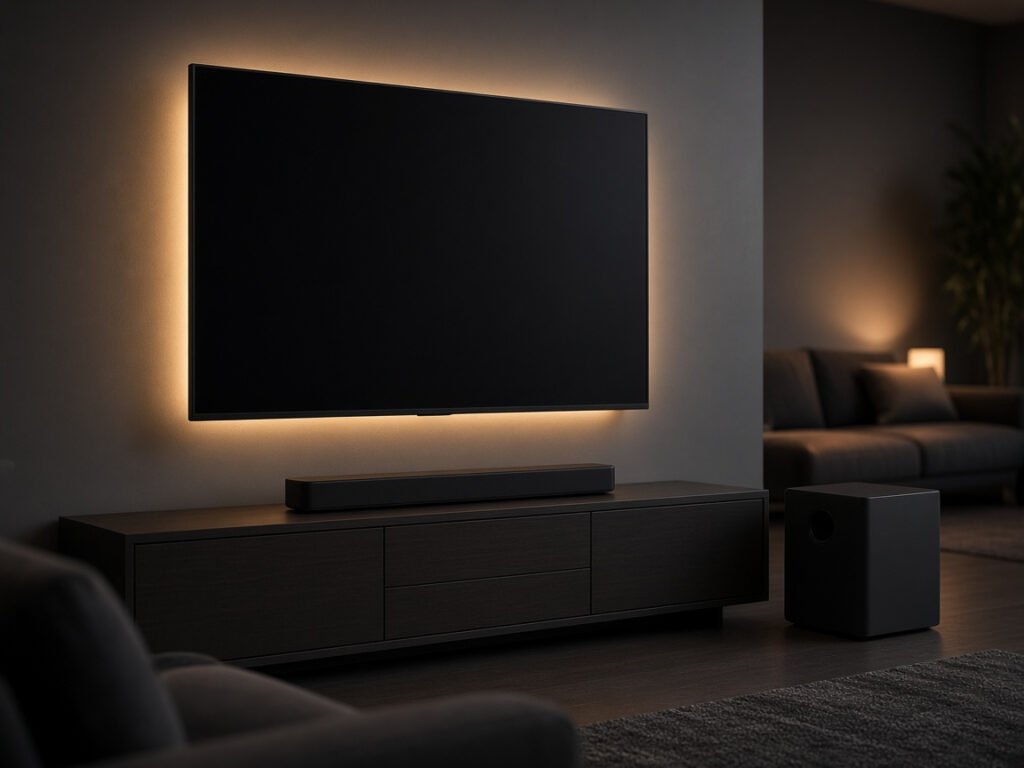
A Bose soundbar paired with a matching Bass Module delivers a tightly integrated, acoustically refined home theater system. For buyers who prioritize dialogue clarity, controlled bass extension, and seamless wireless integration, the combination justifies its premium. For buyers focused on raw low-frequency output, automatic room calibration, or competitive value-per-dollar, the case is weaker — and the alternatives have never been stronger.
Executive Summary
- Bose’s current soundbar lineup — the Smart Ultra Soundbar, Soundbar 600, and Soundbar 300 — each supports wireless pairing with Bose Bass Modules through the Bose Music app.
- Dolby Atmos with dedicated up-firing drivers is available on the Smart Ultra Soundbar and Soundbar 600; the Soundbar 300 lacks native height-channel hardware and is not Atmos certified.
- All Bose Bass Modules connect via a proprietary wireless protocol, eliminating subwoofer cables and enabling flexible placement within wireless range of the soundbar.
- Owner reviews consistently identify dialogue clarity and stable multi-room audio integration as standout strengths; bass is described as controlled and musically accurate rather than powerful or impactful.
What Bose Soundbar and Subwoofer Combinations Are Available?
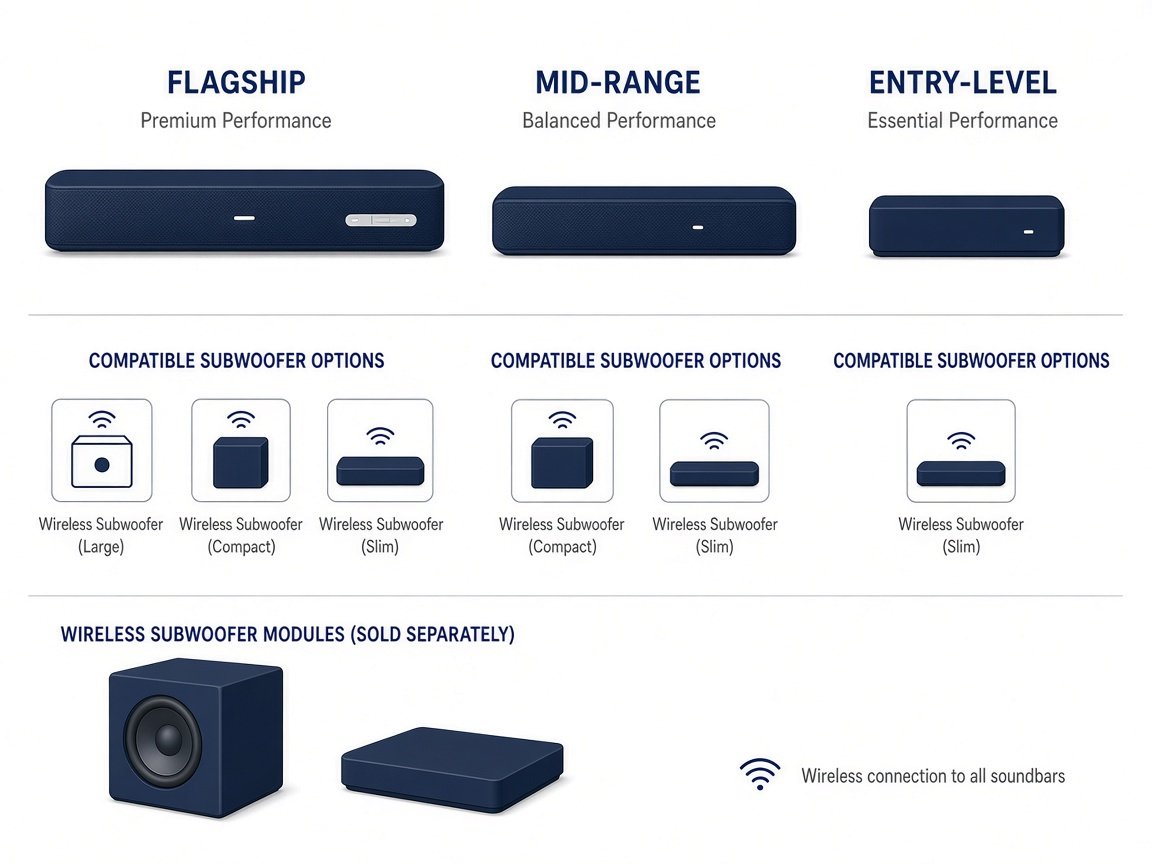
Bose structures its current soundbar lineup into three tiers, each designed to pair wirelessly with one or both Bass Module variants. Buyers should confirm current model availability directly with Bose or authorized retailers, as specifications and product availability can change across product cycles.
The Bose Smart Ultra Soundbar is the flagship tier. According to Bose specifications, it features a multi-driver array — including dedicated up-firing transducers — to generate height channels for Dolby Atmos and DTS:X content. It connects via HDMI eARC, includes an optical input, and supports Wi-Fi, Bluetooth, AirPlay 2, and Spotify Connect. The Smart Ultra Soundbar is compatible with both the Bass Module 500 and Bass Module 700.
The Bose Smart Soundbar 600 occupies the mid-tier position. It also includes up-firing drivers for Dolby Atmos height rendering in a slimmer profile suited to tighter TV cabinet installations. Its connectivity mirrors the Ultra Soundbar: HDMI eARC, optical input, Wi-Fi, Bluetooth, and AirPlay 2. The Soundbar 600 is compatible with both Bass Modules.
The Bose Smart Soundbar 300 is the entry-level option. It does not include dedicated up-firing drivers and therefore cannot render genuine Dolby Atmos height channels. Per Bose’s compatibility guidance, it pairs only with the Bass Module 500. For buyers evaluating a complete Bose home theater system, the soundbar tier and Bass Module size are the two primary configuration decisions across the entire lineup.
The Bass Module 500 is the compact wireless option, suited to smaller rooms. The Bass Module 700 is the larger unit, intended for bigger spaces requiring greater output and low-frequency extension. Both use sealed enclosure designs and connect exclusively via Bose’s proprietary wireless protocol — no third-party subwoofer substitution is possible.
How Does the Bose Bass Module Perform?
Both the Bass Module 500 and Bass Module 700 use sealed-enclosure designs. This is a deliberate acoustic engineering choice. Sealed enclosures reproduce bass frequencies with high accuracy and low distortion, trading maximum output levels for precise, controlled response. The result aligns with Bose’s overall sound tuning philosophy: bass that complements the soundbar’s midrange rather than dominating it.
The Bass Module 700’s larger cabinet allows it to move more air, extending its low-frequency reach further into the sub-bass range and delivering greater output suited to larger listening environments. Bose positions the 700 as the appropriate choice for bigger rooms. The 500 is designed for small to medium spaces, where its output level and extension are proportionate to the acoustic environment.
Wireless synchronization between the Bass Module and soundbar is handled automatically through the Bose Music app during initial pairing. Owners report that the wireless connection is consistent under typical operating conditions, with no perceptible latency between the soundbar’s mid-high frequency output and the subwoofer’s bass contribution.
The principal acoustic limitation of sealed designs — shared by both modules — is a gradual low-frequency roll-off compared to ported alternatives. For action film soundtracks with deep sub-bass content or bass-intensive music at high volumes, some owners find the system’s impact less powerful than comparably priced ported subwoofer designs. Those evaluating standalone subwoofer alternatives can find a broader category comparison in the guide to the best subwoofers for home theater.
What Audio Formats Do Bose Soundbars With Subwoofers Support?
The Smart Ultra Soundbar and Soundbar 600 both decode Dolby Atmos and DTS:X — the two primary object-based surround formats found across Netflix, Disney+, Apple TV+, and physical Blu-ray media. Both soundbars receive high-definition audio streams via HDMI eARC, which is the current standard for lossless audio pass-through from modern televisions.
HDMI eARC is the preferred and recommended connection for Dolby Atmos delivery at full quality. For televisions equipped with standard HDMI ARC or optical outputs only, optical bandwidth is insufficient to carry Dolby Atmos at full resolution. In optical-only configurations, the soundbar falls back to Dolby Digital 5.1 or PCM stereo depending on the TV’s audio output settings — a meaningful quality step down for Atmos content.
The Smart Ultra Soundbar also features Bose’s TrueSpace spatial audio processing. TrueSpace analyzes incoming audio — including stereo and standard Dolby Digital signals — and redistributes it across the driver array to create a wider, more elevated perceived soundstage. This extends spatial presentation to content not encoded with object-based audio, which covers a large proportion of broadcast television and legacy streaming libraries.
The Soundbar 300 supports standard audio formats including PCM stereo, Dolby Digital, and DTS, but is not Dolby Atmos or DTS:X certified and does not include TrueSpace height rendering. For buyers whose primary use case is Atmos content from current streaming platforms, this represents a compatibility ceiling. Those comparing Atmos-capable systems across brands will find a broader market view in the best Dolby Atmos soundbar roundup.
How Does the Setup Process Work for a Bose Soundbar and Subwoofer?
Bose soundbar and subwoofer setup follows a consistent, app-guided sequence. Most owners complete it in under 20 minutes. The process does not include an automatic acoustic room calibration step, which differentiates Bose from several competing systems at the same price tier.
- Physical placement: Position the soundbar directly below or above the television. The Bass Module can be placed anywhere in the room — against a wall, inside a cabinet, or under furniture — within wireless range of the soundbar, provided it has access to a power outlet.
- Cable connection: Connect the soundbar to the TV via the HDMI ARC/eARC port. For the Smart Ultra Soundbar and Soundbar 600, an HDMI eARC connection is required for full Dolby Atmos delivery. An optical cable can serve as a fallback but limits audio quality to Dolby Digital 5.1 at best.
- Power and network: Power on both the soundbar and Bass Module. Download the Bose Music app (available for iOS and Android) and connect the soundbar to your Wi-Fi network using the in-app setup flow.
- Bass Module pairing: Within the Bose Music app, navigate to system settings and select the Bass Module pairing option. The module registers automatically over the proprietary wireless protocol and joins the system within seconds.
- EQ and content mode adjustment: The app allows manual adjustment of bass level, dialogue enhancement, and content modes including Movie, Music, and Night. No microphone-based room calibration is provided — all acoustic adjustment is manual and preference-driven.
The absence of automatic room calibration is the most significant setup limitation compared to competing systems at this price tier. Manufacturers including Sonos (Trueplay), Sony (360 Spatial Sound Mapping), and LG (AI Room Calibration) all offer some form of acoustic measurement and adaptation. Manual Bose EQ adjustments can partially compensate for room characteristics, but the system does not adapt acoustically to room dimensions or surface treatments.
How Does Bose TrueSpace Spatial Processing Work?
TrueSpace is Bose’s proprietary algorithm for simulating spatial audio width and height from non-object-based source material. According to Bose, TrueSpace analyzes the incoming audio signal and redistributes it across the soundbar’s driver array — including the up-firing transducers on the Smart Ultra Soundbar and Soundbar 600 — to extend the perceived soundstage beyond the physical width of the bar itself.
For native Dolby Atmos content, the up-firing drivers render height information directly by bouncing sound off the ceiling to simulate overhead audio objects. TrueSpace complements this by expanding the left-right width perception. For standard stereo or Dolby Digital 5.1 content — the dominant format for broadcast television and older streaming libraries — TrueSpace applies its full processing to widen and elevate the soundstage without height-encoded source material.
Owners describe the TrueSpace result on stereo content as convincingly wider than a standard stereo soundbar. Many note, however, that it falls short of a discrete surround system with dedicated rear speakers in terms of rear-channel separation and localization precision.
Buyers who want to extend beyond the soundbar-plus-subwoofer format can pair Bose Surround Speakers or Surround Speakers 700 with compatible soundbars to reach a 3.1 or 5.1 configuration. TrueSpace continues to process upmixed content in these expanded configurations. For a detailed look at multi-speaker Bose setups, the best Bose surround sound system guide covers the full configuration and performance spectrum.
How Do Bose Soundbar and Subwoofer Combos Compare to the Competition?
Bose’s primary competitors in the premium soundbar-plus-subwoofer category include Sony, Samsung, Sonos, and LG. Each brand takes a meaningfully different approach to the same use case, with notable differences in calibration capability, channel configuration, and ecosystem integration.
| System | Dolby Atmos | Up-Firing Drivers | Wireless Sub | Auto Room Calibration | Rear Speakers Included |
|---|---|---|---|---|---|
| Bose Smart Ultra Soundbar + Bass Module 700 | Yes | Yes | Yes (proprietary) | No | No — optional add-on |
| Bose Soundbar 600 + Bass Module 500 | Yes | Yes | Yes (proprietary) | No | No — optional add-on |
| Bose Soundbar 300 + Bass Module 500 | No | No | Yes (proprietary) | No | No — optional add-on |
| Sony HT-A7000 + SA-SW5 | Yes | Yes | Yes | Yes (360 Spatial Sound Mapping) | No — optional add-on |
| Sonos Arc + Sub Gen 3 | Yes | Yes | Yes | Yes (Trueplay) | No — optional add-on |
| Samsung HW-Q990C | Yes | Yes | Yes | No | Yes — included in base package |
The comparison reveals two consistent gaps in the Bose lineup relative to similarly priced competitors: automatic room calibration and rear speaker inclusion. Sony and Sonos both offer app-based calibration using the smartphone’s microphone. Samsung’s Q990C includes wireless rear speakers in the base package, delivering a true 5.1-channel or higher configuration without additional purchases.
Where Bose maintains a competitive advantage is build quality, acoustic tuning precision for dialogue intelligibility, and ecosystem integration simplicity. For buyers already familiar with Sony’s Atmos approach, the Sony soundbar and subwoofer lineup offers a direct feature-for-feature comparison at overlapping price points.
What Do Owners Report About Real-World Performance?
Owner reviews of Bose soundbar and subwoofer combinations reveal a consistent set of strengths and limitations that reflect the system’s engineering priorities rather than production variability.
Dialogue clarity receives the most consistent positive feedback across all three soundbar tiers. Owners report that center channel intelligibility on Bose soundbars makes speech clear at lower volume levels — particularly useful in environments where late-night viewing or mixed-use spaces require restrained listening levels. This is cited repeatedly as the system’s most distinctive acoustic characteristic.
Bass performance is described consistently as musical and controlled rather than impactful. The sealed Bass Module design contributes to tight, accurate low-frequency reproduction. Owners who primarily watch action films with heavy LFE tracks or who listen to bass-intensive electronic or hip-hop music at high volumes report the system’s output as insufficient for their expectations. Owners focused on dialogue-driven drama, documentary, and comedy content report consistent satisfaction with the tonal balance.
Multi-room integration via the Bose Music app receives positive feedback for reliability and ease of use. Owners with multiple Bose devices across different rooms report stable group playback, responsive source switching, and functional volume synchronization.
Price-to-performance is the most frequently cited concern in critical owner accounts. At the same total system cost, Sony, Samsung, and LG alternatives offer automatic room calibration, additional HDMI inputs, and in some configurations deeper bass extension. This trade-off is the central question for any prospective buyer comparing Bose against the broader category.
Is the Bose Soundbar with Subwoofer Worth the Premium Price in 2026?
The answer depends directly on the buyer’s use case. The Bose system is a well-justified premium when these factors apply:
- Dialogue clarity is the primary performance criterion. Bose’s center channel performance is consistently rated among the strongest in the category by owner reviews.
- Wireless, cable-free subwoofer integration is essential. The proprietary wireless pairing is reliable and eliminates placement constraints tied to cable routing.
- Aesthetic minimalism matters. Bose soundbars carry a compact, low-profile design suited to modern living rooms where hardware visibility is a consideration.
- Multi-room Bose ecosystem integration is planned or already in use. The integration value of SimpleSync and the Bose Music app increases significantly with multiple Bose devices in the same household.
- Simple, guided app-based setup is preferred over manual acoustic calibration. The Bose setup process is among the most streamlined in the category.
The system is a weaker value proposition when these conditions apply:
- Maximum bass output or sub-bass extension is the priority. The sealed Bass Modules are precise, not powerful. Ported alternatives at this price deliver more visceral impact.
- Automatic room calibration is required. Bose does not offer this. Sony, Sonos, and LG do — and all three are priced competitively with Bose combinations.
- Multiple HDMI source inputs are needed. Most Bose soundbars provide a single HDMI ARC/eARC port. Buyers with multiple HDMI devices will need an external switch.
- Budget is the primary constraint. Competing systems now deliver Dolby Atmos, wireless subwoofers, and app control at meaningfully lower total costs.
- Discrete rear-channel audio is essential. Rear speakers are a separate optional purchase rather than included in any base Bose configuration.
As an illustrative example: a buyer who watches evening films in a medium-sized living room, already owns a Bose smart speaker for music, and values a clean aesthetic with simple setup would find this combination well-matched to their use case. A buyer prioritizing blockbuster bass impact and hardware flexibility at the same budget would likely find a competing system more rewarding.
What Should Buyers Expect From Bose Soundbar Technology in the Next 12–24 Months?
Several developments are plausible in the Bose soundbar category based on current industry direction, though no specific product announcements have been confirmed as of November 2026.
Automatic room calibration is the most significant current gap in the Bose lineup relative to same-tier competitors. Industry-wide adoption of microphone-based acoustic tuning creates competitive pressure for Bose to introduce equivalent functionality — either through a software update to existing hardware or as a defining feature of the next hardware generation. The gap is well-documented in owner comparisons and represents the clearest area of differentiation Bose could address.
AI-driven spatial audio processing is an emerging area across the category. Dolby and Apple have both invested heavily in spatial audio ecosystems. Bose’s TrueSpace algorithm represents their current upmixing approach; further development through AI-based spatial enhancement and more granular object placement is an expected firmware and hardware direction for future generations.
Expanded channel configurations are another likely development. The current maximum for a Bose soundbar system is 5.1 — soundbar plus Bass Module plus optional surround speakers. Competing systems targeting 7.1.4 and higher configurations create pressure for Bose to expand supported channel counts in future hardware releases.
Smart home ecosystem refinement — including tighter integration with Matter-based home automation protocols and voice assistant improvements — is an expected area of continued investment across all major soundbar manufacturers including Bose, as smart home standardization accelerates.
Frequently Asked Questions About the Bose Soundbar with Subwoofer
Can I pair any Bose Bass Module with any Bose soundbar?
Not all combinations are compatible. Per Bose’s product compatibility guidance, the Bass Module 500 pairs with the Soundbar 300, Soundbar 600, and Smart Ultra Soundbar. The Bass Module 700 is compatible with the Soundbar 600 and Smart Ultra Soundbar but not the Soundbar 300. Always confirm compatibility on the current Bose product page before purchasing, as compatibility guidance may be updated with new hardware releases.
Does the Bass Module require its own power outlet?
Yes. Both the Bass Module 500 and Bass Module 700 are powered devices that require a standard AC power outlet. The wireless connection handles only the audio signal. Flexible room placement is still possible, but a power source must be accessible wherever the module is positioned.
Can I use a third-party subwoofer with a Bose soundbar?
No. Bose soundbars use a proprietary wireless protocol to communicate with Bose Bass Modules. Third-party subwoofers — regardless of brand or connectivity type — cannot integrate into the Bose soundbar system. This is an important consideration for buyers who already own a standalone subwoofer they intend to repurpose.
Does the Bose Soundbar 300 support Dolby Atmos?
No. The Soundbar 300 does not include up-firing drivers and is not Dolby Atmos certified. It supports PCM stereo, Dolby Digital, and DTS. For Dolby Atmos with height-channel rendering, the Soundbar 600 or Smart Ultra Soundbar is required. This is a hard hardware limitation and cannot be addressed through firmware updates.
Does the Bose Music app require a subscription?
No. The Bose Music app is a free download for iOS and Android. It is required for initial setup and ongoing system configuration including Bass Module pairing, EQ adjustments, content mode selection, and multi-room group management. No paid subscription is required for core soundbar and subwoofer functionality.
How many HDMI inputs does a Bose soundbar have?
Current Bose soundbars provide a single HDMI ARC/eARC port used to connect to the television. This port is for TV connection only and does not function as a source input for additional HDMI devices such as game consoles or media players. Buyers with multiple HDMI source devices should factor in an external HDMI switch.
How does a Bose soundbar and subwoofer compare to a full surround sound system?
A Bose soundbar with Bass Module is a 3.1 configuration at most — covering left, center, and right channels via the soundbar, plus the subwoofer’s low-frequency extension. It does not reproduce discrete rear-channel audio without the optional Bose Surround Speakers. For true 5.1 discrete surround, additional components and cost are required. TrueSpace processing simulates width and height for upmixed content, but cannot substitute for dedicated rear-channel hardware.
Final Verdict: Who Should Buy the Bose Soundbar with Subwoofer?
The Bose soundbar and subwoofer combination represents a coherent, well-engineered home theater solution for a specific type of buyer. Its acoustic tuning philosophy — precise, dialogue-forward, and musically balanced — is a consistent strength across the lineup. The wireless Bass Module integration is among the most reliable in the category. Build quality and industrial design meet premium expectations at every tier.
Its limitations are consistent and deliberate: no automatic room calibration, single HDMI port, proprietary subwoofer lock-in, and controlled rather than powerful bass output. These reflect engineering priorities rather than oversights — and they define who the system is built for.
Use this evaluation sequence before committing:
- Confirm Dolby Atmos priority. If height-channel Atmos is essential, focus on the Soundbar 600 or Smart Ultra Soundbar. The Soundbar 300 does not support it.
- Match Bass Module to room size. The Bass Module 500 suits smaller rooms; the Bass Module 700 is designed for larger spaces. Room square footage should drive this decision.
- Compare total system cost against alternatives. Sony, LG, and Samsung all offer complete Dolby Atmos soundbar and subwoofer packages at competing price points with auto-calibration built in. Verify current pricing directly with retailers.
- Assess ecosystem fit. Existing Bose smart speakers or home audio components amplify the integration value of the Bose system considerably — if you already own Bose devices, the case for staying within the ecosystem strengthens.
- Prioritize your performance criterion. If dialogue clarity and acoustic refinement rank above bass impact and feature breadth, the Bose system is a justified choice. If raw capability per dollar is the metric, evaluate the full competitive field before committing.
Key tools and resources for this purchase decision: the Bose Music app (free, iOS/Android) for ecosystem preview; Bose’s official compatibility checker for Bass Module pairings; and authorized Bose retail locations in many markets that offer demonstration units for direct comparison before purchase.
For buyers whose priorities align with Bose’s design philosophy, the combination delivers a genuinely capable and durable home theater foundation that remains competitive through the current product cycle.