
The Klipsch Cinema soundbar and subwoofer series earns its price in most home theater setups. Its Tractrix horn technology and high-efficiency driver architecture produce louder, more dynamic output per watt than most competing systems at similar price points — a meaningful advantage for large-room listening or action-film viewing where genuine dynamic range matters.
- Klipsch’s Cinema lineup spans 2.1, 3.1, and Dolby Atmos configurations, each including a factory-paired wireless subwoofer
- Tractrix Horn tweeters are the primary acoustic differentiator, increasing driver efficiency and reducing compression at high SPL
- The Cinema series is optimised for large-room dynamics rather than nearfield listening or studio-flat frequency response
- Price-to-performance ratio is strongest at the Cinema 400 and Cinema 600 tiers for buyers prioritising dynamic impact over DSP versatility
What Sets Klipsch Soundbar Technology Apart from the Competition?
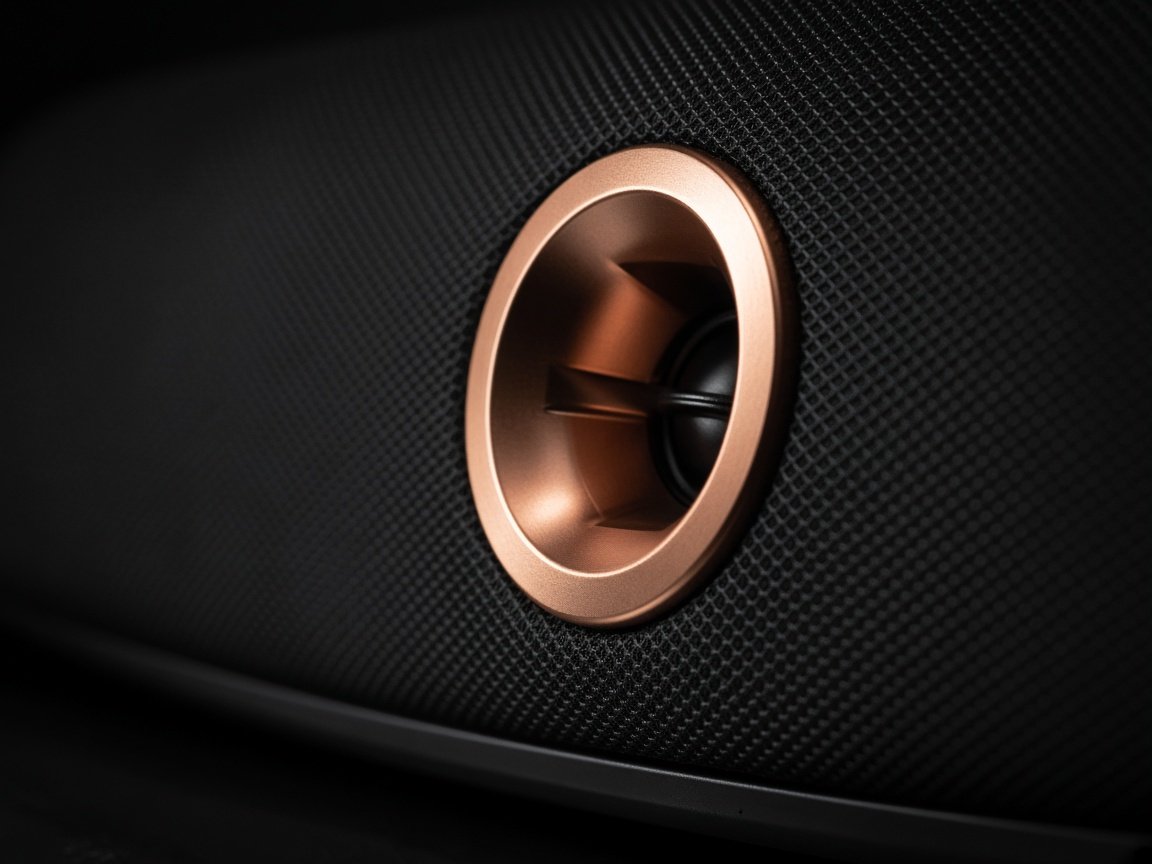
Klipsch’s engineering identity — rooted in horn-loaded loudspeaker design since 1946 — carries directly into the Cinema soundbar series. The defining technology is the Tractrix Horn: a flared waveguide geometry applied to the high-frequency drivers inside each soundbar enclosure. Horn loading increases acoustic efficiency by allowing the driver to move less air to produce the same SPL (sound pressure level), which reduces mechanical compression and thermal distortion at high output levels. This is a fundamentally different acoustic architecture from the direct-radiating dome tweeters used in most competing soundbars at the same price tier. Where a dome tweeter relies entirely on the driver itself to project sound, a horn-loaded driver uses the flared waveguide to amplify and control dispersion — a principle that has governed high-efficiency loudspeaker design for decades and that Klipsch applies more consistently than any other soundbar manufacturer in the mainstream market.
The practical result, by design intent, is that Cinema series systems achieve higher clean output levels before audible distortion sets in. This matters most during action-film soundtracks with wide dynamic range: the sharp transient attack of an impact effect, the sustained low-frequency energy of an explosion, or close-range dialogue against a dense multi-channel mix. Many competing soundbars apply dynamic compression algorithms internally to protect their drivers at high SPL, which effectively narrows the perceived dynamic range of the content. Klipsch’s horn architecture is specifically engineered to reduce that compression. The Cinema series also carries the brand’s visual language — copper-accented drivers, solid cabinet construction, and a deliberately large-format subwoofer cabinet — signalling loudspeaker-grade acoustic ambition within a soundbar product category that often prioritises slim-profile aesthetics over acoustic substance.
Which Models Make Up the Klipsch Cinema Soundbar Lineup?
The Cinema series covers three primary power and configuration tiers. The Cinema 400 is a 2.1-channel system rated at 400W peak system power per Klipsch’s published specifications, paired with an 8-inch wireless down-firing subwoofer. It is intended for rooms up to approximately 300 square feet. The Cinema 600 steps up to a 3.1-channel architecture — adding a discrete centre channel driver in the soundbar for improved vocal separation from the left-right channels — and pairs with a 10-inch wireless subwoofer at 600W peak system power. That dedicated centre driver is a meaningful upgrade for dialogue-heavy content: it decouples voice reproduction from the stereo image, improving speech intelligibility at higher listening levels in ways that a 2.1 configuration cannot match.
The Cinema 800 is Klipsch’s core Dolby Atmos entry point in the Cinema line. It adds upward-firing drivers to the soundbar for height channel reproduction and is rated at 800W peak system power, retaining the wireless subwoofer architecture. For buyers building a Dolby Atmos-ready system without rear satellite speakers, the Cinema 800 is the minimum Klipsch option for object-based audio decoding. Each model across the range ships with the subwoofer factory-paired to the soundbar — the two units recognise each other at first power-on without manual RF frequency assignment or button-sequence pairing. For buyers evaluating the full scope of Klipsch’s speaker ecosystem beyond the Cinema line, the dedicated guide to Klipsch home theater systems on this site covers the brand’s traditional speaker-and-receiver packages alongside the soundbar options.
| Model | Configuration | Peak System Power | Subwoofer Driver | Dolby Atmos Decoding | Dedicated Centre Ch. |
|---|---|---|---|---|---|
| Cinema 400 | 2.1 | 400W | 8-inch wireless, down-firing | No | No |
| Cinema 600 | 3.1 | 600W | 10-inch wireless, down-firing | No | Yes |
| Cinema 800 | 3.1.2 | 800W | 10-inch wireless, down-firing | Yes | Yes |
Specifications per Klipsch published product data. Peak power figures represent total system output across all amplification channels.
How Does the Klipsch Wireless Subwoofer Integrate with the Soundbar?
Klipsch’s wireless subwoofer connection uses a proprietary 2.4GHz radio link to maintain synchronisation with the soundbar, which avoids the latency issues that can affect standard Bluetooth subwoofer links. The receiver circuit is built directly into the subwoofer cabinet — there is no external RF dongle to manage or misplace. Factory pairing means the subwoofer is recognised by the soundbar automatically at first power-on without button presses, indicator-light sequences, or manual channel assignment. This represents a user experience advantage over competing systems that require manual RF pairing routines, which can fail on first attempt and require troubleshooting steps that frustrate initial setup. The connection stability of the 2.4GHz proprietary protocol is designed to maintain signal lock in environments with competing wireless signals, including home Wi-Fi networks operating on the same 2.4GHz band.
Placement flexibility is a practical benefit of the wireless design. The subwoofer can sit on either side of the room, against a rear wall, or in a corner without cable-routing constraints — an advantage in living rooms where furniture placement or structural features complicate running low-level audio cables across the floor. The down-firing driver orientation, used across the Cinema subwoofer line, is designed to couple low-frequency output with the floor surface, distributing bass energy more evenly into the listening space rather than projecting it directionally from a front-facing port. Owners of Cinema 600 and Cinema 800 models note in product reviews that bass integration with the soundbar is seamless, with no perceptible timing offset between the high-frequency attack transient and the low-frequency body of bass-heavy content. For buyers comparing subwoofer performance across brands before making a final decision, the best subwoofer for home theater comparison on this site provides a useful reference across both standalone and bundled subwoofer options.
What Does Tractrix Horn Technology Actually Do for Audio Performance?
The Tractrix Horn geometry is defined by a mathematically derived flare rate that minimises back pressure on the driver while maintaining controlled directivity across the frequency range. Klipsch specifies a 90×90-degree (horizontal × vertical) coverage pattern for the horn-loaded tweeters in the Cinema series, ensuring consistent high-frequency dispersion across a wide listening area. This is a deliberate contrast to conventional dome tweeters, which narrow their dispersion angle at higher frequencies — above approximately 8–10kHz, a dome tweeter’s output becomes increasingly directional, meaning listeners seated significantly off-axis receive a rolled-off high-frequency response that dulls the perceived resolution of the system. The 90-degree horizontal coverage angle means that listeners at wide angles from the centre of the soundbar — common in living-room seating arrangements with wide sofas — receive a more consistent high-frequency character than they would from most competing systems.
The horn architecture also makes the Cinema series a high-sensitivity design. High acoustic sensitivity means the system produces more output per watt of amplification, reaching its rated SPL at lower amplifier power draw. This leaves thermal headroom in the amplification section and contributes to lower audible distortion at loud listening levels — the driver and amplifier are both operating further below their thermal limits compared to a low-sensitivity system pushed to the same volume. Klipsch’s heritage in this area is not marketing language: the company’s Reference and Heritage loudspeaker lines have been defined by high-sensitivity horn-loaded designs since the company’s founding, and the Cinema series applies that same engineering principle to the soundbar category more rigorously than any competitor at comparable price points.
How Does the Klipsch Cinema System Compare to Sony, LG, and Vizio?
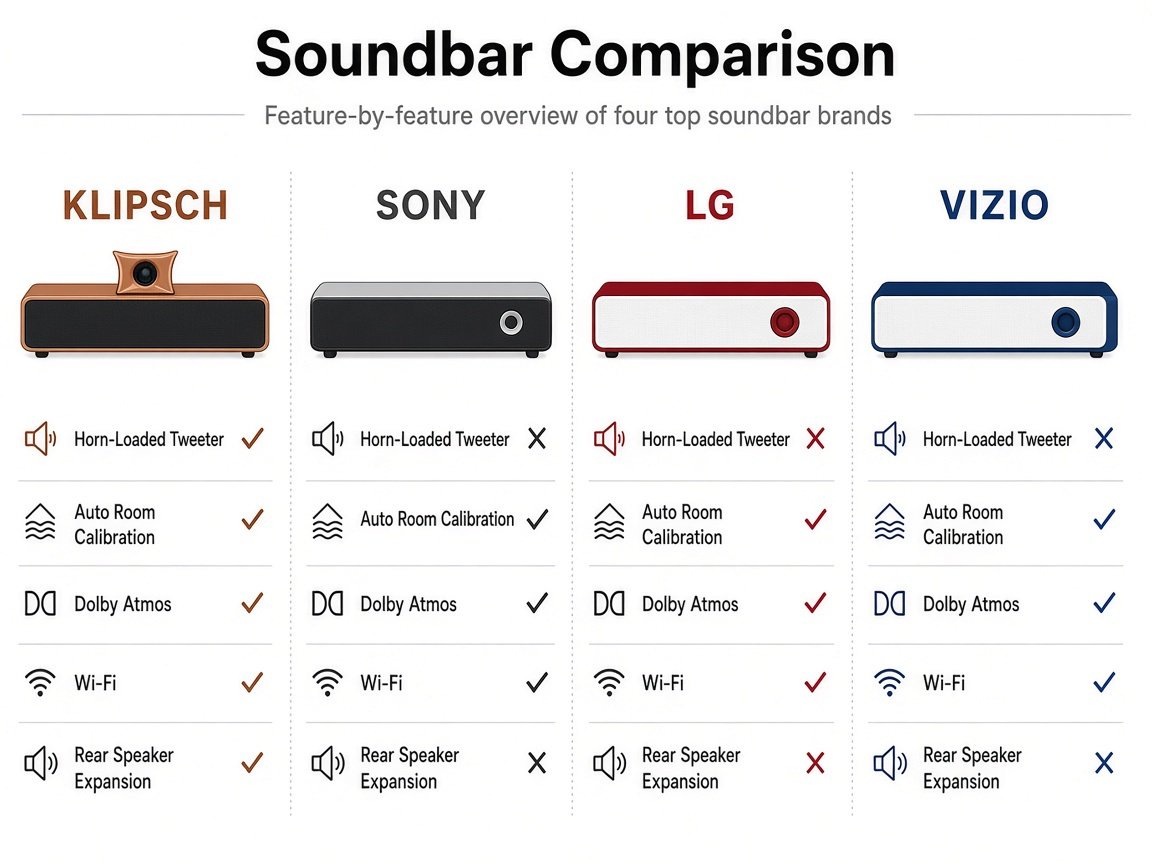
Positioning the Klipsch Cinema line requires understanding the competing engineering philosophies in the mid-tier soundbar market. Sony’s HT-A series soundbars prioritise advanced DSP processing — 360 Spatial Sound Mapping and Vertical Surround Engine algorithms simulate height and surround channels through software processing rather than through physical driver count or placement. The result is a broader virtual surround effect in some room geometries, with the trade-off of relying on processing accuracy rather than acoustic hardware. LG’s mid-range soundbars apply Meridian Audio processing at higher tiers and offer competitive Dolby Atmos support; Vizio’s soundbar and subwoofer pairings position Dolby Atmos at lower absolute price points, compressing the value difference in the sub-$500 segment where acoustic driver quality is harder to differentiate.
Klipsch’s competitive differentiation is specifically in physical acoustic efficiency and dynamic headroom — not DSP feature depth. The Cinema line offers fewer software-based processing modes than Sony’s soundbar and subwoofer systems at comparable prices, and no built-in room calibration microphone. Buyers who prioritise processing versatility, virtual surround algorithms, Wi-Fi streaming integration, or expandable rear speaker kits will find Sony or LG a stronger fit for their use case. Buyers who value the dynamic impact, driver efficiency, and heritage acoustic architecture of a horn-loaded design — especially in rooms large enough to benefit from high dynamic headroom — will find Klipsch a better-suited choice. These represent different engineering priorities, not a simple quality ordering between brands.
| Feature | Klipsch Cinema 600 | Sony HT-A series (mid-tier) | LG mid-range | Vizio Elevate |
|---|---|---|---|---|
| Horn-loaded tweeter | Yes | No | No | No |
| Auto room calibration | No | Yes | No | No |
| Dolby Atmos decoding | No (Cinema 800+ only) | Yes | Yes | Yes |
| Wi-Fi streaming | No | Yes | Yes | No |
| Wireless sub included | Yes | Yes | Yes | Yes |
| Rear speaker expansion | Not supported | Yes (via add-on kit) | Yes (via add-on kit) | Yes |
| Multi-room audio (native) | No | Yes | Yes | No |
Feature comparison based on published product specifications as of 2026. Competing model features vary by specific SKU and firmware version.
What Audio Formats and Connectivity Does the Klipsch Cinema Support?
The Cinema 400 and Cinema 600 decode Dolby Digital and DTS encoded content, handling standard 5.1-channel audio from streaming services, Blu-ray discs, and broadcast sources without reprocessing. HDMI ARC (Audio Return Channel) is included across the Cinema line, enabling the soundbar to receive audio from the TV over a single HDMI cable while also passing CEC remote control signals. This reduces the cable count in a standard setup to one HDMI and one power cable per unit. Optical input is provided for compatibility with older televisions that lack ARC-designated HDMI ports, and an analog 3.5mm input covers secondary source connections such as portable audio devices. Bluetooth connectivity is included for two-channel wireless music streaming from smartphones and tablets, though the system operates in soundbar output mode rather than discrete stereo speaker mode during Bluetooth playback.
The Cinema 800 adds Dolby Atmos and DTS:X decoding, with the HDMI connection supporting the higher-bandwidth audio bitstreams required by object-based audio formats. For lossless Dolby Atmos passthrough from a compatible TV source, buyers should verify whether their television supports HDMI eARC (enhanced Audio Return Channel) — standard ARC does not carry sufficient bandwidth for lossless TrueHD Atmos bitstreams, only for compressed Dolby Digital Plus with Atmos metadata. The Cinema 800’s eARC compatibility should be confirmed in the product specification sheet for the specific unit purchased, as ARC and eARC are distinct in both bandwidth capacity and format support. For buyers evaluating Dolby Atmos performance across the competitive field, the best Dolby Atmos soundbar ranking on this site covers the Cinema 800 alongside its primary competitors in the object-based audio tier.
Is the Klipsch Cinema System Straightforward to Set Up?
Setup of a Klipsch Cinema soundbar system follows a linear five-step process. The factory-paired wireless subwoofer eliminates one of the most common sources of setup difficulty in competing systems — manual RF frequency matching and indicator-light pairing sequences. The soundbar connects to the television via a single HDMI ARC cable for both audio and CEC control, or via optical cable for older televisions. No separate app download or account creation is required for basic home theater operation; the core functionality is accessible immediately from the system’s included remote. The following steps represent a standard first-time installation:
- Position the soundbar. Place it on the TV stand or mount it below the display, centred horizontally with the screen. The Cinema series soundbars are taller than typical thin-profile bars — verify clearance between the top of the soundbar and the bottom bezel of the TV before finalising placement or mounting.
- Connect HDMI ARC. Run an HDMI cable from the soundbar’s HDMI ARC output to the ARC-designated HDMI port on the television. This port is typically labelled “ARC” or “HDMI (ARC)” in the TV’s port cluster. Use a High Speed HDMI cable rated for the bandwidth required by the Cinema 800 if Dolby Atmos is the target format.
- Place the wireless subwoofer. Position the subwoofer in the room — beside the TV, along a side wall, or in a rear corner. Factory pairing is complete at the factory; the subwoofer connects to the soundbar automatically at first power-on without any additional pairing sequence required from the user.
- Enable CEC on the television. Navigate to the TV’s HDMI-CEC setting — branded as “Anynet+” on Samsung TVs, “Bravia Sync” on Sony, “SimpLink” on LG, or “HDMI-CEC” generically on other brands — and enable it. CEC allows the TV remote to pass volume commands to the soundbar, eliminating the need to manage two remotes for routine viewing.
- Select the soundbar as the audio output device. In the television’s audio settings, designate the HDMI ARC port as the audio output and confirm that the TV’s internal speakers are disabled. This prevents the TV from outputting audio simultaneously through both its own speakers and the soundbar.
What Do Owner Reviews Reveal About Real-World Performance?
Owner feedback across major retail platforms points consistently to the wireless subwoofer’s bass output and the system’s overall volume ceiling as the primary strengths of the Cinema lineup. The Cinema 400’s 8-inch subwoofer is frequently noted as producing low-frequency output that exceeds expectations for a system in its price range, with reviewers citing its ability to handle action-film low-end content without audible strain at high listening volumes. The Cinema 600’s 10-inch subwoofer receives similar characterisations — owners describe it as capable of filling rooms larger than the system’s nominal recommendation, with deep bass extension that competing 2.1 and 3.1 systems at the same price struggle to match. The down-firing driver placement and large cabinet volume of the Cinema subwoofers appear to be strong contributors to this perception, providing greater low-frequency authority than typical ported soundbar subwoofers in the same price bracket.
Vocal clarity on dialogue is cited positively by owners of the Cinema 600 and Cinema 800, with reviewers specifically attributing the improvement to the dedicated centre channel driver. This is acoustically consistent: a physically discrete centre driver decouples voice reproduction from the left-right channels, reducing comb filtering artefacts that can smear voice intelligibility when dialogue is panned to the centre of a 2.0 or 2.1 soundbar. Where owner reviews identify limitations, they tend to cluster around two areas: the relatively basic EQ control set available via the system’s remote or companion app, and the physical height of the soundbar enclosure — taller than thin-profile competing bars — which can partially obstruct the lower portion of a TV screen in certain stand configurations. Neither issue is a performance limitation, but both are worth checking against a buyer’s specific installation requirements before purchase.
Where Does the Klipsch Soundbar System Fall Short?
The most substantive technical limitation of the Cinema line is the absence of a room calibration system. Automatic EQ tools — built into Sony’s mid-range and high-range soundbars using 360 Spatial Sound Mapping, and into Yamaha soundbars via YPAO (Yamaha Parametric room Acoustic Optimizer) — measure the acoustic characteristics of the listening room and adjust driver output to compensate for room-mode buildup, early reflections, and uneven bass response. Klipsch’s Cinema series provides manual bass, treble, and dialogue level adjustment via the included remote control, but no automatic calibration. In a room with hard parallel surfaces — bare drywall, hardwood floors, low ceilings — low-frequency energy builds up at room resonance frequencies, and the Cinema line provides no automated mechanism to identify and reduce that buildup. The manual EQ controls available are limited relative to the parametric equalisation options found in competing systems at similar prices.
The second significant limitation is the absence of Wi-Fi connectivity and multi-room audio integration. The Cinema series soundbars offer Bluetooth for wireless two-channel audio streaming but no Wi-Fi, no AirPlay 2 compatibility, no Chromecast built-in, and no native integration with Sonos, Denon HEOS, or other multi-room audio ecosystems. For buyers in a household where audio streaming is routed through a whole-home audio network, this means the Klipsch Cinema system cannot participate as a node in that network — it operates as a standalone home theater playback device only. That use case it handles at a high level, but the feature boundary is firm. The absence of rear speaker expansion support on the Cinema 400 and Cinema 600 is a third constraint: buyers who intend to eventually expand to a full discrete surround configuration should consider whether the Cinema 800 or a separate AV receiver system better serves that future intent before committing to the lower Cinema tiers.
Does the Klipsch Soundbar Represent Real Value in 2026?
The Klipsch Cinema series occupies a specific — and defensible — market position: a home theater output device engineered around acoustic efficiency and dynamic headroom, drawing on decades of horn-loaded loudspeaker heritage, priced in the mid-tier category where most competing systems prioritise DSP feature depth over driver-level acoustic architecture. Whether it represents value depends on what the buyer prioritises. For the buyer who watches action films and sports content in a mid-to-large room and wants maximum dynamic impact from a soundbar-and-subwoofer package, without the complexity of a full AV receiver and discrete speaker system, the Cinema series offers a genuinely differentiated acoustic performance that is difficult to replicate at the same price from DSP-heavy competitors. The horn-loaded tweeter and high-sensitivity driver design produce a qualitatively distinct output character — more dynamic, more efficient, and less reliant on signal processing to generate apparent impact.
For the buyer who wants Dolby Atmos processing with room calibration, Wi-Fi streaming, and rear speaker expansion in a single integrated system, the Cinema 400 and Cinema 600 do not deliver that feature set. At those requirements, the step-up cost to a Sony HT-A series system or a comparable LG soundbar with auto-calibration is justified. The Cinema 800 is competitive in the Dolby Atmos tier on acoustic performance grounds, but the absence of Wi-Fi and room calibration remains. In 2026, the Cinema line holds its value most convincingly as a pure home theater audio device — not as a connected home audio platform. Buyers who understand and accept that scope will find the Cinema series among the most acoustically capable soundbar systems available at its price. Those expecting a broader connected feature set will be better served by the Sony and LG alternatives at the same budget.
The Klipsch Cinema series earns a strong recommendation for buyers prioritising acoustic efficiency, dynamic headroom, and driver-level audio performance for dedicated home theater use. The Cinema 600 is the strongest value point in the lineup — the 10-inch sub and dedicated centre channel represent a meaningful per-dollar upgrade over the Cinema 400. The Cinema 800 is the right choice for Dolby Atmos at Klipsch’s acoustic standard. If Wi-Fi streaming, automatic room calibration, or rear speaker expansion are firm requirements, those features must be weighed against competitor options before deciding. The hometheaterinfoline.com editorial team rates the Klipsch Cinema series as a Buy within its defined use case.
Frequently Asked Questions
Does the Klipsch Cinema 800 support Dolby Atmos?
Yes. The Cinema 800 includes upward-firing drivers and decodes both Dolby Atmos and DTS:X encoded content. For full lossless Atmos bitstream passthrough from a TV source, the connected television must support HDMI eARC. Standard HDMI ARC carries sufficient bandwidth for compressed Dolby Atmos via Dolby Digital Plus, but not for lossless TrueHD Atmos. The Cinema 400 and Cinema 600 do not support Dolby Atmos decoding.
What is the wireless range of the Klipsch Cinema subwoofer?
The Cinema subwoofer uses a proprietary 2.4GHz wireless link designed for in-room use. The connection maintains reliable signal lock throughout a standard room, including through furniture obstructions typical of living-room setups. For specific range figures, Klipsch’s product documentation for each Cinema model should be consulted — wireless range can vary by room environment, wall composition, and the RF interference conditions present in the installation location.
Can rear surround speakers be added to the Klipsch Cinema 400 or Cinema 600?
No. The Cinema 400 and Cinema 600 do not include a dedicated rear speaker output or a rear satellite expansion kit. These models are designed as self-contained soundbar systems. Buyers who want expandable 5.1 or 7.1 rear speaker capability from a Klipsch product should evaluate Klipsch’s separate AV-receiver-and-discrete-speaker packages rather than the Cinema soundbar line. The Cinema 800 also does not natively support rear satellite expansion in the standard configuration.
Which Klipsch Cinema model suits a room of 300–400 square feet?
The Cinema 600 is the more appropriate choice for a 300–400 square foot room. Its 3.1 configuration with a dedicated centre channel improves dialogue intelligibility at the volume levels needed to fill that room size, and the 10-inch subwoofer provides low-frequency output appropriate to the room’s cubic volume without pushing the system near its limits. The Cinema 400 is better suited to rooms under 300 square feet. The Cinema 800 is the preference when Dolby Atmos decoding is required regardless of room size.
Does the Klipsch Cinema series work with 4K HDR televisions?
Yes. The Cinema soundbars’ HDMI ARC connection carries only the audio return signal — the video signal path runs directly between the source and the television and is not affected by the soundbar connection. The soundbar does not interfere with the TV’s 4K or HDR video processing in any way. HDMI eARC-compatible Cinema models support the highest-quality audio bitstreams from 4K HDR sources, provided the connected TV also supports eARC on the port used.
How does the Klipsch Cinema 800 compare to the Sonos Arc for home theater?
The Sonos Arc offers Wi-Fi streaming, AirPlay 2, Dolby Atmos support, automatic Trueplay room calibration, and native integration with the Sonos multi-room audio ecosystem. The Klipsch Cinema 800 offers superior acoustic efficiency through horn-loaded tweeter technology and a higher-wattage bundled subwoofer package at a comparable price point. The choice maps directly to priorities: Sonos leads on networked audio integration, smart home compatibility, and auto-calibration; Klipsch leads on acoustic dynamic performance, driver-level efficiency, and bass output volume for dedicated home theater playback.
What to Do Next If You Are Considering the Klipsch Cinema Series
The Klipsch Cinema series rewards buyers who approach it knowing what it is built for. Its acoustic architecture — horn-loaded tweeters, high-sensitivity drivers, large wireless subwoofers — is specifically optimised for home theater dynamic performance in mid-to-large rooms. If that use case describes your setup, the Cinema lineup competes with or exceeds every competing system in its price tier on its stated priorities. If your requirements extend to auto room calibration, Wi-Fi streaming, or multi-room audio, the feature map points toward Sony, LG, or Sonos alternatives before you commit.
For buyers ready to proceed, the recommended evaluation sequence is as follows. First, determine your room size and confirm whether the Cinema 400, 600, or 800 is the appropriate tier. Second, confirm your television’s HDMI ARC or eARC port capability — particularly important if the Cinema 800 and Dolby Atmos is the target. Third, verify physical clearance between the soundbar height and your television’s stand configuration. Fourth, check the current retail pricing across authorised Klipsch dealers, as the Cinema series is periodically discounted. Finally, if you are comparing the Klipsch system against LG alternatives, the best LG soundbar with subwoofer comparison on this site provides a structured side-by-side view of LG’s current lineup to aid that decision.