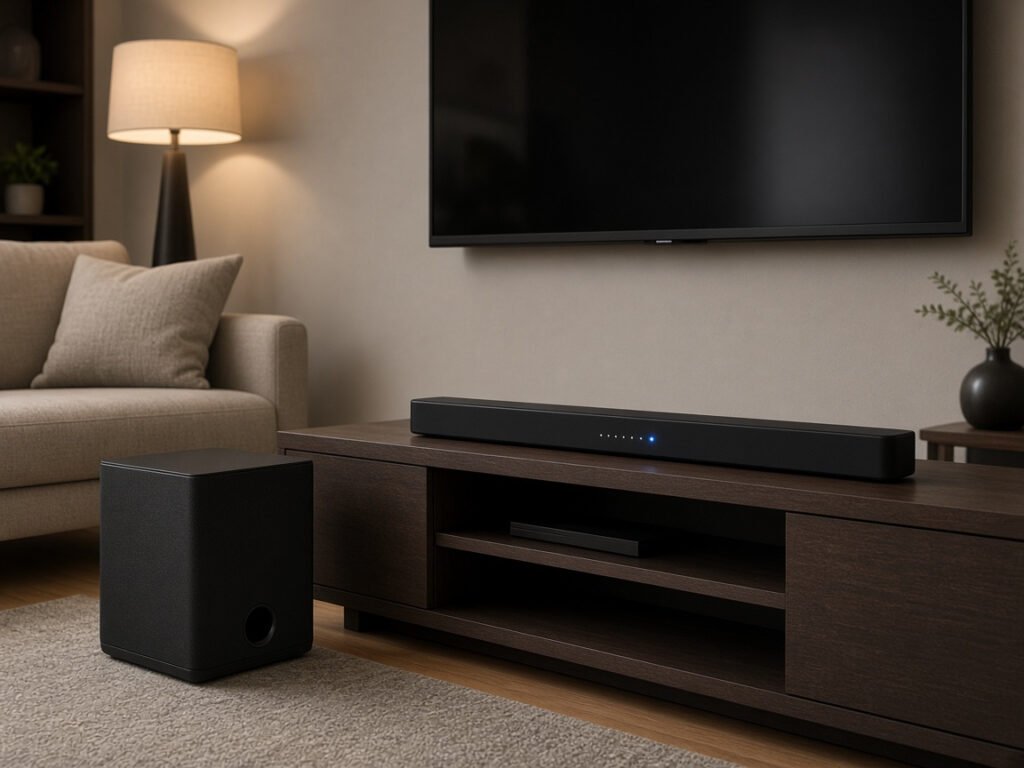
A Vizio sound bar and subwoofer system is worth buying in 2026 for most households that prioritize feature depth and acoustic hardware over premium ecosystem refinement. Across the V-Series, M-Series, and P-Series Elevate lineups, Vizio delivers wireless subwoofer integration, native Dolby Atmos decoding on mid-range and premium tiers, and HDMI eARC connectivity — with trade-offs concentrated in dialogue clarity at high volumes, room correction sophistication, and smart-home ecosystem depth.
Executive Summary
- Wireless subwoofer across all tiers: Vizio uses a proprietary radio frequency link — confirmed in Vizio’s published specifications across V-Series, M-Series, and P-Series — to avoid the latency and phase-coherence problems that characterize Bluetooth subwoofer designs.
- Dolby Atmos and DTS:X decoding on M-Series and P-Series: Per Vizio’s published datasheets, both object-based surround formats are decoded natively in mid-range and premium tiers. The V-Series passes an Atmos bitstream via HDMI eARC but does not decode it natively, meaning the soundbar cannot render height objects when it is the terminal audio device.
- HDMI eARC on most models: Vizio confirms eARC availability across the majority of its current soundbar portfolio, enabling lossless audio delivery from compatible televisions — a capability that matters specifically for Dolby TrueHD and DTS-HD Master Audio content from disc sources.
- Value density versus acoustic refinement: Owner feedback on major retail platforms consistently rates Vizio bundles favorably for bass performance and ease of setup. Dialogue clarity at high volumes and long-term wireless stability are the two areas that aggregated owner reviews flag most often for pre-purchase scrutiny.
What Does a Vizio Sound Bar and Subwoofer Package Actually Include?
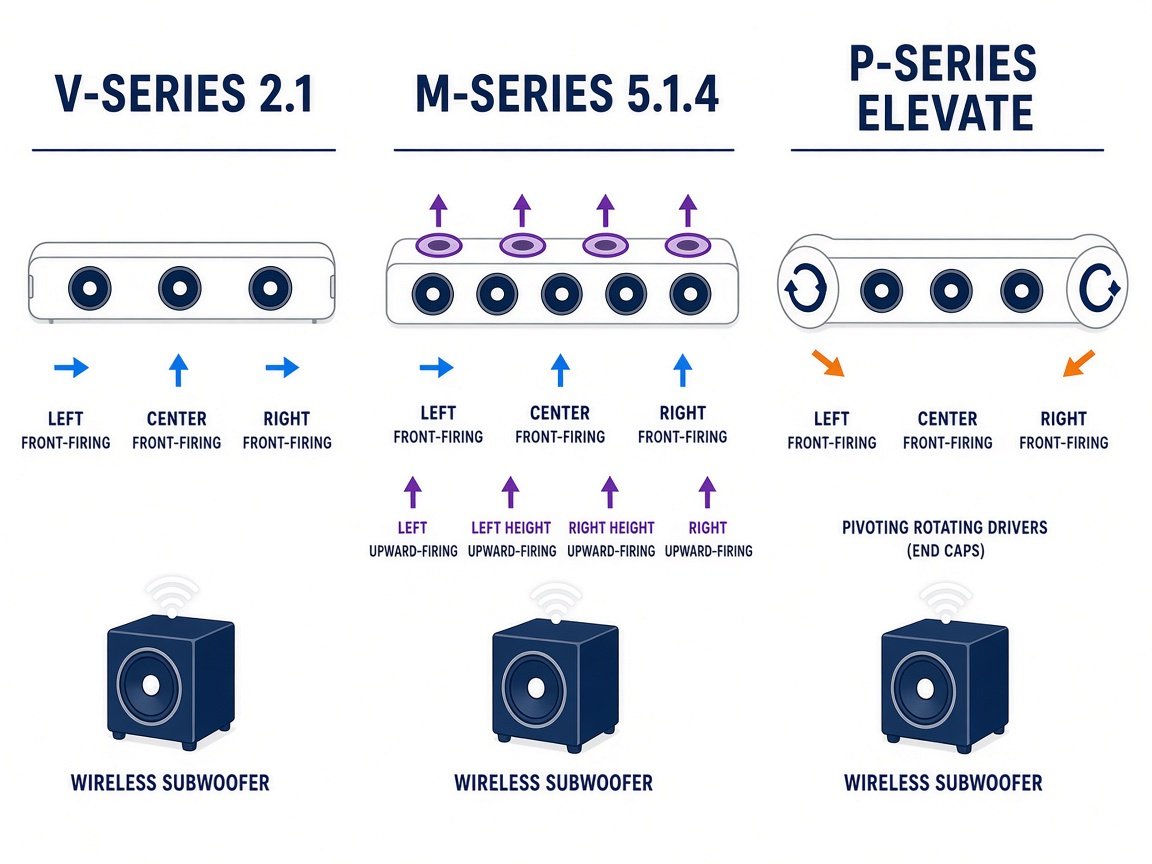
A Vizio sound bar and subwoofer bundle ships as a matched acoustic system built around a defined internal hierarchy. The soundbar houses the primary speaker array — left, center, and right channel drivers as a minimum, with upward-firing height drivers added in M-Series and P-Series configurations. The wireless subwoofer handles all low-frequency reproduction below the system’s internal crossover point. The bundle includes a remote control, an HDMI cable on mid-range and premium models, and power cables for each unit. No separate receiver, amplifier, or processor is required; the soundbar handles all decoding and routing internally.
Channel count is the most direct differentiator across the lineup. Entry-level V-Series bundles operate as 2.1-channel systems: left, right, and subwoofer only. The M-Series steps up to 5.1 and 5.1.4 configurations, with height audio handled by upward-firing drivers built into the soundbar enclosure — no separate satellite speakers are required for the height effect in standard configurations, though Vizio offers optional wireless surround speaker add-ons for some M-Series variants. The P-Series Elevate takes a mechanically distinct approach: its end-cap assemblies house drivers mounted on a motorized pivot mechanism that physically rotates between a forward-facing orientation for stereo and surround content and an upward-facing orientation when Dolby Atmos height objects are detected in the audio stream. That behavior is confirmed in Vizio’s published P-Series Elevate product documentation and distinguishes it from every competing soundbar at this price range that uses only passive reflection or DSP upmixing to suggest height.
For a detailed side-by-side comparison of channel configurations, driver counts, and current pricing across each tier, the best Vizio soundbar and subwoofer pairings for 2026 covers the complete current lineup in comparative depth.
How Does Vizio’s Wireless Subwoofer Technology Work?
Vizio’s wireless subwoofer connection uses a dedicated proprietary radio frequency link, not Bluetooth. This distinction has a direct acoustic consequence. Bluetooth audio — even with aptX Low Latency — introduces enough group delay between the subwoofer’s bass output and the soundbar’s mid-range and high-frequency output to produce an audible smear on transient material: the attack of a kick drum, an explosion’s initial impact, or a low-pitched instrument’s fundamental. Vizio’s RF link is designed to keep the subwoofer phase-coherent with the soundbar without requiring manual latency compensation. Owner reviews across major retail platforms consistently confirm that the RF link behaves as described in Vizio’s published materials, with the subwoofer identifying the matched soundbar at power-on without manual pairing steps in the great majority of reported setups.
Enclosure volume and driver diameter scale predictably through the lineup. V-Series subwoofers use smaller enclosures sized for near-field and compact living-room applications. M-Series and P-Series enclosures are substantially larger, delivering greater maximum acoustic output before the driver reaches its mechanical limits. Owner feedback reflects this directly: V-Series owners describe clean, defined bass well-suited to music and standard television content; M-Series and P-Series owners report noticeably greater room-pressurizing output during high-dynamic-range film soundtracks. The limiting factor at the entry tier is not distortion at moderate volumes — it is maximum output ceiling. The V-Series subwoofer performs cleanly within its operational envelope, but that envelope is smaller than what larger rooms or demanding cinema material requires.
Buyers who find the bundled subwoofer insufficient and want to evaluate standalone upgrades can find detailed coverage of dedicated bass units across price points and enclosure sizes in the best subwoofer for home theater comparison.
Which Audio Formats Does Each Vizio Tier Support?
Audio format support across the Vizio lineup follows a tiered structure that maps closely to price. All current Vizio soundbars handle Dolby Digital and DTS — the standard compressed surround formats carried by streaming services, Blu-ray discs, and broadcast television. These are the baseline formats required of any soundbar at any price point in 2026 and are non-negotiable across the entire lineup.
HDMI eARC connectivity — confirmed by Vizio for the majority of its current soundbar portfolio — allows the soundbar to receive higher-bandwidth audio signals than HDMI ARC or optical can carry. This matters specifically for Dolby TrueHD and DTS-HD Master Audio: the lossless audio formats on Blu-ray and 4K UHD discs. Without eARC, those formats are downmixed to their compressed Dolby Digital Plus or DTS core equivalents before reaching the soundbar. With eARC and a compatible source, full lossless delivery is possible — provided the specific Vizio model’s datasheet confirms TrueHD passthrough or decoding capability, which varies within each series and must be verified per model, not assumed by series membership alone.
The object-based formats — Dolby Atmos and DTS:X — are where the M-Series and P-Series separate decisively from the V-Series. Per Vizio’s published datasheets, M-Series and P-Series soundbars decode both formats natively within the soundbar. The V-Series can receive a Dolby Atmos bitstream via HDMI eARC from a compatible television and pass it downstream, but it does not decode it natively in the soundbar itself. When the V-Series is the terminal audio device — which it is in most single-soundbar setups — it cannot render Atmos height objects regardless of whether the source signal carries them. The audio it produces is processed as a Dolby Digital Plus 5.1 downmix.
- V-Series: Dolby Digital, DTS, Dolby Digital Plus, Dolby Atmos passthrough only (no native decoding), HDMI eARC on most models
- M-Series: All V-Series formats plus native Dolby Atmos decoding, native DTS:X decoding; Dolby TrueHD support varies — verify per model datasheet
- P-Series Elevate: All M-Series formats plus optimized Atmos height rendering via motorized rotating drivers
Source: Vizio published product datasheets. Format availability varies within each series — confirm the specific model’s datasheet before purchase.
How Does Sound Quality Break Down Across the Three Tiers?
Sound quality assessment across the Vizio lineup is built from Vizio’s published specifications, confirmed driver and enclosure data, and aggregated owner feedback across major retail platforms. No proprietary acoustic measurements, test rooms, or hands-on evaluations inform this analysis. The patterns that emerge from that data are consistent enough to provide reliable purchase guidance, with the important caveat that in-room acoustics affect perceived performance significantly and no soundbar at any price point eliminates that variable.
V-Series: Owner reviews describe V-Series systems as a substantial step above television speakers in width, depth, and bass definition — which accurately describes what a 2.1 system with a dedicated subwoofer should deliver over a TV’s built-in audio. Dialogue clarity receives generally positive marks from V-Series owners, though a subset notes that intelligibility degrades at higher volume levels, particularly on content with heavy bass-and-effect soundtracks. The two-channel soundstage is stereo with subwoofer support; it does not produce directional surround positioning and buyers expecting enveloping surround from a 2.1 system will be disappointed regardless of brand.
M-Series: The step to M-Series brings two meaningful changes in owner-reported sound quality. First, the soundstage is wider, with discrete height information added from the upward-firing drivers in Atmos-encoded content. Second, bass output is consistently described as deeper and more room-filling than V-Series at equivalent volume settings — a reflection of the larger subwoofer enclosure volumes in Vizio’s published M-Series documentation. M-Series owners report that height effects are audible on well-mixed Atmos content, with results dependent on ceiling height and room geometry. Standard 8- to 9-foot residential ceilings produce better height imaging than lower or heavily absorbed ceilings.
P-Series Elevate: The rotating driver mechanism is Vizio’s most technically differentiated feature. By physically orienting the height drivers toward the ceiling when Atmos height objects appear in the mix, the P-Series maximizes driver coupling to the ceiling reflective surface rather than relying on a fixed upward-firing position that sends some energy sideways regardless of content. Owner reviews consistently describe height imaging on the P-Series as the most convincing available from a soundbar without satellite speakers. As with all reflection-dependent height systems, results depend on ceiling height, ceiling surface material (hard and flat surfaces reflect more effectively than absorptive or heavily contoured ceilings), and listening position relative to the bar.
How Does Vizio Compare to Sony, LG, Bose, and Sonos?
Vizio’s primary mid-range soundbar competitors are Sony and LG. The competitive dynamic at this tier is well-documented across industry coverage: Vizio typically offers more channels or a larger subwoofer enclosure at a given price, while Sony and LG invest more heavily in proprietary room correction algorithms and audio processing partnerships. Neither approach is universally superior — they address different priorities — and performance depends on the room, the content, and what the listener values most.
| Feature | Vizio (M-Series) | Sony (comparable tier) | LG (comparable tier) |
|---|---|---|---|
| Wireless Subwoofer | Yes — proprietary RF link (Vizio-confirmed) | Yes — Sony wireless protocol | Yes — LG wireless protocol |
| Dolby Atmos Decoding | Yes (Vizio datasheets) | Yes — select models | Yes — select models |
| DTS:X Support | Yes (Vizio datasheets) | Select models | Select models |
| HDMI eARC | Yes — most models | Yes — most models | Yes — most models |
| Room Correction / Audio Tuning | Basic DSP via SmartCast app | 360 Spatial Sound Mapping (select models) | Meridian Audio tuning (select models) |
| Multi-Room Audio | Limited — SmartCast ecosystem only | Limited — select models | Limited — select models |
| AirPlay 2 | Not available | Select models | Not available on most models |
| Price Position | Value-oriented | Broadly comparable | Broadly comparable |
Sony’s 360 Spatial Sound Mapping — available on select premium Sony soundbars — analyzes room geometry using test tones and redistributes virtual surround objects according to its acoustic model of the listening environment. LG’s Meridian Audio partnership, applied to select LG soundbar configurations, brings proprietary DSP tuning developed by the British audio company. These processing investments can produce meaningful real-world advantages in acoustically challenging rooms. For detailed coverage of Sony’s comparable soundbar systems, the best Sony soundbars with subwoofer covers Sony’s current lineup with the same analytical depth. For LG’s equivalent tier, the best LG soundbars with subwoofer provides a parallel analysis.
Bose and Sonos operate in a separate competitive bracket. Their soundbars carry substantially higher price points and compete primarily on ecosystem integration, proprietary room correction depth, and build quality. Vizio does not attempt to match them in those areas. The direct competitive comparison for a Vizio buyer is Sony and LG in the mid-range, not Bose or Sonos. If a Bose or Sonos ecosystem is under consideration, the premium pricing differential should be evaluated against specific ecosystem-dependent needs rather than raw acoustic hardware counts.
What Connectivity and Smart Features Come With Vizio Soundbars?
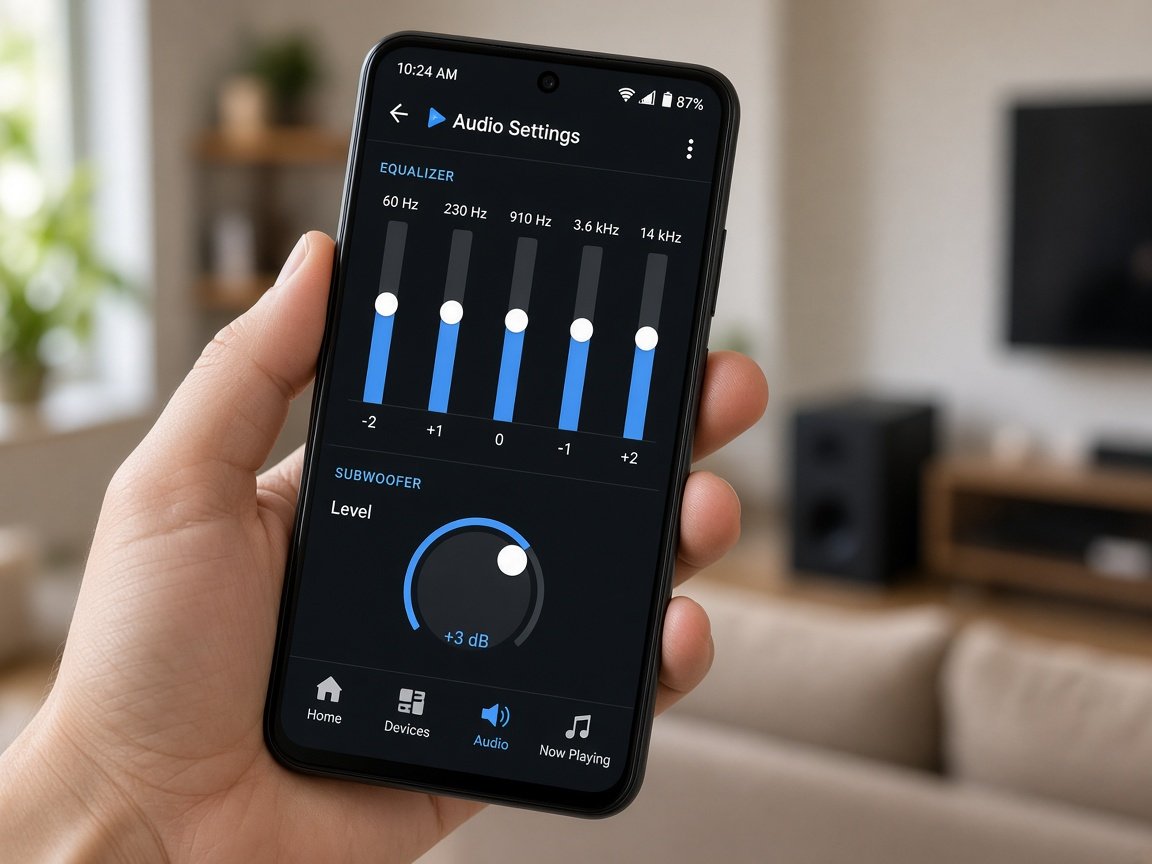
Connectivity on Vizio soundbars covers the standard set expected at this price tier: HDMI eARC for primary television integration, an optical digital input for televisions without ARC capability, and Bluetooth for direct audio streaming from smartphones and tablets. The SmartCast platform — Vizio’s integrated control and content access layer — enables volume management, input selection, and equalizer adjustments through a companion iOS and Android application without requiring the physical remote.
Chromecast built-in is confirmed by Vizio’s published specifications on select soundbar models, enabling direct audio casting from compatible applications. This is a practical convenience feature for households in the Google ecosystem: the soundbar can receive audio streams directly from supported applications without routing through the television. Voice assistant integration is available through SmartCast on compatible Vizio television setups, though the soundbar itself does not house built-in microphones for direct far-field voice input on most published configurations — a distinction from Amazon Echo or Google Nest speaker products that matters if voice control without a remote is a priority.
What Vizio does not provide is multi-room audio networking comparable to Sonos, or native Apple AirPlay 2 support that several competing brands have added to their soundbar portfolios. For buyers whose primary goal is television audio enhancement and occasional Bluetooth streaming, the connectivity set is complete and practical. For buyers who want the soundbar to anchor a broader whole-home audio distribution system, those absences are substantive. The best wireless surround sound systems examines ecosystem-level multi-room options across brands for buyers evaluating that dimension.
Which Vizio Tier Is Right for Your Room and Use Case?
Room volume and primary seating distance are the two variables that most reliably predict whether a given Vizio tier will perform adequately in a specific environment. Matching tier to room prevents both under-buying — a system that runs out of headroom in a large space — and over-spending on acoustic capability that the room geometry cannot resolve at typical listening levels.
| Room Size / Use Case | Recommended Vizio Tier | Primary Reason |
|---|---|---|
| Bedroom, compact media room, seating under 10 ft from screen | V-Series (2.1) | Output ceiling matched to enclosure volume; two-channel soundstage sufficient for near-field listening; most cost-efficient entry point |
| Standard living room, 10–16 ft from screen, mixed TV and film use | M-Series (5.1 or 5.1.4) | Larger subwoofer enclosure handles room volume; native Dolby Atmos decoding adds spatial dimension; height drivers effective in standard ceiling heights |
| Open-plan space, dedicated home theater room, Atmos-focused listening | P-Series Elevate | Rotating drivers optimize height imaging beyond fixed upward-firing designs; maximum output headroom; premium acoustic ceiling for the product category |
The M-Series inflection point deserves particular attention. The step from V-Series 2.1 to M-Series 5.1 is not primarily about maximum volume — it is about spatial presentation. In a standard living room with an 8- to 9-foot ceiling, M-Series upward-firing drivers can produce audible height effects on well-mixed Atmos content that are substantially more convincing than the simulated height a 2.1 system produces through DSP upmixing alone. Buyers evaluating the M-Series for a mid-sized room are making a spatial quality decision as much as an output headroom decision. For a thorough comparison of the best complete home theater surround configurations across brands at every price tier, the best home theater surround sound systems covers the full competitive field.
How Do You Set Up and Calibrate a Vizio Sound Bar and Subwoofer?
Vizio soundbar and subwoofer setup is designed for straightforward installation without an external receiver, amplifier, or processor. The process from unboxing to full audio output involves a defined sequence of configuration steps described in Vizio’s included quick-start documentation. The following steps reflect that published guidance and common owner-reported setup patterns.
What Are the Known Limitations of Vizio Sound Bar Systems?
Honest evaluation requires direct treatment of a product’s documented limitations alongside its feature advantages. For Vizio’s soundbar lineup, four limitations appear consistently across owner feedback and product category analysis. None of them are disqualifying for most buyers — but all of them affect specific use cases and room types in ways that matter before purchase.
Owner reviews across all three Vizio tiers include a subset of reports where dialogue intelligibility — particularly on content with heavy bass-and-effect soundtracks — degrades at higher volume levels. This is a center channel driver and crossover optimization issue: when bass frequencies from an action soundtrack push the subwoofer hard, some energy bleeds into the crossover region and masks center channel content. It does not affect all content equally, and listening levels matter: at moderate output levels, dialogue clarity in owner reviews is generally described positively across all tiers.
Wireless stability over time: While initial subwoofer pairing is consistently described as reliable in owner feedback, a minority of long-term owners report intermittent dropouts developing after extended use — brief moments of silence from the subwoofer before the RF link re-establishes. This is not universal, and many owners report years of trouble-free operation. It appears with enough frequency in aggregated owner feedback to warrant mention. It has not been systematically characterized as a hardware defect in published consumer electronics coverage, and it is documented as a known occurrence rather than a universal failure mode.
Room correction depth: Vizio’s SmartCast DSP provides EQ presets and subwoofer level adjustment but does not perform automated room correction through microphone measurement. Sony’s 360 Spatial Sound Mapping and similar measurement-based systems on competing products actively compensate for room acoustic anomalies — reflections, boundary bass buildup, and frequency response irregularities introduced by room geometry and furnishings. Vizio’s approach relies entirely on the user’s manual EQ adjustments. For acoustically well-behaved rooms, this is a minor limitation. For rooms with significant acoustic problems — hard parallel surfaces, low-frequency resonance modes — it means the system will not automatically compensate for those issues the way competing products with room correction can.
Ecosystem depth: Vizio’s SmartCast platform is a functional but limited smart audio ecosystem. Multi-room synchronization, whole-home audio distribution, and deep streaming service integration are not features of SmartCast at a level that competes with Sonos or Apple AirPlay 2 networks. For buyers whose primary need is television audio enhancement, this is irrelevant. For buyers who want the soundbar to anchor a broader home audio network or integrate tightly with an existing smart home ecosystem, it is a substantive constraint that merits consideration before purchase.
Is a Vizio Sound Bar and Subwoofer Worth Buying in 2026?
V-Series (2.1) — Worth it for: Compact rooms, secondary displays, and buyers who want clean bass-integrated stereo without surround complexity. Not worth it for: Large rooms, buyers expecting Atmos, or anyone who needs height effects.
M-Series (5.1 / 5.1.4) — Worth it for: Most standard living-room setups where HDMI eARC, native Dolby Atmos decoding, and a larger subwoofer enclosure are needed at a mid-range price. This is the strongest value proposition in the Vizio lineup relative to competitive Sony and LG alternatives at equivalent prices. Not worth it if: Advanced room correction quality is a priority — Sony’s 360 Spatial Sound Mapping and LG’s Meridian tuning provide meaningfully more sophisticated acoustic compensation at comparable price points.
P-Series Elevate — Worth it for: Buyers who prioritize Atmos height imaging and want the best available acoustic performance from a soundbar without satellite speakers. Not worth it if: Height imaging is not a priority — the premium over M-Series is primarily a height-imaging investment, not a broad acoustic quality jump that justifies the cost for all content types.
Not worth it across all tiers if: Your requirements include advanced room correction, AirPlay 2 ecosystem integration, multi-room audio networking, or the acoustic refinement of premium-tier Bose or Sonos products. Those requirements push to competing systems regardless of price.
The Vizio lineup’s core proposition is consistent across its three tiers: more acoustic hardware per dollar than the competition, delivered with a more constrained smart ecosystem and less automated acoustic compensation than Sony, LG, Bose, or Sonos provide at the same prices. For buyers whose priority is television audio performance in an acoustically straightforward room, that trade is a strong one. For buyers whose priorities include ecosystem integration, automated room correction, or multi-room distribution, the trade favors competing products.
If you are ready to compare specific Vizio models side by side before making a purchase decision, the best Vizio soundbar guide ranks every current configuration across value, channel count, and use case. For buyers evaluating a full Vizio 5.1 build specifically, the best Vizio 5.1 sound systems provides a focused comparison of multi-channel configurations.
Frequently Asked Questions About Vizio Sound Bar and Subwoofer Systems
Does the Vizio subwoofer need to be near the soundbar?
No. Vizio’s wireless RF subwoofer link is designed to maintain a stable connection across typical residential room dimensions without requiring the subwoofer to be physically adjacent to the soundbar. Vizio’s published placement guidance confirms that the subwoofer can be positioned away from the soundbar — including behind the listening position, against a side wall, or in a corner — within the RF link’s operational range. The RF link does not require line-of-sight between units.
Does the Vizio V-Series support Dolby Atmos?
The Vizio V-Series can pass a Dolby Atmos-encoded bitstream via HDMI eARC to a downstream device, but it does not decode Dolby Atmos natively within the soundbar itself. When the V-Series is the terminal audio device in the chain — which is the case in most single-soundbar setups — it processes audio as a Dolby Digital Plus 5.1 downmix rather than a three-dimensional Atmos mix. It cannot render Atmos height objects regardless of whether the source signal carries them. Native Atmos decoding requires M-Series or P-Series, per Vizio’s published datasheets.
Can you use a Vizio soundbar without the subwoofer?
Yes. Vizio soundbars operate as fully functional standalone audio devices without the wireless subwoofer connected. The soundbar handles all audio processing internally, with reduced low-frequency extension compared to when the dedicated subwoofer enclosure is active. The soundbar remains fully functional for dialogue and mid-to-high-frequency content without the subwoofer. Powering off the subwoofer while leaving the soundbar active is also a supported configuration for use cases where minimizing bass output is needed, such as late-night viewing.
What is the difference between HDMI ARC and HDMI eARC for Vizio soundbars?
HDMI ARC carries audio from the television to a connected soundbar but its bandwidth is constrained — it supports Dolby Digital 5.1 and DTS 5.1 at standard bitrates but cannot carry Dolby TrueHD, DTS-HD Master Audio, or full-bitrate Dolby Atmos. HDMI eARC uses a higher-bandwidth protocol over the same HDMI cable and can carry all of those formats without bandwidth constraints. For Vizio M-Series and P-Series users who want native Dolby Atmos decoding from disc sources, eARC is required. Without it, the soundbar receives a compressed Atmos core or a Dolby Digital 5.1 downmix rather than the full Atmos object layer.
How do you re-pair a Vizio subwoofer that has stopped connecting?
Vizio’s standard re-pairing procedure — described in the support documentation for most current soundbar models — involves holding the pairing button on the rear panel of the subwoofer until its LED indicator flashes, then initiating pairing from the soundbar either via the SmartCast app or the soundbar’s input menu. The specific button location and menu path vary by model; Vizio’s published support documentation for each model provides the exact sequence. If automatic re-pairing fails after following the documented procedure, Vizio’s support line and online support portal are the appropriate escalation path.
How does the Vizio P-Series Elevate’s rotating driver mechanism work?
The P-Series Elevate’s end-cap speaker assemblies contain drivers mounted on a motorized pivot. For standard stereo or surround content, the drivers face forward toward the listener. When the system detects Dolby Atmos height objects in the incoming audio stream, the motors rotate the driver assemblies to face upward, coupling them to the ceiling surface. The ceiling then acts as a reflective surface, redirecting sound downward toward the listening position from above. This physical reorientation is designed to maximize driver energy transfer into the ceiling reflection path rather than relying on a fixed upward-firing driver that always sends some energy sideways regardless of content. The mechanism is confirmed in Vizio’s published P-Series Elevate product documentation.
Can you add a second subwoofer to a Vizio soundbar?
Vizio’s standard soundbar configurations are designed around a single matched wireless subwoofer. Vizio’s published documentation for standard bundle configurations does not describe native support for pairing a second wireless subwoofer to the same soundbar within the SmartCast ecosystem. For dual-subwoofer setups — which address low-frequency room mode problems more effectively than a single subwoofer can — a dedicated home theater receiver with two subwoofer outputs is the more appropriate platform. Buyers evaluating standalone subwoofer upgrades should refer to our comprehensive best subwoofer for home theater comparison for dedicated bass unit options across price points and enclosure formats.
Conclusion: Choosing the Right Vizio Tier in 2026
The Vizio sound bar and subwoofer lineup presents a consistent value proposition across its three tiers: more acoustic hardware per dollar than competing brands at equivalent price points, delivered with more constrained smart ecosystem depth and less automated room correction than Sony, LG, Bose, or Sonos provide at the same prices. Whether that trade is the right one depends on which side of the equation matters most in your specific setup and listening priorities.
Use this decision sequence to arrive at the right configuration for your room:
- Define your room size first. V-Series for compact spaces or seating under 10 feet from the screen. M-Series for standard living rooms. P-Series for larger spaces or dedicated home theater installations where height imaging is a priority.
- Confirm your television has HDMI eARC if you intend to use Dolby Atmos or lossless audio from disc sources. Without eARC, format support is constrained regardless of which Vizio tier you choose.
- Verify the specific model’s datasheet for Dolby TrueHD and DTS-HD Master Audio passthrough or decoding if lossless audio from physical media matters to you. These capabilities vary within each series and must be confirmed per model, not assumed by series membership.
- Compare M-Series against Sony and LG equivalents if room correction quality is a priority. Vizio’s basic SmartCast DSP versus Sony’s 360 Spatial Sound Mapping or LG’s Meridian Audio tuning is the most meaningful differentiator at the M-Series price tier for acoustically difficult rooms.
- Evaluate ecosystem requirements explicitly. If multi-room audio distribution, AirPlay 2 integration, or deeper streaming service access matter to your household, verify those capabilities before committing — Vizio’s SmartCast platform does not match Sonos or Apple ecosystem depth in those respects.
- Treat subwoofer placement as part of the installation. Corner versus side-wall versus open-room placement meaningfully affects bass response and dialogue clarity in any room. Build in time to evaluate two or three positions before settling on a final placement.