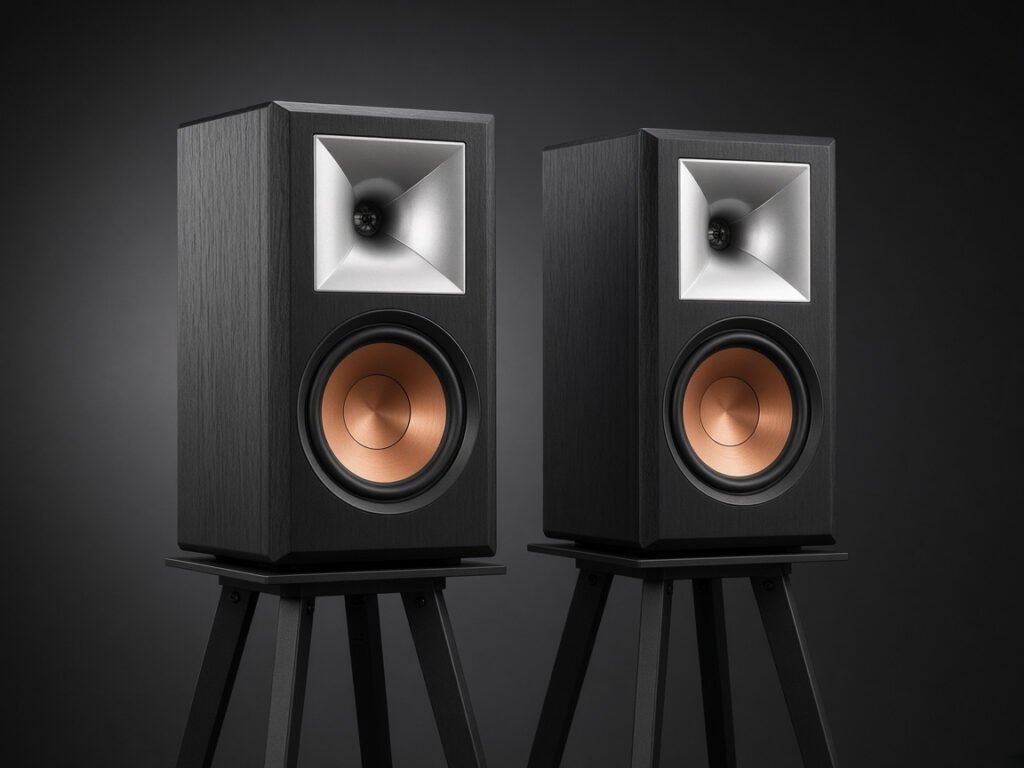
The Klipsch R-51M is worth buying in 2026 for listeners who prioritize efficiency, horn-loaded treble clarity, and compact form over flat-response neutrality. Rated at 93dB sensitivity per Klipsch’s published specifications — one of the highest figures in its price category — it ranks among the most amplifier-friendly speakers home theater speakers enthusiasts reach for without crossing into premium territory. That single specification shapes every practical aspect of its performance.
- Klipsch rates the R-51M at 93dB sensitivity, meaning it reaches high listening levels from amplifiers rated as low as 20 watts per channel — an unusually low power requirement for a passive bookshelf speaker.
- The 1-inch aluminum LTS tweeter in a Tractrix horn is designed to reduce distortion at the driver and control high-frequency dispersion across a 90×90-degree horizontal and vertical window.
- Owner reviews consistently describe a dynamic, forward sound character that suits home theater, rock, and film soundtracks; some find the treble presentation forward on compressed or poorly mastered recordings.
- The rated low-frequency limit of 62Hz (±3dB) per Klipsch’s specifications means the R-51M is not full-range: a subwoofer is advisable for home theater use or bass-heavy listening material.
What Are the Klipsch R-51M Bookshelf Speakers?
The Klipsch R-51M is a two-way, rear-ported bookshelf speaker from Klipsch’s Reference series. It replaced the R-15M as the entry point for the Reference bookshelf line, retaining the same core technical identity: a 1-inch aluminum LTS tweeter mounted in a 90×90-degree Tractrix horn, paired with a 5.25-inch spun-copper IMG (Injection Molded Graphite) woofer. The brushed black polymer veneer cabinet is finished in Klipsch’s signature aesthetic — the copper-toned cone is a visual marker of the Reference line, though the material is a copper-colored graphite composite rather than metal.
Within Klipsch’s current portfolio, the Reference series sits below the Reference Premiere and Heritage lines. This positioning places the R-51M as a gateway product into Klipsch’s horn-loaded sound signature without the premium price of its upper-tier engineering. The speaker is designed to integrate within a matched Klipsch Reference ecosystem — pairing with the RC-52 II center channel and R-series tower speakers to maintain a consistent horn-loaded character across all channels. For buyers weighing a broader Klipsch system investment, the full range of best Klipsch home theater system configurations covers every tier from entry-level bundles to Heritage-class builds.
What Specifications Define the R-51M’s Technical Profile?
The R-51M’s specification sheet reveals a speaker engineered specifically for efficiency and dynamic headroom, not flat-response neutrality or bass extension. The table below reproduces Klipsch’s published product specifications in full.
| Sensitivity | 93dB @ 2.83V / 1m |
| Frequency Response | 62Hz – 21kHz (±3dB) |
| Power Handling — Continuous | 50W |
| Power Handling — Peak | 200W |
| Nominal Impedance | 8 ohms compatible |
| Tweeter | 1″ aluminum LTS with Tractrix Horn |
| Woofer | 5.25″ spun-copper IMG |
| Crossover Frequency | 1.8kHz |
| Enclosure Type | Rear-ported bass reflex |
| Dimensions (H × W × D) | 11.3″ × 7.0″ × 8.9″ |
| Weight (each) | 9.5 lbs |
| Cabinet Finish | Brushed black polymer veneer |
Source: Klipsch published product specifications.
The 93dB sensitivity figure is the most consequential number in the specification sheet. Sensitivity measures sound pressure output from one watt at one meter. Many passive bookshelf speakers in a comparable price range are rated between 85 and 88dB — a 5 to 8dB gap that translates to a substantial difference in playback volume from the same amplifier output. At 93dB, the R-51M can reach reference-level listening levels from amplifiers producing as little as 20–30 watts per channel, which is relevant for buyers using budget integrated amplifiers, entry-level AV receivers, or vintage receivers with limited power reserves.
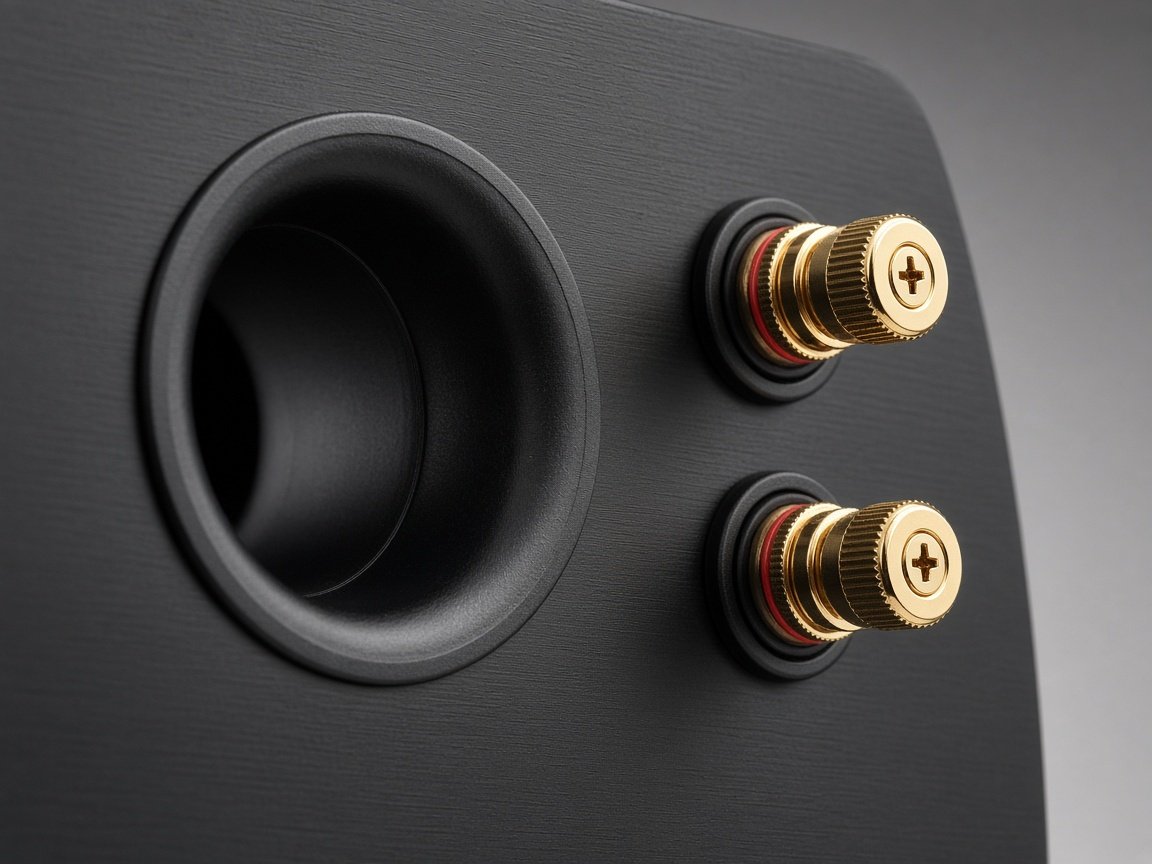
The 1.8kHz crossover frequency is notably low for a horn-loaded tweeter. This configuration assigns a wide portion of the upper midrange — from 1.8kHz upward — to the aluminum tweeter and horn assembly rather than the woofer. Klipsch designs this to minimize the transition zone where both drivers overlap, reducing phase and amplitude anomalies at the crossover point. The rear-firing port requires physical clearance behind the cabinet: Klipsch recommends positioning the speaker away from the back wall to prevent port turbulence or uncontrolled bass reinforcement from boundary proximity.
How Does Klipsch’s Tractrix Horn Technology Work?
The Tractrix horn is Klipsch’s proprietary horn geometry, defined by a mathematical curve called the tractrix — a shape that describes the flare profile of the horn throat as it expands outward. Klipsch’s engineering argument is that this geometry produces a more linear acoustic impedance transition between the tweeter diaphragm and the surrounding air than exponential or conical horn profiles. The practical effect, by design, is a reduction in back pressure on the tweeter diaphragm during playback, which Klipsch states lowers distortion at higher output levels.
The dispersion pattern of the R-51M’s Tractrix horn is specified at 90×90 degrees — 90 degrees horizontally and 90 degrees vertically. This is intentionally narrower in the vertical axis than the radiation of a typical soft-dome tweeter. Klipsch’s design intent is to reduce high-frequency energy reflecting off ceilings and floors, which can blur stereo imaging in reverberant rooms. For home theater seating configurations where multiple listeners are seated across a wide horizontal arc, the 90-degree horizontal dispersion is designed to maintain consistent treble delivery across the full seating width.
The LTS tweeter mechanism — Linear Travel Suspension — uses a vented magnetic gap configuration. Klipsch states this design reduces thermal compression and magnetic gap distortion that can occur in dome tweeters under sustained high-level drive. The aluminum diaphragm is chosen for its high stiffness-to-mass ratio, allowing extension above 20kHz per the rated specification. The horn loading allows the tweeter to operate at higher efficiency than a free-air dome design of comparable diameter, contributing directly to the speaker’s overall 93dB sensitivity rating.
What Does the R-51M Sound Like According to Owners?
Owner feedback across multiple retailer review platforms consistently describes the R-51M as dynamic, immediate, and detailed in the high and upper-midrange frequencies. The horn-loaded tweeter is the most frequently cited characteristic — producing what owners describe as a sense of presence and directness, particularly on percussion, brass, and film soundtrack dynamic peaks. This quality is attributed by owners to the horn’s efficient conversion of electrical energy into acoustic output, which creates transient impact that many listeners associate with live sound reproduction.
At the low end, owners frequently note that bass performance is adequate for near-field listening and modest room sizes, but that the 62Hz lower limit becomes noticeable without a subwoofer when playing bass-heavy content. Electronic music, pipe organ recordings, and home theater LFE effects are described by owners as audibly thin or absent below the speaker’s rated low-frequency cutoff. This is consistent with what a 5.25-inch driver in a compact bass-reflex enclosure is acoustically capable of producing, and aligns precisely with the published specification.
The midrange character is generally reported as clean and resolving. Some owners note an upper-midrange prominence on compressed pop and rock recordings — a characteristic often associated with horn-loaded designs and the relatively low 1.8kHz crossover frequency that places a broad midrange swath under the tweeter’s control. On well-recorded acoustic, vocal, and orchestral material, owners describe the presentation as natural and uncoloured. At higher playback levels, particularly in moderately damped rooms, some listeners report an increase in perceived treble intensity — a known trait of high-sensitivity horn designs driven into their upper output range.
How Does the R-51M Compare to Rival Bookshelf Speakers?
The R-51M sits in a competitive segment of the passive bookshelf speaker market. The comparison table below positions it against three commonly evaluated alternatives using manufacturer-published specifications. No third-party acoustic measurements are included, as the data below is drawn from published manufacturer product pages only.
| Speaker | Sensitivity | Freq. Response | Woofer | Impedance |
|---|---|---|---|---|
| Klipsch R-51M | 93dB | 62Hz – 21kHz | 5.25″ IMG | 8 ohm compat. |
| Q Acoustics 3020i | 88dB | 64Hz – 30kHz | 5″ PP cone | 6 ohm |
| ELAC Debut 2.0 B6.2 | 87dB | 44Hz – 35kHz | 6.5″ aramid fiber | 6 ohm |
| Polk Audio T15 | 89dB | 65Hz – 24kHz | 5.25″ composite | 8 ohm |
Specifications as published by each manufacturer. Frequency response tolerances may differ between brands. Verify current figures at manufacturer websites before purchase.
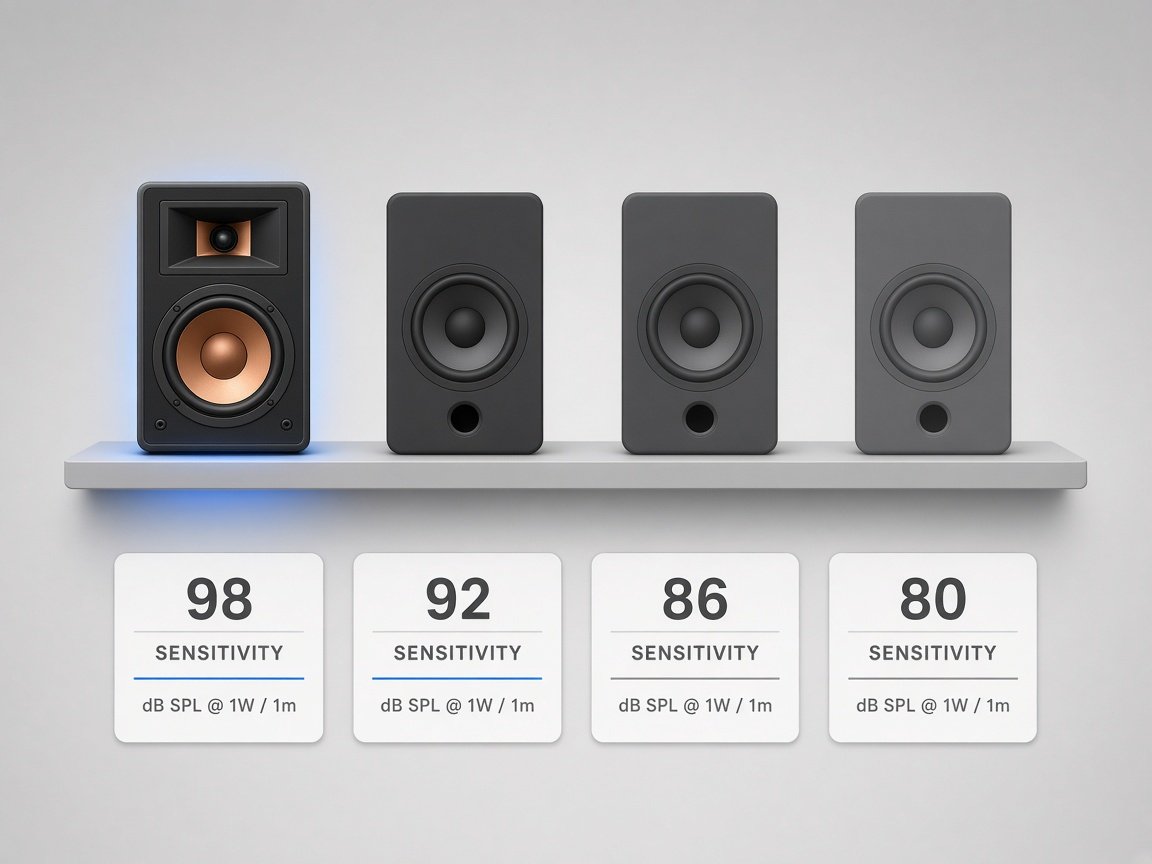
The sensitivity gap is the most practically significant difference in the table. The 5–6dB advantage the R-51M holds over the Q Acoustics 3020i and ELAC Debut 2.0 B6.2 means it produces considerably more output from the same amplifier wattage. For buyers using entry-level AV receivers rated below 50 watts per channel, this efficiency gap is audible and meaningful at typical listening volumes. The ELAC Debut 2.0 B6.2’s 6.5-inch woofer gives it a theoretical low-frequency extension advantage on paper at 44Hz, though both speakers benefit from subwoofer support in a cinema-focused system. The R-51M’s 8-ohm compatible load is easier for budget amplifiers to drive than the 6-ohm designs of the Q Acoustics and ELAC alternatives. For listeners weighing these options against more expensive passive alternatives, the guide to the best high-end audio speakers covers models at a significantly higher specification and price tier for direct context.
What Amplifier or Receiver Pairs Best With the R-51M?
The R-51M’s 93dB sensitivity and 8-ohm compatible impedance make it one of the least demanding passive bookshelf speakers to drive in its category. Any AV receiver or integrated amplifier rated at 20 watts per channel or more into 8 ohms is technically sufficient to reach high listening levels in a standard domestic room. This unusually low power threshold makes the R-51M compatible with vintage receivers, low-wattage tube amplifiers, and budget AV receivers where 85–87dB-sensitivity alternatives would struggle at the same volume settings.
Klipsch’s published continuous power handling of 50 watts means the speaker absorbs typical AV receiver output comfortably. The 200W peak rating provides substantial headroom against transient peaks in film soundtracks or live concert recordings. From a practical pairing standpoint, any AV receiver in the 50–100W per channel range — which covers the majority of mid-tier home theater receivers — will drive the R-51M to its full dynamic capability without approaching its limits. What the receiver must be stable into 8 ohms: some budget units specify wattage only into 4 ohms, which overstates their practical output into the R-51M’s load.
- Speaker stands: Rigid stands rated for at least 15 lbs per column; the R-51M weighs 9.5 lbs each with modest stability margin required.
- Speaker wire: 16AWG minimum for runs under 10 feet; 14AWG for runs between 10 and 25 feet to minimise resistive losses into the 8-ohm load.
- Subwoofer: Strongly recommended for home theater use; set the R-51M’s bass management crossover at 80Hz in the receiver to protect the woofer and integrate smoothly with an LFE channel.
- Wall clearance: A minimum of 3–4 inches behind the rear-firing port to prevent port turbulence and uncontrolled bass reinforcement.
Can the R-51M Work in a Home Theater Surround Sound Setup?
The R-51M’s compact dimensions — 11.3 inches high and 7 inches wide — make it a practical choice for surround satellite roles in 5.1 and 7.1 configurations. Its high sensitivity ensures it keeps pace dynamically with more powerful front-stage speakers without requiring the surround amplifier channels to work disproportionately hard. Because Klipsch designs the Reference series as a matched system, the R-51M shares the same horn geometry and cabinet aesthetic as the larger R-series towers and the RC-52 II center channel — a coherent timbre across all channels being one of the core design goals of the lineup.
For Dolby Atmos configurations, the R-51M is not an Atmos-enabled speaker. It has no upward-firing driver for height channel reproduction and cannot function as an elevation speaker in a 5.1.2 or 7.1.4 layout. It can function as a standard surround speaker in an Atmos system — handling left surround, right surround, or rear surround channels — while dedicated overhead or Atmos-enabled add-on speakers handle the height layer. Understanding the precise role and placement requirements for each channel in an Atmos system is essential before specifying equipment; the technical guide to Dolby Atmos speaker requirements and placement explains what each channel position demands from its speaker. For buyers comparing compact satellite options across brands before committing to a surround configuration, the guide to the best small surround sound speakers covers alternatives across multiple price tiers.
What Are the Known Limitations of the R-51M?
Several limitations are worth addressing directly for buyers evaluating the R-51M against their specific use case. The first is bass extension. The 62Hz rated low-frequency limit means the R-51M cannot reproduce the sub-bass register present in film LFE tracks, electronic music bass lines, or kick drum fundamentals below 60Hz. For music listening in small rooms with modest volume requirements, many owners report satisfactory bass character without a subwoofer. For home theater use, the LFE channel requires a dedicated subwoofer regardless of the main speakers’ capability. Those evaluating subwoofer options to complement the R-51M can review dedicated low-frequency performance criteria in the guide to the best bass speakers for home theater in 2026.
The second limitation is placement sensitivity. The 90×90-degree dispersion pattern of the Tractrix horn is intentionally directional. In near-field desktop scenarios — where the listening position is very close to the speaker and significantly off-axis horizontally or vertically — some owners report a tonal shift compared to the on-axis sweet spot. Proper toe-in adjustment, angling the speakers toward the primary listening position, is more critical with the R-51M than with wider-dispersion dome-tweeter designs. This is not a defect; it is a property of controlled-dispersion horn loading that requires deliberate placement to exploit correctly.
The third limitation is amplifier noise floor transparency. High-sensitivity speakers reproduce the entire signal chain’s output — including residual hiss or hum present in an amplifier’s noise floor — more audibly than lower-sensitivity designs. Hiss that is inaudible through an 85dB speaker may become noticeable through the R-51M at close listening distances in quiet passages. This is a characteristic shared by all high-efficiency horn-loaded designs and is not a speaker defect. It does, however, mean the R-51M is more revealing of amplifier and source quality than many alternatives at this price point.
Is the Klipsch R-51M Worth Buying in 2026?
For the right buyer, the R-51M remains a technically strong and competitive choice in 2026. Its value proposition rests on three intersecting advantages: 93dB sensitivity that reduces amplifier requirements, a horn-loaded tweeter that delivers dynamic transient impact uncommon at this price, and an 8-ohm compatible load that pairs reliably with the broadest range of amplification. These characteristics are not replicated by most bookshelf speakers in the same price bracket — the sensitivity figure alone is a genuine differentiator.
The R-51M is best suited to: music listeners who favour dynamic, forward sound presentation; home theater surround applications where compact size and high sensitivity reduce per-channel amplifier demand; and system builders who want a matched Klipsch Reference house sound across all channels without upgrading to the Reference Premiere tier. It is less suited to flat-response critical monitoring applications, bass-heavy near-field desktop use without a subwoofer, or listeners who prefer the more relaxed treble presentation of wide-dispersion dome-tweeter designs.
Looking at the 12–24 months ahead, the passive bookshelf speaker segment is expected to face increasing competition from DSP-integrated active designs — speakers with built-in amplification and EQ that can compensate digitally for the room-placement sensitivities that passive designs like the R-51M require the buyer to manage. Klipsch’s horn-loaded passive approach remains relevant as long as amplifier-based home theater is the dominant system architecture, and the R-51M’s specifications hold up well against 2026 competition. If Klipsch updates the Reference series, the R-51M’s successor is likely to retain the Tractrix horn topology while refining cabinet construction and crossover components — the core technology has remained consistent across Reference iterations.
The R-51M’s 93dB sensitivity, Tractrix horn tweeter, and 8-ohm load make it one of the most amplifier-friendly passive bookshelf speakers in its price class. Its limitations — bass roll-off below 62Hz and placement sensitivity from the horn’s directional pattern — are predictable, well-documented, and manageable with proper setup. For buyers who want to understand how the R-51M fits within a broader speaker system context, the guide to the best speaker systems for home theater in 2026 positions it against full-range system alternatives at every budget tier.
Frequently Asked Questions About the Klipsch R-51M
How much amplifier power do the Klipsch R-51M speakers need?
Per Klipsch’s published specifications, the R-51M has a continuous power handling of 50 watts and a sensitivity of 93dB at 2.83V/1m. These figures mean it reaches high listening levels from amplifiers rated at 20–30 watts per channel into 8 ohms — a very low threshold by passive speaker standards. Any modern AV receiver rated into 8 ohms is technically adequate. Higher-powered amplifiers are not harmful; they provide greater headroom for transient peaks rather than operating the speaker harder at equivalent listening volumes.
Can the Klipsch R-51M reproduce bass without a subwoofer?
The R-51M is rated to 62Hz at ±3dB per Klipsch’s specification. This covers most of the bass register in acoustic music, voice, and standard rock recordings, but misses sub-bass frequencies present in film LFE content, electronic music, and bass guitar fundamentals below 60Hz. For music listening in small rooms at moderate volumes, many owners report satisfactory bass without a subwoofer. For home theater use, a matched subwoofer is advisable to reproduce the full low-frequency bandwidth of Dolby Atmos and DTS:X soundtracks correctly.
What is the difference between the Klipsch R-51M and the R-41M?
The R-41M is Klipsch’s smaller Reference bookshelf speaker, using a 4-inch woofer compared to the R-51M’s 5.25-inch driver. Per Klipsch’s published data, the R-41M is rated at 68Hz low-frequency response versus the R-51M’s 62Hz, meaning the R-51M extends slightly lower in bass. Both share the 1-inch Tractrix horn tweeter and similar sensitivity ratings. The R-51M’s larger woofer is designed to produce more low-frequency output and handles higher continuous power, making it the more capable choice for larger rooms or home theater applications.
Are the Klipsch R-51M speakers good for movies?
The R-51M’s high sensitivity and horn-loaded tweeter are well-matched to home theater use. The dynamic character of the horn design means transient peaks — gunshots, explosions, and orchestral swells — are reproduced with the impact and immediacy that owners consistently describe as cinematic. For a full-range home theater experience, pairing with a subwoofer is recommended to handle the LFE channel frequencies below the speaker’s 62Hz lower limit. In a 5.1 or 7.1 configuration, the R-51M functions effectively as a main, surround, or rear surround speaker.
Do the Klipsch R-51M speakers work with a turntable?
Yes, with the appropriate amplification in the signal chain. The R-51M is a passive speaker requiring a separate amplifier or AV receiver. Turntables with a built-in phono preamp can connect to any line-level input on an amplifier, which then drives the R-51M. Turntables without an integrated phono stage require a separate phono preamplifier between the turntable and amplifier. The R-51M’s 93dB sensitivity is advantageous here: low-wattage integrated amplifiers commonly used in turntable-focused setups are more than sufficient to drive it to satisfying listening levels.
How does the Klipsch R-51M compare to Bose bookshelf speakers at a similar price?
The R-51M and Bose bookshelf speakers in a similar price range represent notably different design philosophies. Klipsch’s horn-loaded approach prioritises high sensitivity and controlled directional dispersion; Bose’s proprietary acoustic designs have historically prioritised room-filling, wide-dispersion sound from compact enclosures. Sensitivity and impedance specifications differ significantly across Bose models, making direct comparison dependent on which specific Bose model is under evaluation. A comprehensive breakdown of current Bose bookshelf options is available in the guide to the best Bose bookshelf speakers for direct specification comparison across the range.
Conclusion: Making the Right Decision on the Klipsch R-51M
The Klipsch R-51M’s case for purchase rests on its specification sheet and consistent owner endorsement of its core strengths: high efficiency, dynamic horn-loaded treble, and wide amplifier compatibility. It does not aim to be a flat-response monitor or a full-range bass system. Within those design parameters, it delivers what it promises — and what it promises is well-defined and technically coherent.
For buyers evaluating the R-51M in 2026, the following implementation sequence is recommended before purchase and setup.
- Confirm room size and primary listening position. The Tractrix horn’s 90×90-degree dispersion pattern is best exploited when the listening position falls within the speaker’s on-axis window. Rooms where seating extends significantly off-axis horizontally will require deliberate toe-in adjustment to maintain tonal accuracy across all seats.
- Verify amplifier compatibility. Confirm your amplifier or AV receiver is rated into 8 ohms specifically — not only into 4 ohms — and delivers at least 20 watts per channel at that impedance. The R-51M’s high sensitivity means virtually any modern receiver is sufficient, but older vintage units should be checked for 8-ohm stability and noise floor performance.
- Plan subwoofer integration before purchase. For home theater use, budget for a matched subwoofer from the outset. Configure the AV receiver’s speaker management to route frequencies below 80Hz to the subwoofer — protecting the R-51M’s woofer from bass it cannot reproduce and improving overall system integration.
- Address port clearance at placement stage. Allow at least 3–4 inches of clearance behind the cabinet for the rear-firing port. Use rigid stands or open-backed shelving; avoid enclosing the speakers in solid-sided furniture that restricts port airflow.
- Evaluate tonal character against your content library. The R-51M’s forward, dynamic character suits film soundtracks, rock, acoustic jazz, and high-energy vocal recordings. Listeners whose primary library is electronic music requiring deep sub-bass extension, or classical orchestral works where neutral tonal balance is prioritised, should audition it against alternatives before committing.
The Klipsch R-51M is a technically coherent, well-specified bookshelf speaker that earns its recommendation in 2026 for listeners whose priorities align with its design. Its limitations are real but entirely predictable, and its strengths — particularly the 93dB sensitivity and horn-loaded dynamic presentation — remain genuinely competitive across its price category.