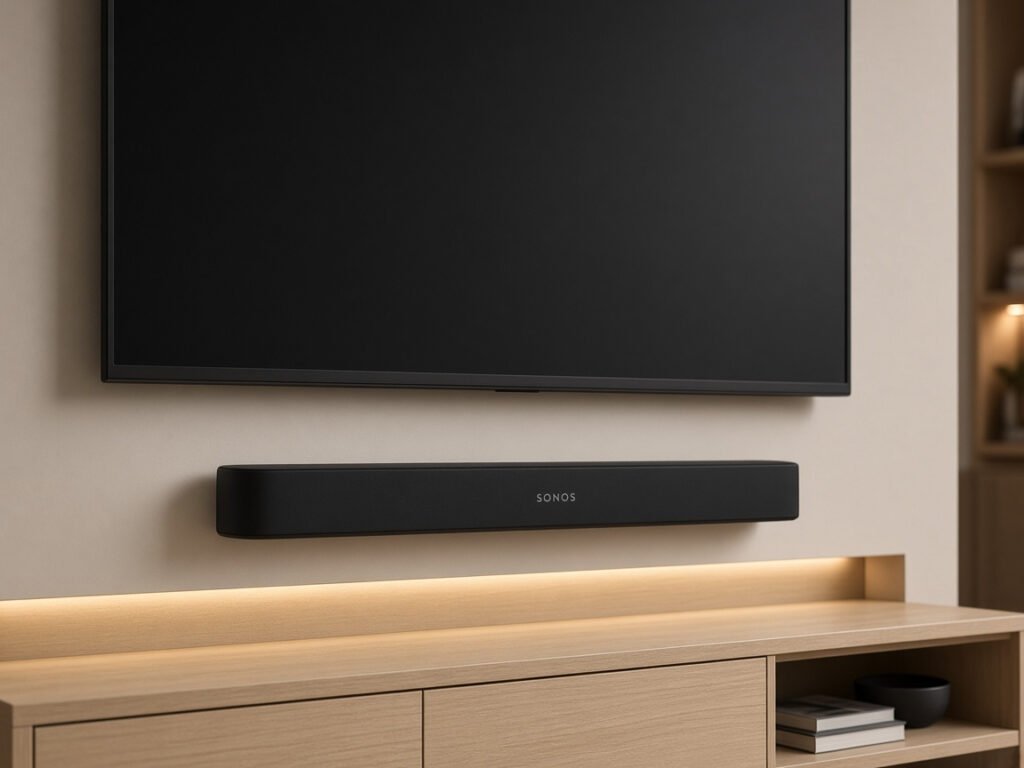
The Vizio 2.1 all-in-one soundbar is worth buying in 2026 for small-to-medium rooms. It delivers a clear improvement over TV speaker quality, with Dolby Audio and DTS Virtual:X built in. Buyers expecting separate-subwoofer bass will be disappointed by what an integrated enclosure can physically produce.
Executive Summary
- All-in-one architecture: Bass drivers and passive radiators are built directly into the soundbar chassis. No separate wireless subwoofer is required or supported on this model.
- Codec support: According to Vizio’s published specifications for the V21x-J8, the bar decodes Dolby Audio and DTS Virtual:X. Dolby Atmos and DTS:X are not supported.
- Low-frequency trade-off: Owner reviews consistently describe strong mid-bass impact in the 80–200 Hz range, but limited extension below 80 Hz — a direct consequence of cabinet volume constraints in the compact chassis.
- Best-fit scenario: Apartments, bedrooms, and secondary viewing spaces where a compact, single-unit solution matters more than deep sub-bass or Atmos certification.
What Is the Vizio 2.1 All-In-One Soundbar?
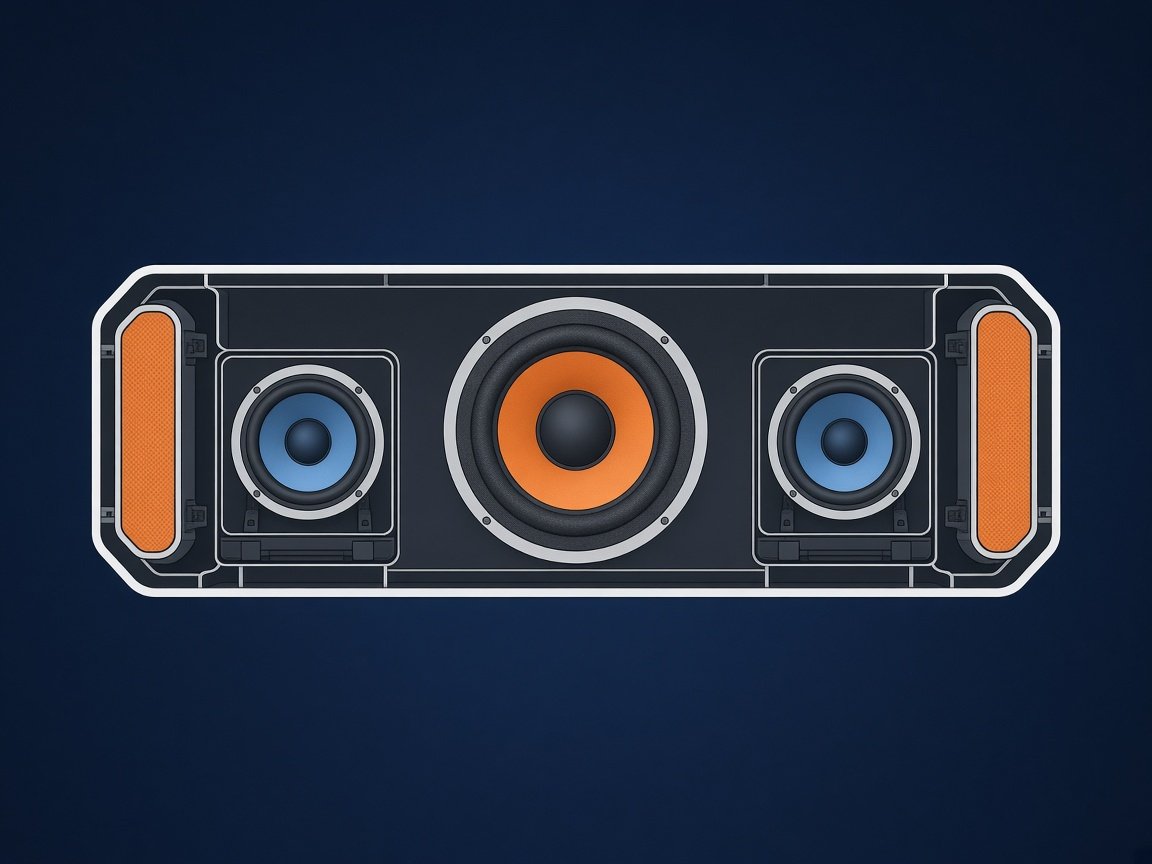
The “2.1” designation defines a channel architecture: two main audio channels (left and right stereo) plus one dedicated bass channel. What makes the Vizio V-Series 2.1 soundbar technically distinct is the “all-in-one” configuration. The bass driver is housed inside the same chassis as the full-range drivers. There is no separate wireless enclosure to place elsewhere in the room.
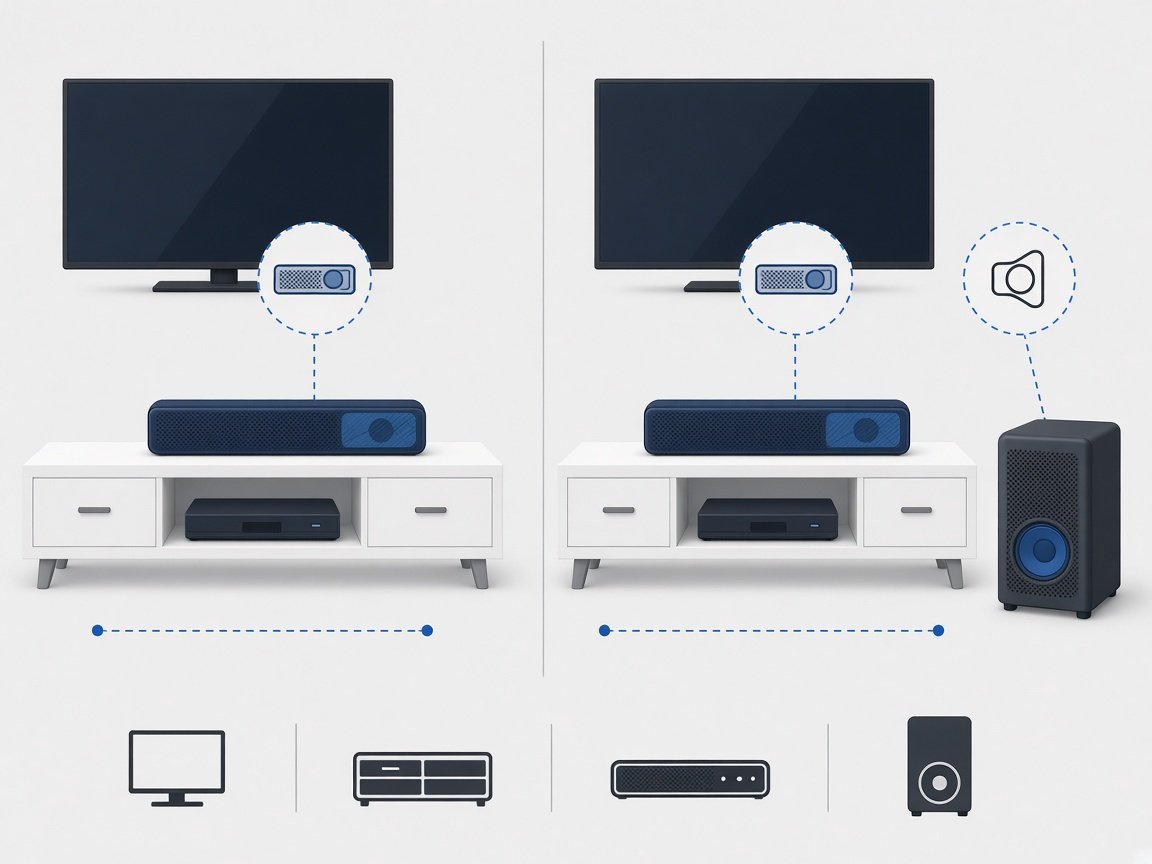
This design contrasts with the more common 2.1 approach used by most competing brands. The full range of Vizio soundbars across current price tiers includes both separate-subwoofer and all-in-one configurations, serving buyers with different room constraints. The all-in-one variant trades acoustic flexibility for a single-unit form factor that fits neatly under virtually any display — without secondary placement decisions, extra power cables, or Bluetooth subwoofer sync to manage on first setup.
The V21x-J8 is the primary production model in this lineup. According to Vizio’s published specifications, it measures 36 inches wide. That is wide enough to track the stereo image across a standard 55-inch display. It is also narrow enough to sit flush on most TV stands. The design targets the buyer who would otherwise use TV speakers alone — offering a low-commitment audio upgrade without demanding shelf space or rewiring.
How Does the Integrated Bass Design Work?
The acoustic engineering challenge of any all-in-one 2.1 soundbar is straightforward to state and difficult to solve well. Low-frequency reproduction requires large cabinet volumes and substantial driver excursion to generate meaningful air displacement. A compact soundbar chassis imposes strict physical constraints on both.
Vizio addresses this through dedicated bass drivers combined with passive radiators built into the bar’s enclosure. Passive radiators are driver-shaped components without their own voice coil or motor. They move in response to pressure changes created by the active drivers inside the cabinet, effectively extending the apparent bass response without additional amplification or a larger active driver. This technique is well-established across premium portable speakers and compact soundbar designs.
The practical outcome is a bass response that owner reviews consistently describe as defined and punchy in the 80–200 Hz range. This covers kick drums, male vocals, and dialogue weight adequately. However, the bar trails dedicated separate subwoofers on sub-80 Hz content — the frequencies responsible for physical room pressure during LFE-heavy film scenes. DTS Virtual:X processing broadens the perceived soundstage by upmixing two-channel audio into a wider psychoacoustic envelope, partially compensating for depth limitations at the listening position.
Key Specifications at a Glance
The following specifications are drawn from Vizio’s published product information for the V21x-J8. Vizio refreshes its V-Series lineup periodically. Buyers should verify current model availability and specification revisions before purchase.
| Specification | Detail |
|---|---|
| Model | V21x-J8 (V-Series 2.1 All-In-One Sound Bar) |
| Channel Configuration | 2.1 — integrated bass drivers, no separate subwoofer |
| Width | 36 inches |
| Maximum SPL | 101 dB |
| Audio Decoding | Dolby Audio, DTS Virtual:X |
| Dolby Atmos | Not supported |
| DTS:X | Not supported |
| Bluetooth | Yes — Bluetooth 5.0 |
| HDMI | 1× ARC (not eARC) |
| Optical Digital Audio | 1× Toslink input |
| USB | Yes — Type-A port |
| Finish | Matte black |
| Remote Control | Included |
Dialogue Clarity and Movie Performance
DTS Virtual:X is Vizio’s primary tool for soundstage expansion on this bar. It analyzes incoming audio — whether Dolby Digital, DTS, or standard stereo PCM — and applies psychoacoustic cues to simulate a wider, more enveloping field. Performance varies by source material. Film mixes with clearly separated 5.1 channel information benefit more than highly compressed streaming audio running at lower bitrates.
For dialogue intelligibility, the 2.1 all-in-one’s center channel simulation is a meaningful upgrade over typical TV speakers. Built-in TV drivers push dialogue, music, and sound effects through the same small transducer array with no channel separation. Owner reviews on major retail platforms describe dialogue clarity as consistently strong at standard living-room volumes, with less frequency masking during busy action sequences than thin TV speakers produce.
The 36-inch physical width provides adequate left-right driver separation for a credible stereo image alongside a TV in the 55–65-inch range. At wider screen sizes — 75 inches and beyond — the stereo image can feel narrower relative to the display. This is a physical limitation of any soundbar shorter than the screen it supports, not a Vizio-specific shortcoming. Dolby Audio decoding ensures full compatibility with the compressed 5.1 Dolby Digital streams delivered by most streaming services and broadcast channels, though the bar collapses those channels to 2.1 output rather than distributing to discrete rear speakers.
Low-Frequency Performance: What the Built-In Bass Actually Delivers
This is the most technically consequential distinction between the Vizio 2.1 all-in-one and soundbars that ship with a separate wireless subwoofer. Cabinet volume is the governing acoustic constraint. A standalone subwoofer enclosure — even a compact one — can provide several liters of internal volume. That gives its driver room to generate substantial air movement at frequencies from roughly 25–30 Hz upward. The soundbar’s integrated enclosure is far smaller.
Owner reviews across multiple retail platforms consistently describe the integrated bass as “punchy” and “impactful” for music and standard film content. The most noticeable performance sits in the 80–200 Hz range. Reports of significant extension below 60 Hz — the range that creates physical room pressure during LFE-heavy action sequences — are sparse. This is acoustically expected behavior. Passive radiator designs and constrained cabinet volumes set a predictable ceiling on low-frequency extension depth.
For buyers who want deeper bass from the Vizio ecosystem without stepping up to a full surround system, pairing a Vizio soundbar with a dedicated wireless subwoofer adds the low-frequency extension the all-in-one design cannot replicate. That approach adds a second unit to place and power, but delivers meaningfully deeper and louder sub-bass performance for home theater environments where LFE impact matters.
Connectivity and Input Options
According to Vizio’s published specifications, the V21x-J8 connects to source devices via three primary paths. HDMI ARC is the preferred connection for modern TV setups. It carries both audio and CEC control signals over a single cable, allowing the soundbar to respond to TV remote volume commands. The V21x-J8 supports ARC rather than eARC — meaning it cannot receive lossless formats such as Dolby TrueHD or DTS-HD Master Audio, which require eARC bandwidth. For standard Dolby Digital 5.1 and DTS streams from streaming services and broadcast television, ARC is fully sufficient.
The optical digital audio (Toslink) input provides a fallback for older televisions without HDMI ARC. Bluetooth 5.0 enables wireless streaming from smartphones, tablets, and laptops without TV involvement. The USB Type-A port supports firmware updates and direct audio playback from compatible USB storage devices on supported configurations.
Setting up the bar for optimal performance involves four steps in sequence:
- Connect via HDMI ARC if your TV supports it — this carries both audio and CEC volume control over one cable.
- Center the bar under or directly in front of the display, flush with the cabinet edge.
- Select an appropriate sound mode (Movie or Music) via the included remote to match your content type.
- Enable DTS Virtual:X processing for surround-encoded streaming content to maximize perceived soundstage width.
There is no Wi-Fi, no AirPlay 2, no Chromecast built-in, and no voice assistant integration. The bar is a passive audio output device rather than a network-connected media hub. Buyers expecting Spotify Connect, multi-room audio grouping, or app-based control must source those functions from the connected TV or a separate streaming device.
Vizio 2.1 All-In-One vs. The Competition
At the budget-to-mid soundbar tier, the Vizio 2.1 all-in-one competes against both other all-in-one designs and 2.1 bars that use a separate wireless subwoofer. The key differentiators are form factor, bass architecture, and codec support. Specifications in the comparison below are drawn from each manufacturer’s published product information.
| Soundbar | Channels | Subwoofer Type | Atmos / DTS:X | HDMI | Wireless Audio |
|---|---|---|---|---|---|
| Vizio V21x-J8 | 2.1 | Integrated (AIO) | No / No | ARC | Bluetooth 5.0 |
| Samsung HW-C400 | 2.0 | None | No / No | ARC | Bluetooth |
| LG S40Q | 2.1 | Separate wireless | No / No | ARC | Bluetooth |
| Polk Audio Signa S2 | 2.1 | Separate wireless | No / No | ARC | Bluetooth |
| Sonos Ray | 2.0 | None (optional add-on) | No / No | ARC | Wi-Fi (no Bluetooth) |
Competitor model availability is subject to change. Specifications reflect manufacturer-published data for models listed; verify current variants at time of purchase.
The LG S40Q and Polk Audio Signa S2 represent the primary competition for buyers weighing integrated bass against a separate subwoofer at a similar price tier. LG’s soundbar and wireless subwoofer pairings generally deliver deeper low-frequency extension for similar spend — but add the footprint and placement consideration of a second unit. For buyers who explicitly want to avoid a floor-standing subwoofer, the Vizio all-in-one is one of the few 2.1-rated options at this price point.
The Sonos Ray occupies a different market position entirely. It is a pure 2.0 bar with no bass channel, relying on Wi-Fi ecosystem integration and an optional separate sub for low-end. Its strengths are network audio and multi-room capability — categories the Vizio 2.1 AIO does not compete in. At a significantly higher price point, it makes sense for Sonos ecosystem buyers, not for buyers evaluating budget-tier TV audio upgrades.
Who Should Buy This Soundbar — and Who Shouldn’t?
The Vizio 2.1 all-in-one fits specific use cases precisely and others poorly. Understanding which category your setup falls into is worth more time than any specification comparison.
Well-matched buyers: renters or apartment dwellers with limited floor space; secondary-room setups in a bedroom, home office, or kitchen; displays in the 40–55-inch range; anyone who wants a zero-configuration audio upgrade with one power cable and no secondary Bluetooth sync; buyers whose content diet is primarily streaming TV, news, and dialogue-heavy programming.
As an illustrative example: consider a one-bedroom apartment with a 55-inch TV in a living area of roughly 250 square feet. The Vizio 2.1 all-in-one would sit flush under the TV, improve dramatically on built-in TV speakers for streaming, and require zero floor space for a subwoofer. That is the scenario this product is designed to solve.
Buyers who should consider alternatives: primary home theater setups in rooms larger than roughly 350 square feet; anyone who watches action films or plays games regularly at high volume; buyers who want Dolby Atmos object-based decoding; anyone who wants discrete surround channels from real rear speakers. For that last group, Vizio’s 5.1 system configurations add surround satellites and a full-size wireless subwoofer for a substantially more complete home theater architecture — at higher cost and larger footprint.
The honest framing: this soundbar solves the “TV speakers are inadequate” problem cleanly and cheaply. It is not positioned to replicate a discrete multi-speaker home theater system. Those are genuinely different product categories, and the Vizio 2.1 all-in-one excels at the former.
Known Limitations Worth Understanding Before Buying
No Dolby Atmos or DTS:X. The V21x-J8 does not decode object-based audio formats. Atmos-encoded content from Netflix, Disney+, Apple TV+, and other streaming platforms is downmixed to standard Dolby Digital before playback. For buyers who want certified Atmos processing, dedicated Dolby Atmos soundbars at mid-tier pricing offer either physical height drivers or software Atmos upmixing with certified decoding — a meaningfully different listening experience on Atmos-sourced content.
No eARC. The absence of HDMI eARC means lossless multi-channel formats — Dolby TrueHD and DTS-HD Master Audio from Blu-ray players or media servers — cannot pass through in their native form. For compressed Dolby Digital and DTS streams from streaming and broadcast sources, HDMI ARC is entirely adequate. This limitation only matters to buyers with a Blu-ray or disc-based source chain.
No network connectivity. There is no Wi-Fi, AirPlay 2, Chromecast built-in, or voice assistant. All networked audio functions must be handled by the connected TV or upstream device. Buyers expecting a network-connected soundbar should evaluate alternatives in the mid-price tier.
Constrained deep-bass extension. The integrated bass architecture is physically limited by the cabinet volume available inside the soundbar chassis. This is a category-level constraint, not a manufacturing defect. Buyers who have experienced a dedicated subwoofer setup will notice the difference on low-frequency-intensive content.
Is the Vizio 2.1 All-In-One Soundbar Worth Buying in 2026?
At its price point and within its defined use cases, the Vizio 2.1 all-in-one soundbar is worth buying in 2026. It delivers a clear improvement over TV speaker output. It requires no secondary hardware. And it covers the codec landscape for standard streaming and broadcast content — which represents the majority of real-world viewing hours for most households.
The market has not produced a compelling all-in-one alternative at this price tier that significantly outperforms it on bass depth. The acoustic physics governing driver excursion and cabinet volume apply equally to all competing all-in-one designs. Buyers choosing between the Vizio and a similarly priced all-in-one competitor should evaluate connectivity features and room matching rather than expecting one brand’s integrated bass to substantially outperform another’s.
What has shifted in 2026 is the streaming content landscape. More library titles now arrive in Dolby Atmos than in prior years. Atmos is increasingly the default audio track on major streaming platforms. If Atmos processing matters for your primary viewing setup, the Vizio 2.1 AIO is the wrong tool — it will downmix those tracks. For buyers watching primarily non-Atmos content, or equipping a secondary room rather than a primary home theater, it remains a rational, well-priced choice with no meaningful single-unit competitor at its price tier.
Looking ahead to 2027–2028: Atmos decoding is migrating down the price curve across all major brands. It is reasonable to expect that the budget all-in-one soundbar category — currently Atmos-free — will see Atmos-capable all-in-one designs emerge at comparable price points within the next product generation. Buyers who are Atmos-focused and can wait should monitor that category. For current-year buyers in the target use case, the Vizio 2.1 all-in-one remains the strongest all-in-one option at its tier.
Buy if: you want a compact, single-unit TV audio upgrade for a small-to-medium room with no floor space for a subwoofer, primarily watching streaming TV and standard film content.
Skip if: you want Dolby Atmos decoding, deep sub-bass impact below 80 Hz, network audio integration, eARC lossless passthrough, or are equipping a room larger than roughly 350 square feet.
Frequently Asked Questions
Does the Vizio 2.1 all-in-one soundbar support Dolby Atmos?
No. According to Vizio’s published specifications, the V21x-J8 decodes Dolby Audio and DTS Virtual:X but does not support Dolby Atmos or DTS:X. Atmos-encoded content from streaming platforms is downmixed to standard Dolby Digital output before playback.
Can I add a separate subwoofer to the Vizio 2.1 all-in-one?
No. The V21x-J8 does not include a subwoofer output jack or a Vizio wireless subwoofer pairing capability. It is a fixed all-in-one configuration. If you want expandable bass from the Vizio ecosystem, the separate-subwoofer V-Series and M-Series models are designed for that purpose.
What is the difference between the Vizio 2.1 all-in-one and a Vizio soundbar that ships with a wireless subwoofer?
The all-in-one integrates its bass drivers inside the soundbar chassis, limiting cabinet volume and deep-bass extension. Models that include a wireless subwoofer use a separate floor-standing enclosure with a larger driver and significantly greater cabinet volume. That produces deeper and louder low-frequency output. The tradeoff is placement complexity and a second power cable versus the all-in-one’s single-unit simplicity.
Does the Vizio 2.1 all-in-one work with any TV?
Yes, via optical digital audio input (Toslink), which is present on virtually all modern and older televisions. HDMI ARC connectivity requires a TV with an ARC-labeled HDMI port, which is standard on most televisions manufactured in the past several years. Bluetooth 5.0 enables wireless device pairing regardless of TV connectivity type.
How large a room is the Vizio 2.1 all-in-one suited for?
Owner reviews and the bar’s rated 101 dB maximum SPL (from Vizio’s specifications) suggest adequate performance in rooms up to approximately 300–400 square feet at normal listening volumes. Beyond that, the integrated bass system produces diminishing returns as room volume increases and the bar’s output capacity becomes a constraint relative to the acoustic space.
Does the Vizio 2.1 all-in-one support HDMI eARC?
No. The V21x-J8 supports HDMI ARC, not eARC. This means it cannot receive lossless audio formats such as Dolby TrueHD or DTS-HD Master Audio, which require eARC bandwidth. For standard Dolby Digital and DTS content from streaming services and broadcast channels — the dominant audio format for most households — HDMI ARC is fully sufficient.
Does Vizio make an all-in-one soundbar with Dolby Atmos?
At the time of publication, Vizio’s Atmos-certified soundbars pair with separate wireless subwoofers and in some configurations include rear satellite speakers. The V-Series all-in-one design does not support Dolby Atmos decoding. Buyers prioritizing Atmos should evaluate Vizio’s higher-tier models or competing brands with Atmos-capable bars in the mid-price tier.
Final Verdict
The Vizio 2.1 all-in-one soundbar occupies a specific and defensible niche: the simplest possible upgrade from TV speakers, in a single chassis, at a budget-tier price. It delivers on that positioning with competent Dolby Audio and DTS Virtual:X decoding, adequate stereo imaging across a standard 55-inch display, and bass presence that owner reviews describe as improved but physically constrained compared to dedicated subwoofer designs.
For buyers equipping a primary home theater space where bass performance is a priority, the acoustic limitations of the all-in-one architecture make a separate-subwoofer design the more capable choice. For secondary rooms, apartments, and buyers who have ruled out floor-standing subwoofers as a constraint, the Vizio 2.1 all-in-one is a coherent solution. It does what it advertises without asking for shelf space, secondary Bluetooth sync, or a second power outlet.
The absence of Dolby Atmos decoding is the most significant functional limitation in 2026. It is not a dealbreaker for most buyers at this price point, but worth acknowledging clearly given how widely Atmos is now distributed across streaming platforms. Know your content diet before you buy.
— **Schema Markup (shown separately for reference):** Embedded above as a `