
Sony’s passive CS-series bookshelf and floor-standing speakers share a 6Ω impedance standard that makes receiver matching predictable across all channel positions. The range covers the most technically consistent home theater speakers available from Sony, running from the three-way SS-CS5 bookshelf and SS-CS3 floor-stander through the timbre-matched SS-CS8 center channel, the SA-CS9 active subwoofer, and the fully wireless HT-A9 four-speaker array. This guide compares each model across six technical criteria — driver configuration, frequency response, nominal impedance, sensitivity, power handling, and ecosystem compatibility — and ranks them by technical merit and practical fit in a home theater context.
- Best overall passive speaker: Sony SS-CS5, rated at 53 Hz – 50,000 Hz, 6Ω nominal impedance, 87 dB sensitivity, three-way driver topology per Sony product specifications — the entry point for any CS-series home theater build.
- Best floor-standing option: Sony SS-CS3, dual-woofer three-way design rated to 35 Hz with 88 dB sensitivity — reduces subwoofer dependency in smaller to medium rooms more than the SS-CS5’s 53 Hz floor.
- Best active system: Sony HT-A9, four-speaker wireless array with 360 Spatial Sound Mapping, Dolby Atmos/DTS:X decoding, and no external receiver requirement.
- Key compatibility factor: All passive CS-series models share 6Ω nominal impedance and closely matched sensitivity ratings (87–88 dB), keeping receiver channel assignment uniform across a full 5.1 or 7.1 configuration.
What Makes Sony’s CS-Series Technically Distinct From Two-Way Competitors?
The defining technical feature of Sony’s passive CS-series is a three-way driver architecture with a dedicated 0.75-inch super tweeter operating above the main tweeter’s range. Most bookshelf and floor-standing speakers at comparable price points use two-way designs — a woofer paired with a single tweeter that must cover everything from the crossover point to the top of the audible band. That places the main tweeter’s operational bandwidth under compression at high frequencies, where it simultaneously handles both upper midrange and the highest octaves.
Sony’s CS-series dedicates a separate driver to the high-frequency extension above the main tweeter’s optimum operating range. The super tweeter extends the frequency ceiling to 50,000 Hz across all three passive CS-series models. This matters for Hi-Res Audio sources — FLAC files and lossless recordings carrying content above 20,000 Hz — and theoretically reduces intermodulation distortion in the top octaves by narrowing each driver’s operational bandwidth, since neither tweeter is asked to cover the full high-frequency range alone.
The woofer cones across the full CS-series line use Sony’s mica-reinforced cellular (MRC) material. Sony describes MRC as a composite chosen for its stiffness-to-mass ratio, stating it improves transient response relative to conventional paper cones at equivalent weight. Because the same MRC driver material and crossover philosophy carry across the SS-CS5, SS-CS3, and SS-CS8, timbre consistency in a full CS-series surround configuration is a designed characteristic. This is the structural basis for using CS-series speakers as a matched set across all channel positions — including front L/R, center, and surround channels in a 5.1 or 7.1 layout.
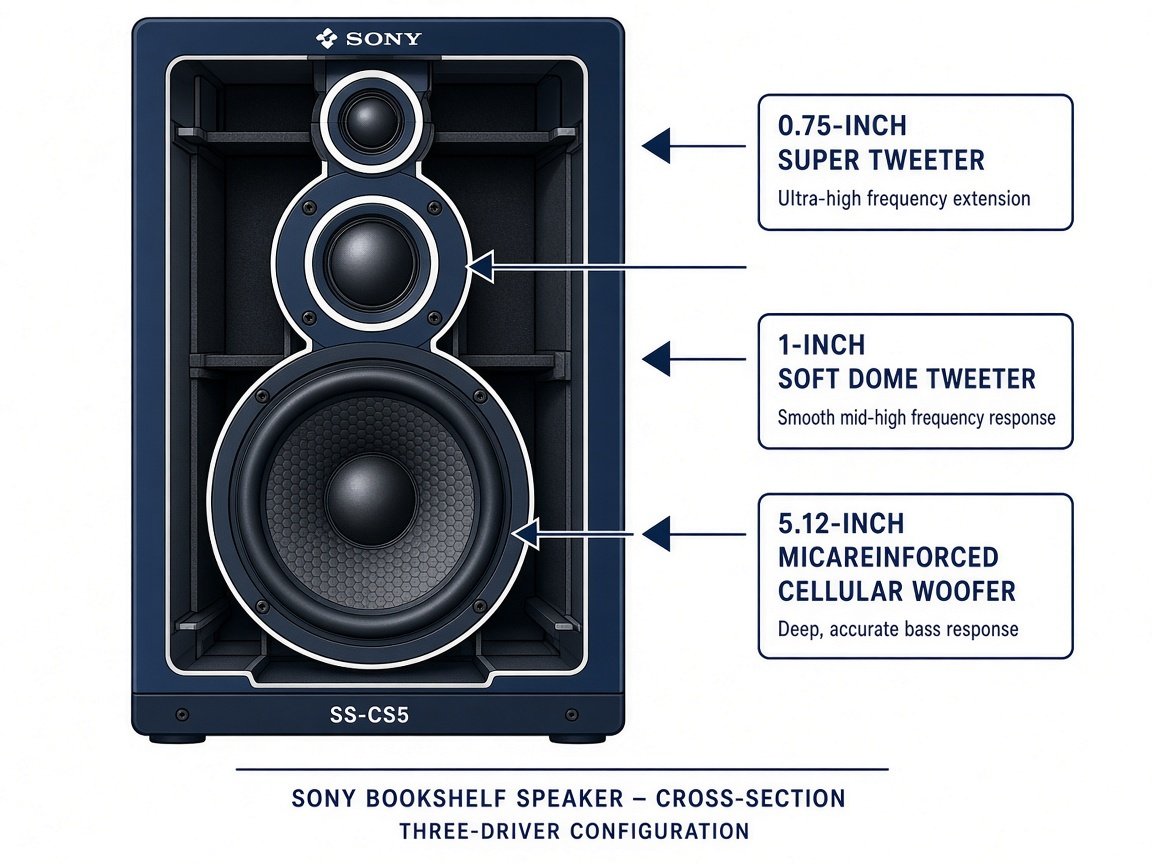
Sony SS-CS5: Does a Three-Way Bookshelf Speaker Justify Its Position as the Default CS-Series Choice?
The SS-CS5 is Sony’s primary passive bookshelf speaker and the standard entry point for a CS-series home theater build. According to Sony’s product specifications, it uses a 5.12-inch MRC woofer, a 1-inch soft dome tweeter, and a 0.75-inch super tweeter in a three-way, three-driver configuration. Frequency response is rated at 53 Hz – 50,000 Hz. Nominal impedance is 6Ω, sensitivity is 87 dB (1W/1m), and maximum power handling is rated at 100W.
The 53 Hz lower limit positions the SS-CS5 for use with a subwoofer crossing over in the 60–80 Hz range — the standard LFE configuration on most AV receivers in the mid-range category. At 87 dB sensitivity, an amplifier channel rated at 20W is sufficient to reach moderate listening levels in a typical room. The 100W maximum power handling provides headroom for dynamic transients in film soundtracks. These figures are compatible with the channel output specifications of AV receivers rated for 6–8Ω loads across all channel positions.
The dedicated super tweeter means high-frequency reproduction does not compete with the main tweeter’s operating bandwidth — the most direct technical distinction from two-way designs in the same category. Owner reviews, aggregated across major retail platforms, consistently identify the midrange as the SS-CS5’s strongest range, with the super tweeter contributing detail resolution in the upper octaves rather than adding brightness. Its physical footprint supports bookshelf mounting, stand placement, or wall-bracket installation, covering front L/R, surround, and height channel positions in a 5.1, 5.1.4, or 7.1 configuration.
Sony SS-CS3: When Does a Floor-Standing Speaker Justify the Footprint?
The SS-CS3 is Sony’s floor-standing option in the CS series. It uses four drivers in a three-way configuration: two 5.12-inch MRC woofers operating in tandem, a 1-inch tweeter, and the same 0.75-inch super tweeter topology carried from the SS-CS5. Sony rates the frequency response at 35 Hz – 50,000 Hz — an 18 Hz extension below the SS-CS5’s lower limit. That difference is audible in bass-heavy film soundtracks and music where low-frequency energy extends below 50 Hz.
The dual-woofer arrangement provides greater cone area than the SS-CS5’s single woofer, capable of moving more air at low frequencies under equivalent power conditions. Nominal impedance remains at 6Ω; sensitivity rises to 88 dB — one dB above the SS-CS5. Sony rates maximum power handling at 145W. The floor-standing enclosure positions the tweeter at approximately ear height for a seated listener without stands, maintaining the correct vertical dispersion axis without additional hardware or speaker stands.
Owner reviews consistently describe a configuration using SS-CS3 for front L/R and SS-CS5 for surround and height positions as the most common CS-series mixed build — consistent timbre across all channels follows from the shared MRC driver material and crossover philosophy. For builds where subwoofer integration remains a priority regardless of front speaker choice, our coverage of the best bass speakers for home theater covers dedicated low-frequency options that complement the CS-series front stage effectively.
Sony SS-CS8 and SA-CS9: Center Channel and Subwoofer Options for a Complete CS-Series Build
The SS-CS8 is Sony’s dedicated center channel speaker for the CS series. Sony rates it at 90 Hz – 50,000 Hz — beginning higher than the bookshelf and floor-standing models because the center channel in a standard home theater configuration crosses over to a subwoofer below 80–100 Hz, making deep bass extension in the center position structurally redundant. The horizontal enclosure houses two 5.12-inch MRC drivers flanking a 1-inch tweeter and 0.75-inch super tweeter. Sensitivity is 87 dB, impedance is 6Ω — electrically identical to the SS-CS5 — keeping the front soundstage uniform at the receiver’s amplifier stage.
The horizontal driver arrangement provides broader horizontal dispersion than a single-woofer design, supporting off-axis intelligibility across a wider seating area. This is relevant in home theater environments with multiple seating positions separated by a wide angle from the display. Owner reviews across multiple platforms consistently identify film dialogue clarity as the SS-CS8’s principal contribution, with the matched MRC driver material ensuring voice frequencies transition cleanly between the center and front L/R channels without audible tonal step changes.
The SA-CS9 is Sony’s active powered subwoofer for the CS-series line. According to Sony’s product specifications, it uses a 10-inch woofer driven by Sony’s S-Master digital amplifier at 115W. It routes from the LFE (.1) output of a compatible AV receiver, handling low-frequency reproduction below the main channel crossover point independently. The rear panel includes a volume control, crossover frequency adjustment, and phase switch — the standard adjustment set for integrating a subwoofer to a specific room and receiver combination. The SA-CS9 completes a full 5.1 CS-series passive configuration: SS-CS3 or SS-CS5 for front L/R, SS-CS8 for center, SS-CS5 for surround positions, and SA-CS9 for LFE channel coverage.
Sony Speaker Specifications Compared: What Do the Numbers Show?
The table below summarizes key manufacturer-rated specifications for Sony’s current speaker models covered in this guide. All passive CS-series data is sourced from Sony’s official product specifications. Active and wireless system entries note where traditional passive specifications are not applicable — these models contain internal amplification rather than relying on a separate receiver or amplifier channel.
| Model | Type | Frequency Response | Impedance | Sensitivity | Max Power |
|---|---|---|---|---|---|
| SS-CS5 | 3-way Bookshelf | 53 – 50,000 Hz | 6Ω | 87 dB | 100W |
| SS-CS3 | 3-way Floor-Standing | 35 – 50,000 Hz | 6Ω | 88 dB | 145W |
| SS-CS8 | Center Channel | 90 – 50,000 Hz | 6Ω | 87 dB | — |
| SA-CS9 | Active Subwoofer | — | N/A (active) | N/A (active) | 115W |
| HT-A9 | Wireless 4-Speaker System | — | N/A (active) | N/A (active) | N/A (active) |
| SA-RS5 | Wireless Rear Surround (pair) | — | N/A (active) | N/A (active) | N/A (active) |
| SRS-RA5000 | Wireless Home Speaker | — | N/A (active) | N/A (active) | N/A (active) |
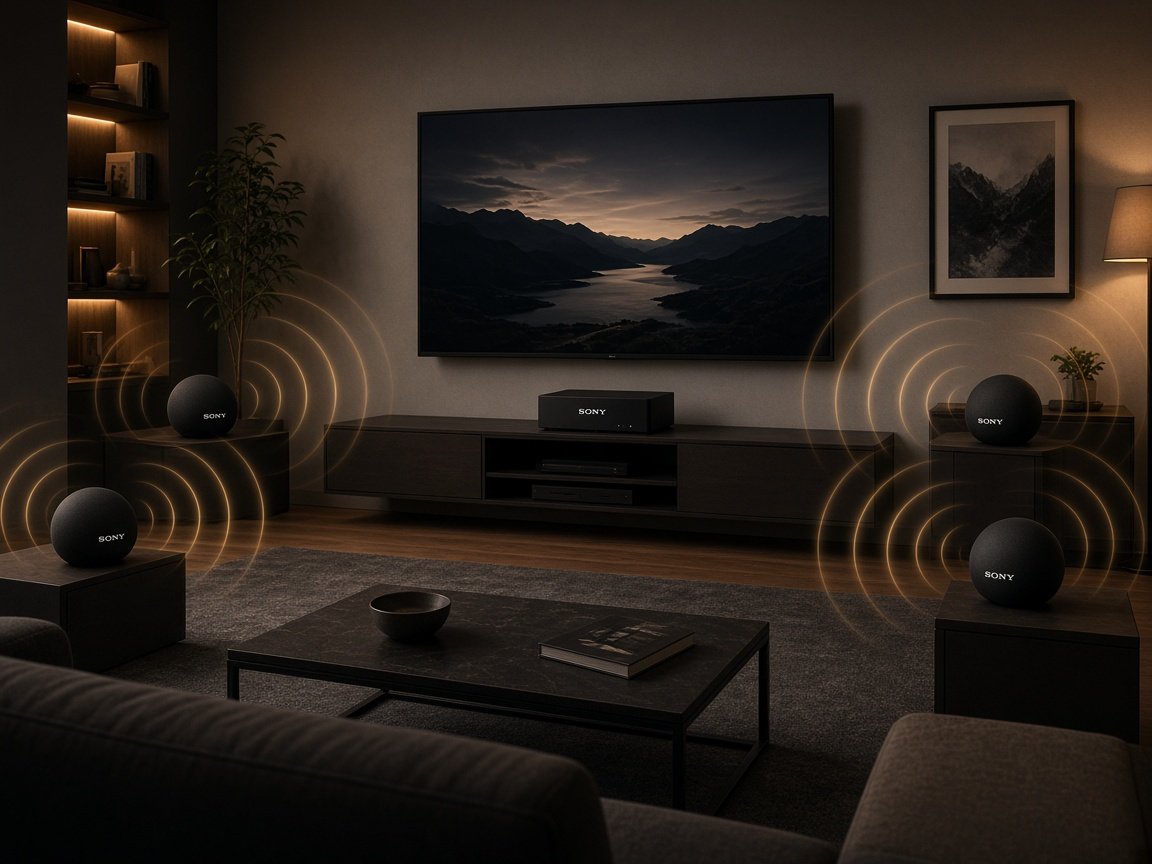
Sony HT-A9: What Does Active Wireless Spatial Audio Deliver Over a Passive System?
The HT-A9 is Sony’s most technically advanced home theater speaker product — a four-speaker, fully wireless active array built around Sony’s 360 Spatial Sound Mapping (360SSM) processing. Rather than operating as a conventional discrete-channel system, the HT-A9 uses digital signal processing to synthesize virtual speaker positions from four physical units, targeting Dolby Atmos and DTS:X object-based audio content. This architecture allows the system to render spatial audio beyond the fixed channel count of a wired passive configuration.
Each speaker includes upward-angling drivers that interact with the ceiling for height channel simulation, eliminating the need for dedicated ceiling-mounted modules or Atmos-enabled speaker elements. The system connects to a source via HDMI eARC and supports Hi-Res Audio formats including FLAC. A built-in room calibration routine measures speaker positions acoustically and adjusts inter-speaker delay and channel amplitude based on the results. Owner reviews consistently report that running this calibration meaningfully improves imaging accuracy, particularly in irregular room shapes where reflective surfaces would otherwise introduce comb filtering effects in the synthesized spatial field.
The processing unit included with the HT-A9 handles Dolby Atmos and DTS:X decoding and 360SSM computation internally — no external processor or AV receiver is required. The tradeoff is upgrade modularity: a passive CS-series system allows component-level replacement and receiver upgrades; the HT-A9 is a closed ecosystem in which speaker performance and processing capability are fixed at the system level. For buyers evaluating Sony’s soundbar-with-subwoofer options as an alternative active configuration, our review of the best Sony soundbar with subwoofer covers those models in depth alongside their HT-A platform integrations.
SA-RS5 and SRS-RA5000: What Do Sony’s Wireless Expansion Options Add?
Sony SA-RS5: Wireless Rear Surround for HT-A Soundbar Systems
The SA-RS5 is a wireless rear surround speaker pair designed to extend Sony HT-A soundbar systems — including the HT-A7000, HT-A5000, and HT-A3000 — to a full discrete surround configuration. Without the SA-RS5, these soundbars render rear surround information through virtual processing rather than physical rear channel drivers. Adding the SA-RS5 introduces physical rear speaker positions, producing measurably different rear surround localization compared to virtual processing — owner reviews consistently characterize rear surround imaging as more precisely placed when the SA-RS5 is active.
Each SA-RS5 unit includes an upward-angling driver for height channel contribution. The pair connects via Sony’s proprietary HT-A wireless protocol to compatible soundbars and includes an internal battery for placement flexibility without requiring proximity to a wall outlet. The SA-RS5 is not compatible with the HT-A9, which manages rear surround through its own four-speaker array. For buyers evaluating Sony’s full range of multi-channel configurations, our guide to the best Sony surround sound systems compares the complete range of Sony multi-channel options available in 2026.
Sony SRS-RA5000: Wireless Home Speaker With Omnidirectional Sound
The SRS-RA5000 is Sony’s premium wireless home speaker using Sony’s Immersive Audio Enhancement technology. Rather than a home theater speaker in the conventional sense, it targets stereo music playback in domestic environments. Its driver array includes upward-angling tweeters designed to distribute audio across a room rather than project it from a single point source. Sony rates Hi-Res Audio support via Wi-Fi at up to 192kHz/24-bit, and the speaker supports Spotify Connect alongside other major streaming platforms.
The SRS-RA5000 operates as a standalone stereo unit and is not a component in a CS-series passive system or the HT-A active ecosystem. For buyers evaluating it in a home theater context, the fundamental distinction applies: the SRS-RA5000 is a music speaker; the CS-series and HT-A9 are home theater components. It does not carry passive speaker specifications — impedance, sensitivity, and channel power handling are not applicable in the same way as the CS-series passive line.
How to Build a Sony CS-Series 5.1 Home Theater System: Step-by-Step
A Sony CS-series 5.1 configuration uses five passive speakers — two front L/R, one center, two surrounds — plus an active subwoofer, all driven by an AV receiver. The uniform 6Ω impedance across the CS-series passive line simplifies receiver selection. The following steps outline the assembly sequence for a standard 5.1 build using Sony’s current CS-series lineup.
- Select front L/R speakers. Choose SS-CS3 floor-standers for medium to large rooms (35 Hz lower limit, 145W handling, 88 dB sensitivity), or SS-CS5 bookshelves for smaller rooms or stand-mount positions (53 Hz lower limit, 100W handling, 87 dB sensitivity).
- Add the center channel. Pair with the SS-CS8. Its MRC drivers and 6Ω impedance match the front L/R pair; its horizontal enclosure supports standard above- or below-screen placement. The matched driver material preserves tonal coherence across the full front soundstage.
- Select surround speakers. SS-CS5 bookshelves cover side-surround and rear-surround positions. Their matched sensitivity (87 dB) and impedance (6Ω) to the front channels keep receiver channel output consistent across all five positions.
- Add the subwoofer. Connect the SA-CS9 to the receiver’s LFE output. Set the receiver’s bass management to route frequencies below 80 Hz to the SA-CS9 — the standard THX crossover point. Adjust the SA-CS9’s volume control and crossover frequency dial to match room acoustics and listening level preference.
- Select a compatible AV receiver. Any AV receiver rated for 6Ω or 6–8Ω loads across all channels is compatible with the CS-series passive line. Receiver selection determines available audio formats, channel count, and room calibration capability — our guide to the best AV receivers for home theater covers current options across mid-range and high-end categories.
- Run room correction. Use the receiver’s automatic acoustic calibration routine — such as Audyssey, YPAO, or AccuEQ depending on the receiver brand — to set speaker distances, channel levels, and crossover frequencies based on measured acoustic conditions. This step has the single largest impact on overall system performance, particularly in rooms with irregular geometry or reflective surfaces.
Which Sony Speaker Configuration Fits Your Room and Use Case?
Sony’s current speaker lineup covers four distinct system architectures. Each has a different receiver requirement, installation complexity, and performance profile. The choice between them is primarily architectural — passive versus active — rather than a question of Sony speaker quality within either architecture.
| Use Case | Recommended Configuration | Receiver Required? | Key Technical Consideration |
|---|---|---|---|
| Compact 5.1, small room | SS-CS5 (front L/R + surround) + SS-CS8 + SA-CS9 | Yes — 6Ω compatible | Front bass extension begins at 53 Hz; subwoofer is essential for full-range reproduction |
| Full 5.1, medium to large room | SS-CS3 (front L/R) + SS-CS5 (surround) + SS-CS8 + SA-CS9 | Yes — 6Ω compatible | Floor-standing footprint requires physical placement planning; dual-woofer front stage extends to 35 Hz |
| Dolby Atmos, no receiver | HT-A9 four-speaker wireless array | No (internal processing) | Closed ecosystem; no component-level upgrade path; most capable Sony spatial audio processing |
| Soundbar + discrete rear surround | HT-A soundbar + SA-RS5 pair | No (soundbar is the hub) | Requires compatible HT-A soundbar; not compatible with passive builds or non-HT-A Sony models |
For buyers comparing Sony’s integrated package offerings against building a CS-series system component by component, our review of the best Sony home theater systems covers complete Sony system packages alongside individual component options in the same evaluation framework, with breakdowns by room size and budget range.
What Does Sony’s Speaker Lineup Look Like in the Next 12 to 24 Months?
Sony’s speaker product strategy in 2026 shows two distinct trajectories. The passive CS-series has remained architecturally stable across several product cycles, suggesting Sony views the MRC driver and three-way topology as a mature platform. Future CS-series updates are more likely to focus on driver material refinement, enclosure resonance control, and sensitivity improvements rather than fundamental topology changes. The 6Ω impedance standard and three-way architecture are likely to remain the defining CS-series characteristics for the foreseeable update cycle.
The more dynamic area is Sony’s wireless and spatial audio ecosystem. The HT-A platform — connecting the HT-A9 four-speaker array, SA-RS5 wireless surrounds, and HT-A soundbars — represents Sony’s primary investment in wireless home theater architecture. Over the next 12–24 months, the most likely developments are expanded 360SSM processing capabilities, tighter integration with Sony’s BRAVIA XR display lineup for automatic audio calibration, and broader HDMI 2.1 and eARC compatibility across the HT-A device range. Sony has consistently developed the HT-A ecosystem as the flagship home theater platform rather than a supplement to its passive line.
Hi-Res Audio format support is another area of likely evolution. As lossless audio streaming becomes more widely available through major platforms, the demand for speakers capable of rendering above-20,000 Hz content will increase. Sony’s CS-series super tweeter topology is already positioned for this shift; the HT-A active line’s digital signal processing capabilities allow firmware-level updates to extend format support without hardware revision. Neither trajectory requires buyers to anticipate a new platform — the CS-series passive and HT-A active ecosystems are both current and stable investment choices in 2026.
Frequently Asked Questions About Sony Speakers
Are Sony CS-series speakers good for home theater use?
Yes. The CS-series uses a three-way driver topology with matched MRC woofer material across all models — SS-CS5, SS-CS3, and SS-CS8 — which produces timbre consistency in a full surround configuration. Their 6Ω nominal impedance is compatible with mid-range AV receivers, and their sensitivity ratings of 87–88 dB (per Sony product specifications) are sufficient for typical home theater listening levels without requiring high-power amplification.
What AV receiver is compatible with Sony CS-series speakers?
Any AV receiver rated for 6Ω or 6–8Ω loads across all channels is compatible with the full CS-series passive line. Sony’s CS-series speakers do not require a Sony-branded receiver. The 6Ω impedance standard is accepted by virtually all mid-range and upper-tier AV receiver brands — including Denon, Yamaha, Marantz, and Onkyo — without special configuration or impedance bridging.
Can I mix SS-CS5 bookshelves and SS-CS3 floor-standers in the same system?
Yes — this is the most common CS-series mixed configuration. SS-CS3 floor-standers serve as front L/R channels; SS-CS5 bookshelves cover surround and height positions. Because both models use the same MRC driver material and crossover philosophy, timbre remains consistent across all channel positions. The SS-CS3’s 88 dB sensitivity is one dB above the SS-CS5’s 87 dB, which requires a minor level trim at the receiver — most AV receivers handle this automatically via room calibration.
Do Sony SS-CS5 or SS-CS3 speakers need a subwoofer?
The SS-CS5 is rated to 53 Hz, which means it requires a subwoofer for full-range home theater reproduction — film soundtracks carry significant content below 50 Hz. The SS-CS3 is rated to 35 Hz, which reduces but does not eliminate subwoofer dependency in medium to large rooms. For home theater content with heavy bass, adding the SA-CS9 subwoofer is the recommended configuration for either model in a standard 5.1 build.
Is the Sony HT-A9 better than a traditional CS-series passive system?
It depends on the priority. The HT-A9 delivers Sony’s most advanced spatial audio processing via 360 Spatial Sound Mapping, requires no AV receiver, and handles Dolby Atmos object-based audio entirely in software. A CS-series passive system is more modular — components can be replaced or upgraded independently, and the receiver selection determines available audio formats and room calibration capabilities. Buyers who prioritize spatial audio sophistication over component flexibility should favour the HT-A9; buyers who prioritize system control and upgradability should build in the CS-series passive architecture.
Can the Sony SA-RS5 work with any soundbar?
No. The SA-RS5 uses Sony’s proprietary HT-A wireless protocol and is compatible only with Sony HT-A series soundbars — specifically the HT-A7000, HT-A5000, and HT-A3000. It is not compatible with passive speaker systems, non-HT-A Sony soundbars, or soundbars from other manufacturers.
What is the difference between the Sony SS-CS5 and SS-CS3?
The SS-CS5 is a bookshelf speaker with a single 5.12-inch MRC woofer, rated to 53 Hz, with 87 dB sensitivity and 100W maximum power handling. The SS-CS3 is a floor-standing speaker with two 5.12-inch MRC woofers, rated to 35 Hz, with 88 dB sensitivity and 145W maximum power handling. Both share the same 0.75-inch super tweeter topology and 6Ω nominal impedance per Sony’s product specifications. The SS-CS3 is a direct technical upgrade in bass extension and power handling; the floor-standing enclosure is the primary practical consideration for most room installations.
Conclusion: Which Sony Speaker Should You Build Around?
Sony’s current speaker lineup has a clear technical logic. The passive CS-series covers matched-timbre receiver-based builds from bookshelf to floor-standing configurations, with the SS-CS8 center channel and SA-CS9 subwoofer completing the low and center frequency management. The HT-A active ecosystem covers wireless spatial audio builds without receiver complexity. The right starting point depends on whether the build is passive or active, and what room size the system needs to serve.
For a passive build, the SS-CS5 is the technically correct entry point for most room sizes and channel positions. The SS-CS3 upgrades the front stage in medium to large rooms. The SS-CS8 completes the front soundstage with matched timbre. The SA-CS9 extends low-frequency support below the passive components’ operational floor. For buyers who want spatial audio processing without a receiver, the HT-A9 is Sony’s most capable home theater speaker product — with no passive alternative in Sony’s current lineup that matches its spatial audio processing architecture.
The uniform 6Ω impedance standard across the CS-series passive line is the most practically useful feature for buyers assembling a system incrementally. It means every component added to a CS-series build is electrically consistent from the first speaker purchase to the last. That predictability, combined with the matched MRC driver architecture across all channel positions, is what makes Sony’s CS-series a technically coherent home theater platform rather than a collection of individual products.
Recommended Next Steps
- Determine whether your build is passive (receiver-based) or active (wireless). This is the primary architectural decision — it determines every other component choice.
- For passive builds: start with SS-CS5 for front L/R and surround positions, add the SS-CS8 for center, and integrate the SA-CS9 for LFE channel coverage. All three components share 6Ω impedance and matched MRC driver material.
- For large-room passive builds: substitute SS-CS3 floor-standers for the front L/R pair to gain the 35 Hz bass extension and dual-woofer output capacity.
- For active builds: evaluate the HT-A9 as the primary system. Add SA-RS5 rear surrounds only if the source is a compatible HT-A soundbar rather than the HT-A9 four-speaker array itself.
- Select a compatible AV receiver rated for 6Ω loads if building a passive CS-series system — receiver selection determines audio format support, channel count, and room calibration capability.
- Run the receiver’s room calibration routine after installation. Automated calibration adjusts speaker distances, channel levels, and crossover frequencies based on measured acoustic conditions and delivers the single largest performance improvement available after hardware selection.