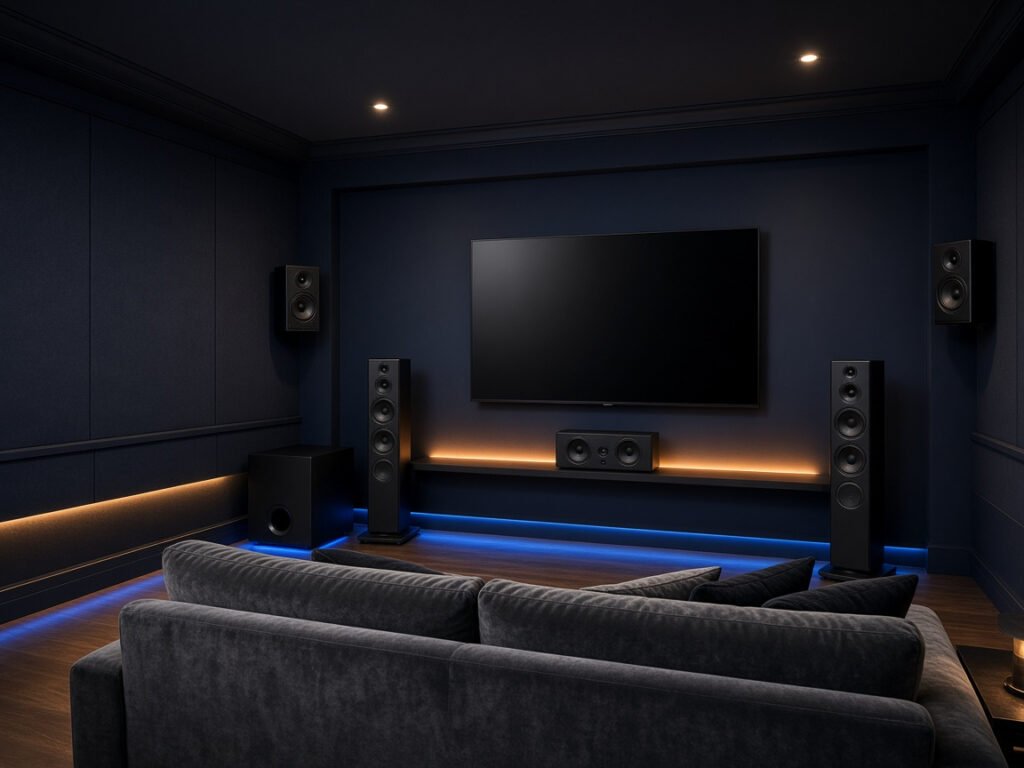
The best home sound system for most households is a 5.1-channel component setup — a dedicated AV receiver driving five passive speakers and one subwoofer. For space-constrained rooms or installations where a single HDMI cable to the television is the only practical wiring option, a premium soundbar with HDMI eARC is the strongest alternative. The right configuration depends on room volume, acoustic treatment, available speaker placement positions, and whether cinema immersion or stereo music fidelity is the primary use case. No single system wins across every room type; this guide ranks options category by category so the right match is unambiguous.
- 5.1 discrete component systems — a dedicated AV receiver driving five passive speakers and a subwoofer — deliver higher per-channel acoustic separation, greater dynamic range, and long-term component upgradability compared to equivalently priced all-in-one soundbars, based on manufacturer specifications and aggregated owner reviews.
- Dolby Atmos certification now spans all price tiers from $250 all-in-one packages to multi-thousand-dollar custom installs; the meaningful differentiator is height-channel implementation type, channel count, and object-processing quality — not Atmos certification alone.
- Room volume and speaker placement constraints are the most significant performance determinants; an under-powered or configuration-mismatched system cannot be corrected by EQ or room correction software regardless of brand or format support.
- Wi-Fi-based wireless audio ecosystems — Sonos, Denon HEOS, Yamaha MusicCast — maintain lossless codec support and reliable multi-room synchronization; Bluetooth’s bandwidth ceiling restricts it to lossy audio compression for most home theater applications.
What Home Sound System Configurations Are Available?
The home audio market organizes around six core configuration families. Each represents a different tradeoff between channel count, acoustic separation performance, installation complexity, and total cost. Identifying which category matches the room and use case is the prerequisite for meaningful product evaluation.
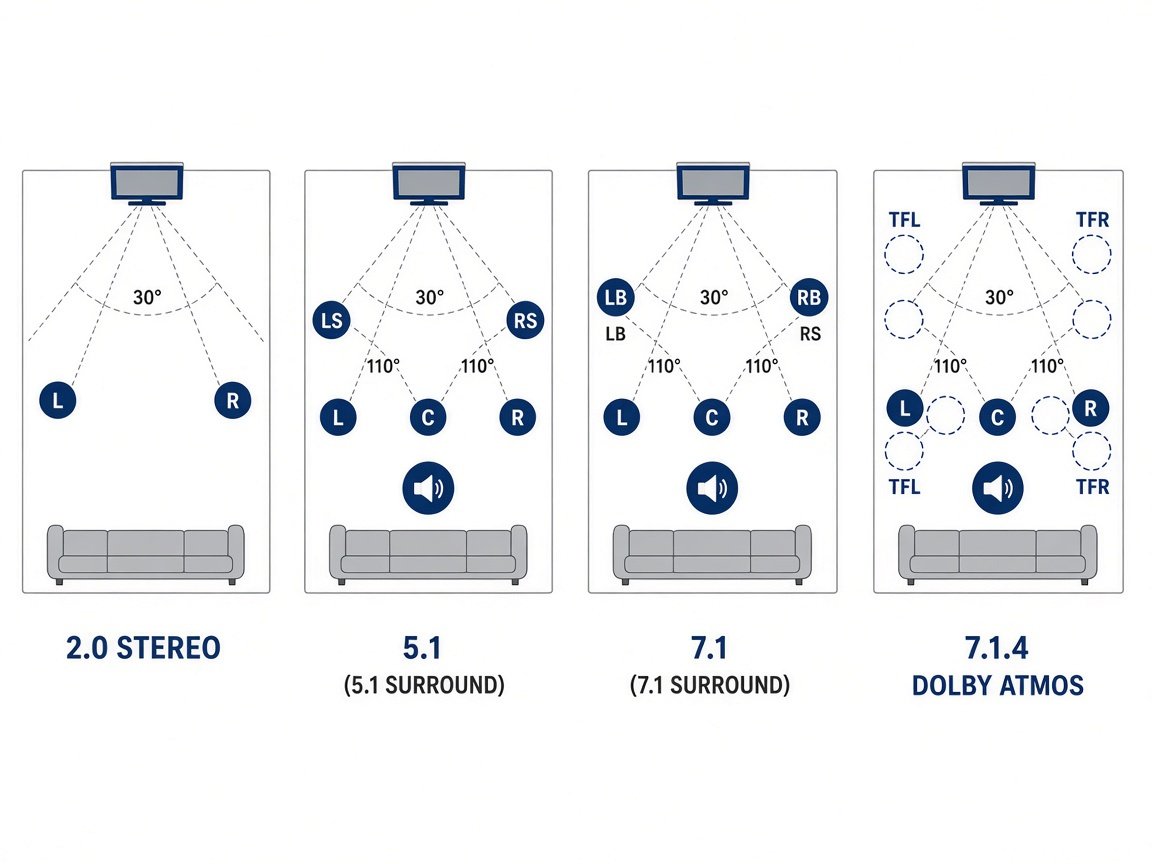
2.0 Stereo: Two speakers, no dedicated subwoofer. The reference configuration for high-fidelity music reproduction and an effective choice for smaller rooms where low-frequency extension is secondary to imaging precision. Powered two-channel monitors with built-in amplification — from KEF, Klipsch, and Audioengine — eliminate the need for a separate receiver in this category, making it the lowest-complexity entry point for audio-first households. The hometheaterinfoline.com ranking of the best home sound systems optimized for music compares leading options in this configuration across price tiers.
2.1: Two speakers plus a dedicated subwoofer. Extends bass response below the satellites’ natural roll-off point — typically below 80–120Hz depending on crossover design. A practical upgrade to 2.0 stereo for rooms where low-frequency extension matters but a full surround configuration is impractical. Subwoofer placement can be chosen independently of the satellite speakers, allowing basic room mode optimization without repositioning the entire system.
5.1 Surround: Front left, center channel, front right, surround left, surround right, and one subwoofer — the industry standard for home theater installations for decades and the dominant configuration in discrete-component setups. Speaker placement per ITU-R BS.775 technical recommendations — 30° off-center for front speakers, approximately 110° for surrounds relative to the primary listening position — delivers measurable per-channel spatial separation that single-enclosure designs simulate rather than replicate. The hometheaterinfoline.com guide to the best home theater surround sound systems benchmarks leading configurations in this category.
7.1 Surround: Adds two rear surround channels to the 5.1 base for improved spatial envelopment in larger rooms where the listening position is sufficiently distant from all speakers. Best suited to dedicated home theater rooms above 350 sq ft where proper rear speaker separation distance is achievable. In rooms smaller than this, the additional channels often produce over-enveloping sound rather than a genuinely expanded spatial image.
Object-Based Formats (Dolby Atmos / DTS:X): Layer overhead height channels onto a 5.1 or 7.1 base, enabling audio objects to be rendered as three-dimensional positions rather than fixed channel assignments. Per Dolby Laboratories’ technical documentation, Dolby Atmos supports up to 128 simultaneous audio objects decoded across up to 64 individual speaker feeds. Height channels are delivered through dedicated ceiling-mounted speakers wired to dedicated receiver channels, Atmos-enabled upward-firing drivers mounted atop or integrated into standard speaker enclosures, or beam-steering technology in premium soundbars. For a detailed look at how Dolby theater audio standards translate from cinema to home environments, the linked resource covers the full format specification and channel requirements.
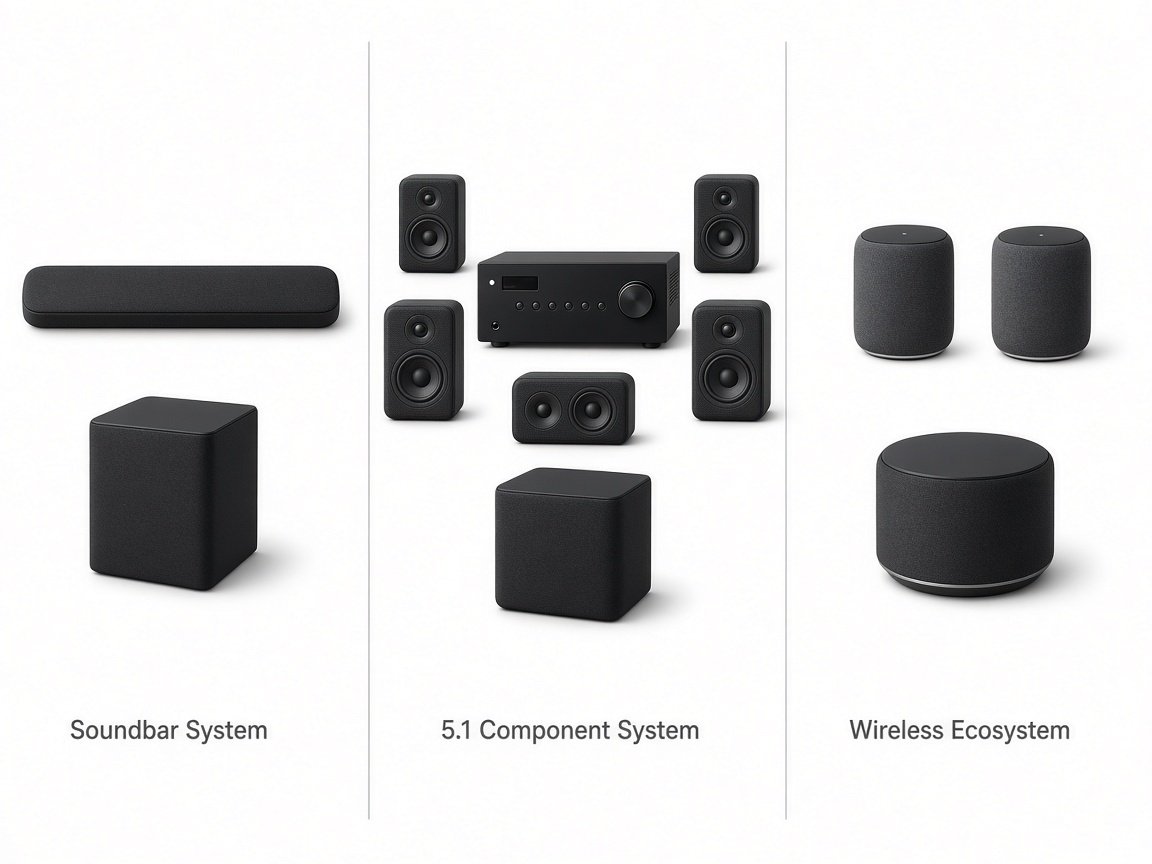
All-in-One Soundbars: Consolidate multiple drivers into a single horizontal enclosure — sometimes supplemented by a wireless subwoofer and optional wireless satellite speakers. These systems use psychoacoustic processing and beam-steering to simulate surround fields that discrete systems achieve through physical speaker separation. Their primary advantage is simplicity: one HDMI eARC connection, no receiver rack requirement, no visible cable runs to rear speaker positions.
What Technical Specifications Determine Real-World Performance?
Several specification categories separate genuinely capable systems from spec-sheet marketing. Each interacts with the others and with room acoustics in ways that make isolated spec comparisons insufficient for predicting real-world performance. Knowing which figures are meaningful and which are inflated is essential for cross-brand evaluation.
Speaker Sensitivity: Measured in dB SPL at 1W/1m on-axis, sensitivity indicates acoustic output per watt of amplifier input. Speakers rated above 90 dB/W/m require significantly less amplifier power to reach standard reference listening levels than lower-sensitivity designs. Klipsch’s horn-loaded tweeter architecture is specifically engineered around this principle; their Reference series rates sensitivity between 94 and 98 dB/W/m depending on model, per Klipsch product specifications. This directly reduces demands on the driving AV receiver and lowers the probability of audible compression at peak dynamic passages.
Nominal Impedance: Rated in ohms, impedance must be matched to the driving amplifier’s rated minimum safe load. Most consumer speakers are rated at 4Ω, 6Ω, or 8Ω nominal. Connecting a 4Ω nominal speaker to a receiver specified only for 6Ω minimum safe loads creates sustained thermal stress during long listening sessions and can trigger thermal protection circuit shutdowns at high playback levels. Always cross-reference the receiver’s minimum impedance specification against the speakers’ nominal impedance before purchasing any mixed-brand system.
Continuous RMS Power (All Channels Driven): This is the only amplification figure that reliably predicts real-world multichannel performance. Continuous RMS power reflects what an amplifier sustains simultaneously across all channels at a stated impedance and total harmonic distortion level (THD%). Peak and burst figures — which many all-in-one packages lead with in marketing materials — are measured under conditions that do not reflect sustained multichannel movie playback. A sub-0.1% THD rating at rated continuous power is a reasonable benchmark for mid-range components. Verifying that a receiver’s continuous wattage figure was measured with all channels driven simultaneously at 8Ω or 6Ω identifies genuine power delivery versus inflated single-channel bench measurements.
HDMI eARC Connectivity: HDMI eARC (Enhanced Audio Return Channel), introduced with the HDMI 2.1 specification, supports lossless audio formats including Dolby TrueHD with Atmos metadata and DTS:HD Master Audio over the HDMI connection between TV and receiver or soundbar. Standard HDMI ARC and optical TOSLINK connections are bandwidth-limited to Dolby Digital 5.1 and DTS core streams. If the connected source content — from a 4K Blu-ray disc or a streaming platform delivering lossless tracks — carries higher-quality audio, a standard ARC or optical connection will silently downgrade it. Confirm both the TV’s HDMI port and the receiver or soundbar’s input support eARC rather than standard ARC before purchase. The hometheaterinfoline.com guide to the best receivers for home theater ranks current models with eARC support across price tiers.
Room Correction Technology: Audyssey MultEQ (Denon and Marantz), YPAO (Yamaha), Dirac Live (available across multiple brands), and AccuEQ (Onkyo) use calibration microphones to measure and compensate for room modes, standing waves, and reflective surface artifacts at the listening position. These systems vary meaningfully in filter complexity and the number of spatial measurement positions they process. Dirac Live uses FIR (Finite Impulse Response) filtering, which provides phase-accurate correction across the full frequency range — a capability the IIR-based implementations in standard Audyssey MultEQ and YPAO do not fully replicate. Audyssey MultEQ XT32, the highest tier in the Audyssey lineup, uses 8,196 FIR filter taps per channel and supports up to eight measurement positions, per Audyssey’s published technical documentation.
Frequency Response and Driver Design: A nominally flat frequency response from 20Hz to 20kHz covers the full range of human hearing. In practice, full-range bass extension below 40Hz requires a dedicated subwoofer; most passive satellite speakers roll off significantly below 60–80Hz depending on cabinet volume, port tuning, and driver diameter. The center channel speaker is acoustically the most critical position in a home theater system — it carries the majority of spoken dialogue in feature film mixes. Poorly matched sensitivity or frequency response between the center channel and the front left and right speakers creates audible tonal shifts as audio pans across the front soundstage, which is perceptually distracting during dialogue-heavy content.
How Does Room Size and Acoustics Determine the Right Home Sound System?
Room volume, geometry, and acoustic treatment interact with any sound system in ways that no specification sheet fully predicts. Matching the system configuration to the room is as important as matching it to a budget or use case — arguably more so at the lower and middle price tiers, where room acoustics account for a greater share of the perceived performance difference between products.
Small Rooms (Under 150 sq ft): Bedrooms, home offices, and studios present specific acoustic challenges. Physical space constraints typically limit speaker placement to a single wall, reducing the practical value of discrete rear surround channels whose effectiveness depends on adequate separation distance from the listening position. Bass management is especially critical in small rectangular rooms, where room mode resonances determined by room dimensions amplify specific low frequencies unpredictably. A soundbar, compact 2.1 stereo system, or small all-in-one package frequently delivers better acoustic results in these spaces than an under-spaced surround configuration where rear speakers are placed only a few feet behind the listener.
Medium Rooms (150–350 sq ft): This is the optimal range for 5.1 discrete component systems. Standard living room layouts allow front speaker placement near the ITU-R BS.775-recommended 30° off-axis angles and rear surround positioning at approximately 110° from the primary listening position. Owner reviews consistently report that a mid-range 5.1 component system in a medium-sized, reasonably treated room outperforms an equivalently priced soundbar for spatial imaging accuracy and dynamic range. Modest acoustic treatment — a rug on a hard floor, bookshelves on reflective side walls — measurably reduces late reflections that smear spatial imaging without requiring dedicated acoustic panels.
Large and Open-Plan Rooms (350+ sq ft): These spaces demand higher per-channel continuous power output and benefit significantly from 7.1 or Dolby Atmos configurations. Open-plan kitchens, great rooms, and spaces with hard reflective surfaces — polished concrete, floor-to-ceiling glass, bare hardwood — require room correction as a near-essential feature rather than a convenience. Rooms with ceiling heights above 10 feet are particularly well-suited to Atmos height-channel expansion. Under-powered receivers will compress dynamic peaks before reaching adequate SPL across a large volume. For large-room 7.1 builds, the hometheaterinfoline.com guide to the best 7.1 surround sound systems benchmarks leading receiver-and-speaker combinations at this configuration level.
Bass Management and Crossover Frequency: Setting the AV receiver’s crossover point correctly is one of the highest-impact adjustments a buyer can make after installation. The THX-recommended standard — routing all bass content below 80Hz to the subwoofer while applying a matching high-pass filter to the main speakers — prevents satellite over-excursion on bass-heavy content and allows the subwoofer to be positioned independently for optimal room mode cancellation. Rooms with severe standing wave problems may benefit from setting the crossover higher at 100–120Hz, giving the subwoofer broader control of the lower midrange transition frequency range. Bass management settings interact directly with room correction filter output; they should be set before running auto-calibration, not after.
Purchasing a system rated for a large room and installing it in a small untreated space frequently produces worse acoustic results than a correctly sized smaller system. Excess bass output reinforces room modes; excess high-frequency energy from forward-firing tweeters in a close-quarters space produces fatiguing early reflections. Match system power and configuration to room volume first — then optimize from there.
What Are the Top-Ranked Home Sound System Categories for 2026?
The rankings below are based on a research comparison of manufacturer specifications, published technical standards, and aggregated owner reviews compiled by the hometheaterinfoline.com editorial team. No hands-on testing was conducted; performance claims are sourced from manufacturer documentation and owner review data. Systems are ranked by configuration category because no single product wins across every room type, budget, and use case.
| Category | Configuration | Representative Options | Key Specifications to Verify | Typical Price Range |
|---|---|---|---|---|
| Best Overall | 5.1 Discrete Component | Mid-range AV receiver + Klipsch R-Series, Polk Audio T-Series, or Elac Debut 2.0 | Continuous RMS all channels driven; speaker sensitivity ≥88 dB/W/m; impedance match; HDMI eARC; room correction type | $900–$2,500 |
| Best Soundbar | 3.1.2 or 7.1.2 | Sonos Arc Ultra, Sony HT-A7000, Samsung HW-Q990D | HDMI eARC (not standard ARC); Atmos certification; physical rear satellite option; wireless subwoofer included | $600–$1,500 |
| Best Wireless System | Wi-Fi Multi-Room | Sonos Era 300 + Sub + surrounds; Denon HEOS ecosystem | ALAC and FLAC lossless support; Atmos certification; network sync latency spec; 2.4GHz vs 5GHz band support | $700–$3,000+ |
| Best 7.1 / Atmos Build | 7.1 or 7.1.4 | Yamaha AVENTAGE receiver + Klipsch or Polk Atmos-enabled speakers | Height channel type (upward-firing vs in-ceiling); receiver Atmos object processing; continuous power at 6Ω all channels driven | $1,200–$6,000+ |
| Best Budget Package | 5.1 All-in-One | Yamaha YHT-5960U, Vizio V51-H6 | Bundled receiver continuous wattage; speaker sensitivity rating; HDMI input count; ARC vs eARC support | $250–$600 |
| Best for Music | 2.0 Powered Stereo | KEF LSX II, Klipsch The Fives, Audioengine A5+ | Frequency response; built-in DAC quality; connectivity options (USB, optical, Wi-Fi, HDMI ARC) | $300–$1,500 |
Best Overall: Discrete 5.1 Component System
Owner reviews and specification comparisons consistently favour discrete 5.1 component setups over equivalently priced soundbars for spatial imaging accuracy, sustained dynamic range, and long-term upgradability. A mid-range AV receiver with Audyssey MultEQ or YPAO room correction paired with high-sensitivity speakers delivers measurable per-channel acoustic separation that no single-enclosure soundbar replicates. The ability to upgrade individual components — the receiver, the front pair, the subwoofer — without replacing the entire system significantly extends the value of the initial investment. Best suited to rooms of 150–400 sq ft with the ability to run speaker cable or in-wall wiring to surround positions. The hometheaterinfoline.com ranking of the best 5.1-channel home theater systems compares leading configurations in this category across budget brackets.
Best Soundbar: Sonos Arc Ultra / Sony HT-A7000
The Sonos Arc Ultra houses purpose-built transducers for spatial audio rendering, supports Dolby Atmos via HDMI eARC, and integrates Apple AirPlay 2 and Wi-Fi multi-room streaming, making it the most ecosystem-flexible premium soundbar available, per Sonos product specifications. Owner reviews note strong dialogue clarity and effective virtual height processing in medium-sized living rooms. It pairs with the Sonos Sub and Era 100 speakers to expand into a fuller discrete configuration if needed. The Sony HT-A7000 — rated by Sony at 500W total system output with 7.1.2-channel processing and support for both Dolby Atmos and DTS:X, per Sony’s product specifications — is the leading alternative for buyers prioritizing rated output figures and Sony ecosystem integration.
Best Budget Package: Yamaha YHT-5960U
The YHT-5960U bundles a 5.1-channel AV receiver with a matched speaker set including an 8-inch subwoofer in a single purchase, per Yamaha product specifications. It includes Yamaha’s YPAO automatic room calibration and Bluetooth connectivity. Owner reviews cite it as the most accessible entry point to genuine discrete 5.1 performance below $500. The receiver supports 4K HDR passthrough and HDMI ARC for straightforward TV integration. Best suited to first-time home theater buyers in rooms under 300 sq ft who want discrete multi-channel audio without navigating individual component selection.
How Do Soundbars Compare to Discrete Speaker Systems?
The soundbar versus discrete system question has a structurally different answer depending on room, budget, cabling constraints, and primary use case. Neither configuration is universally superior; the right answer follows directly from the installation environment.
Where Soundbars Win: Constrained installation environments where cable runs to rear speaker positions are genuinely impractical — rented properties, open-plan rooms where furniture placement prohibits stands, layouts where cables cannot be managed acceptably. A single HDMI eARC connection and no visible wiring significantly reduce installation complexity. Among great sound bars for living rooms, the best current models produce impressively wide soundstages through psychoacoustic processing and beam-steering. The Samsung HW-Q990D ships with physical rear satellite speakers as part of its 11.1.4-channel speaker configuration, per Samsung’s product specifications — which distinguishes it from soundbars that simulate all surround information entirely through DSP processing from a single enclosure.
Where Discrete Systems Win: Physical driver separation between front, center, surround, and subwoofer positions produces measurably distinct spatial zones; there is no DSP processing involved in creating the acoustic difference between sound emanating from behind the listener versus from the front wall. Discrete systems also allow component-level upgrades — replacing only the receiver, only the front speaker pair, or only the subwoofer — rather than requiring full system replacement when one element becomes the performance bottleneck. The upgrade path effectively extends the return on initial investment indefinitely.
Price Parity Does Not Mean Performance Parity: At identical retail prices, a 5.1 component system almost universally outperforms a soundbar on spatial accuracy in a correctly configured medium-to-large room. Owner reviews comparing same-price-bracket systems consistently reflect this. The soundbar’s value proposition is convenience and aesthetics, not acoustic performance per dollar in well-configured spaces.
Hybrid Approaches: Several manufacturers now sell soundbar-led hybrid systems that add physical rear satellite speakers for a configuration combining front-soundbar convenience with genuine rear channel separation. The Samsung HW-Q990D and Sony HT-A9M2 represent this category, pairing a soundbar with discrete physical rear units. These systems sit between pure soundbar and full discrete setups in both price and acoustic performance, and are particularly well-suited to rooms where only the rear cable runs are problematic rather than the entire installation.
Which Wireless Home Audio Ecosystem Performs Best?
Wireless home audio divides into two transport categories with fundamentally different capability ceilings: Bluetooth and Wi-Fi. The choice determines codec support, latency characteristics, and multi-room functionality. These are not equivalent technologies with different names; they serve different use cases.
Bluetooth’s Practical Limitations: Bluetooth’s available bandwidth limits it to lossy audio codecs in most home theater applications. aptX HD and LDAC extend Bluetooth’s fidelity ceiling — LDAC, developed by Sony, supports up to 990 kbps at its highest quality setting, per Sony’s technical documentation — but neither matches the uncompressed or lossless PCM transmission that Wi-Fi systems support natively. Bluetooth also lacks reliable multi-room synchronization; latency variation between receivers causes audible sync drift in distributed audio deployments. It remains appropriate for casual single-zone playback, mobile device pairing, and secondary use cases rather than primary home theater audio.
Wi-Fi Ecosystem Advantages: Wi-Fi audio systems transmit over the local network without Bluetooth’s bandwidth ceiling, enabling lossless PCM and high-resolution audio file format support — FLAC and ALAC at up to 24-bit/192kHz on compatible endpoints. Network buffering eliminates the latency variation that causes Bluetooth sync drift, enabling reliable multi-room synchronization across zones. All three major Wi-Fi audio ecosystems — Sonos, Denon HEOS, and Yamaha MusicCast — support multi-room zone grouping with sub-millisecond synchronization within each zone, per their respective published technical documentation. For a full configuration comparison, the hometheaterinfoline.com ranking of the best wireless surround sound systems benchmarks current Wi-Fi ecosystem setups.
Sonos Ecosystem: Sonos’ proprietary mesh network protocol operates on both 2.4GHz and 5GHz Wi-Fi bands. The Era 300 adds spatial audio support with dedicated upward-firing and side-firing transducers for use as an Atmos surround speaker when paired with an Arc or Arc Ultra soundbar, per Sonos product specifications. Sonos Trueplay room calibration uses the device’s internal microphone to measure room acoustics and adjust equalization. The ecosystem spans soundbars, powered stereo speakers, amplifiers, and in-ceiling installations, making it the broadest whole-home audio platform currently available.
Denon HEOS: Built into Denon and Marantz AV receivers, HEOS provides multi-room audio streaming without a separate dedicated controller device. This integrates wireless multi-room functionality directly into a traditional component home theater setup, allowing the same system to serve both discrete multichannel movie playback and distributed music zones simultaneously. It is the most compelling wireless option for buyers already invested in a component AV system rather than a consumer electronics ecosystem.
Is Dolby Atmos Worth the Investment in a Home Sound System?
Dolby Atmos adds overhead height channels to a standard 5.1 or 7.1 surround base, enabling audio objects to be rendered as three-dimensional positions rather than fixed channel assignments. Per Dolby Laboratories’ published technical documentation, the format supports up to 128 simultaneous audio objects rendered to up to 64 speaker feeds in professional cinema installations. The practical home implementation is significantly simpler — most home systems decode Atmos to 5.1.2, 5.1.4, 7.1.2, or 7.1.4 channel configurations.
When Atmos Delivers Genuine Value: Rooms with ceiling height above 8 feet, where upward-firing Atmos-enabled drivers or in-ceiling speakers can produce audible vertical separation between overhead sound objects and the front and surround channels. Content availability for Atmos has expanded substantially — major streaming platforms now carry Atmos-mixed originals, and 4K Blu-ray discs carry Dolby TrueHD with Atmos metadata as the standard audio track on premium releases. For buyers already investing in a 5.1 component system, the incremental cost of adding Atmos-enabled speakers — either as dedicated height units wired to spare receiver channels or as upward-firing add-on modules placed atop existing front speakers — is modest compared to a full system rebuild.
When Atmos Adds Limited Value: Rooms with ceilings at or below 8 feet, where upward-firing drivers reflect off the ceiling too close to the speaker position to create convincing overhead placement. Soundbar Atmos implementations vary considerably in effectiveness; beam-steering results depend heavily on ceiling material and room geometry, and owner reviews reflect significant variability in perceived height effect quality compared to certified in-ceiling installations in well-treated rooms.
DTS:X as a Parallel Option: DTS:X offers similar object-based audio rendering without requiring a dedicated height channel configuration — it adapts to any speaker layout and renders overhead information using the available channels without a hardware prerequisite. Many premium AV receivers support both Dolby Atmos and DTS:X in parallel; buyers investing in component systems need not choose exclusively between formats. Confirm both format licenses appear in the receiver’s specifications before purchase if DTS:X source material is in the intended content library.
How Do You Set Up a Home Sound System from Scratch?
Setting up a home sound system involves a sequence of physical placement decisions, electrical connections, and software calibration steps. The order matters significantly — correcting the physical setup before running room correction produces better results than calibrating a poorly positioned system and trying to compensate in software. The following sequence applies to a standard wired 5.1 discrete component installation.
Map all speaker positions on the floor plan before routing any wiring. Front left and right should form an approximate equilateral triangle with the primary listening seat — typically 7–10 feet of separation for a standard living room. The center channel goes directly below or above the TV screen, angled toward the listening position. Surround speakers position at ear height when seated or slightly above — approximately 2–3 feet above the sitting ear level — at approximately 110° from the listening position per ITU-R BS.775. Confirm clear sightlines and cable routing paths exist for every position before committing.
For wired setups, calculate cable lengths with 20% slack for routing around baseboards, door frames, and furniture. Speaker cable gauge matters at longer runs: 16 AWG is adequate to approximately 50 feet for 8Ω loads; 14 AWG is recommended for runs exceeding 50 feet or for 4Ω speaker loads to minimize resistance losses. Label each cable end clearly before terminating to the speakers and receiver. For households that prefer a fully managed installation, Walmart home theater installation services can handle the physical cable routing, wall mounting, and system setup as part of a purchase package.
Connect the TV to the receiver using an HDMI cable in the TV’s eARC-designated port (not standard ARC or optical, which limit audio formats to lossy Dolby Digital 5.1). Connect source devices — streaming players, Blu-ray players, gaming consoles — to the receiver’s HDMI inputs rather than directly to the TV wherever possible. Confirm that eARC is enabled in the TV’s audio output settings; most TVs ship with it disabled by default even on the designated eARC port. Connect speaker cables to the receiver’s labeled terminals, verifying polarity — positive to positive, negative to negative — on every channel connection.
Place the subwoofer temporarily in the primary listening position and play bass-heavy program material. Walk the room’s perimeter listening for where bass sounds fullest and most even without obvious peaks or nulls. That perimeter position typically produces the most even bass response when the subwoofer is permanently placed there, because room mode behavior is symmetric — where the listening position sounds best from the corner, the corner sounds best from the listening position. Set the receiver’s crossover to 80Hz as the initial starting point and adjust only after running room correction.
Place the calibration microphone at the primary listening seat at ear height when seated. Run the receiver’s auto-calibration routine — Audyssey, YPAO, Dirac Live, or AccuEQ depending on brand — following the manufacturer’s prompts. For systems that support multi-point calibration, take measurements at five to eight positions within the listening area; this produces correction filters accurate across a wider zone rather than only at the single microphone position. After calibration completes, review the generated EQ curves and speaker distance/crossover assignments in the receiver’s setup menu. Correct any anomalous settings — an unusually distant speaker measurement, an unexpected crossover assignment — before finalizing.
Play a confirmed Dolby Atmos-encoded stream or disc and check the receiver’s front-panel display or on-screen overlay for the audio format indicator. It should read “Dolby Atmos” rather than “Dolby Digital 5.1” or “PCM 2.0.” If the receiver shows only 5.1 decoding on confirmed Atmos content, the HDMI connection is likely standard ARC rather than eARC, the TV is downmixing audio before output, or the streaming application’s audio output settings are set to a compressed format. Isolate and correct the specific step in the signal chain causing the downmix before considering the installation complete.
What Should You Budget for a Home Sound System in 2026?
Home sound system pricing spans a wide range, and the relationship between price and performance is not linear across all categories. Understanding which price tier delivers the greatest incremental improvement helps allocate budget effectively and avoids both under-spending (where the room-limiting factor is the system) and over-spending (where the room-limiting factor is acoustics, not equipment).
| Budget Tier | Total System Range | Realistic Configuration | Key Limitations at This Tier | Upgrade Priority |
|---|---|---|---|---|
| Entry Level | $150–$350 | All-in-one soundbar or basic 5.1 package (Vizio V51-H6, Yamaha YHT-5960U lower-tier) | Limited dynamic headroom; basic or absent room correction; wattage figures often peak/burst rather than continuous RMS | Receiver upgrade first when budget allows |
| Mid-Range | $500–$1,200 | Dedicated AV receiver + passive 5.1 speaker set (Klipsch R-Series, Polk Audio T-Series, Elac Debut 2.0) | May lack Dirac Live; Atmos height channels require additional speaker investment; eARC present on most units at this tier | Front speaker pair upgrade or height channel add-on |
| Upper Mid-Range | $1,200–$3,000 | Premium AV receiver (Denon AVR-X4800H, Yamaha AVENTAGE RX-A4A) + quality 5.1.2 or 7.1 speaker system | Full Atmos/DTS:X decoding; Dirac Live available on select models; diminishing acoustic returns emerge without room treatment | Acoustic room treatment investment to realize full return |
| High Performance | $3,000–$8,000+ | Separates (preamplifier + multichannel power amplifier) + high-efficiency speakers (Klipsch Heritage, Focal, B&W 700 Series) | Installation complexity increases substantially; dedicated acoustic room treatment is non-optional for full return on investment | Room treatment and acoustic panel investment before speaker upgrades |
The largest performance improvement per dollar in this market occurs at the transition from entry-level to mid-range — specifically the step from a basic all-in-one soundbar or entry-level package to a dedicated receiver plus passive speaker configuration. At that transition, the acoustic separation, dynamic range, and room correction capabilities change categorically rather than incrementally. Above $3,000, the room itself becomes the dominant variable; acoustic treatment investment should precede further equipment upgrades to deliver measurable return at that tier.
What Will Home Sound Systems Look Like in 2027 and Beyond?
The near-term trajectory of the home audio market points toward several converging developments based on current manufacturer roadmaps, format industry direction, and infrastructure deployment trends visible in 2026.
AI-Assisted Room Correction and Adaptive Calibration: The next generation of automatic room correction will likely extend beyond the current single-event measurement-and-filter approach. Dirac and Audyssey have both indicated ongoing development of machine-learning-informed calibration that adapts dynamically to changes in room occupancy and furniture configuration, rather than relying on a static calibration event. Dynamic in-room adaptation — responding to whether the sofa is occupied or the room is empty, for example — represents a logical next step from the correction platforms already embedded in current mid- and high-range receivers.
Spatial Audio as a Baseline Expectation: Apple’s Spatial Audio format, delivered via Apple Music and Apple TV+ using Dolby Atmos encoding, has extended spatial audio availability to a significantly wider installed base of AirPods and Apple TV hardware users than traditional home theater installations alone could reach. This content investment by major platforms is accelerating the expectation of spatial audio as a baseline feature rather than a premium differentiator, increasing pressure on soundbar manufacturers to improve object-based processing quality at mid-tier price points and on streaming services to default to Atmos delivery where available.
Wireless Lossless Audio Over Wi-Fi 6E and Wi-Fi 7: The expanded spectrum and reduced interference characteristics of Wi-Fi 6E (6GHz band) and Wi-Fi 7 (multi-link operation) are removing the latency and reliability constraints that have historically made wired connections preferable for high-performance home theater applications. As Wi-Fi 6E and Wi-Fi 7 routers penetrate the installed consumer base, fully wireless 5.1 and 7.1 discrete systems — currently available but limited in mainstream adoption — are likely to become more competitive with wired installations for sound quality consistency.
HDMI 2.2 and Future Bandwidth Headroom: The HDMI 2.2 specification under development is expected to extend available bandwidth beyond HDMI 2.1’s 48Gbps ceiling. The near-term practical audio impact is limited — current lossless multichannel formats do not approach HDMI 2.1’s bandwidth ceiling — but future high-channel-count object audio formats and uncompressed high-sample-rate multichannel PCM delivery may exploit the additional headroom as format development continues alongside streaming platform infrastructure investment.
Frequently Asked Questions About Home Sound Systems
What is the best home sound system for a living room?
For most living rooms in the 150–300 sq ft range, the best home sound system is a matched 5.1 discrete component setup: a mid-range AV receiver with room correction paired with passive speakers from Klipsch, Polk Audio, or Elac. If cable runs to rear speaker positions are impractical, a premium soundbar with HDMI eARC — the Sonos Arc Ultra, Sony HT-A7000, or Samsung HW-Q990D — is the strongest single-cable alternative. Configuration and room match matter more than brand at any given price point.
Is a 5.1 or 7.1 home sound system better?
7.1 outperforms 5.1 only when the room is large enough to place rear surround speakers at an adequate distance from the listening position — typically rooms above 300–350 sq ft where proper rear channel separation is achievable. In smaller rooms, the additional rear channels produce diffuse or over-enveloping sound rather than a genuinely expanded spatial image, and 5.1 is the better value choice for the majority of domestic room sizes. Budget allocated to a better receiver or higher-quality front speakers in a 5.1 setup typically delivers more audible improvement than adding a 7.1 configuration to an under-powered receiver.
Do I need Dolby Atmos for a home sound system?
Dolby Atmos delivers audible improvement in rooms with ceiling height above 8 feet where upward-firing or in-ceiling height speakers can create convincing overhead separation. In rooms with standard 8-foot ceilings, the improvement is more modest and varies by room geometry and ceiling material. Atmos certification now ships at nearly every price tier, so the question for most buyers is whether height channel hardware is worth the incremental cost of additional speakers and amplifier channels — not whether to include Atmos certification itself, which is essentially unavoidable in 2026 AV receiver and soundbar purchases.
What is the difference between HDMI ARC and HDMI eARC?
HDMI ARC (Audio Return Channel) supports only compressed audio formats — Dolby Digital 5.1 and DTS core streams — over the connection between the TV and a receiver or soundbar. HDMI eARC (Enhanced Audio Return Channel), introduced with the HDMI 2.1 specification, supports lossless formats including Dolby TrueHD with Atmos metadata and DTS:HD Master Audio over the same physical port. If source content carries a lossless audio track, a standard ARC or optical connection will silently downgrade it to a compressed stream. Confirm both the TV’s designated HDMI port and the receiver or soundbar’s input support eARC — and that eARC is enabled in the TV’s output settings — before finalizing any system purchase.
How much should I spend on a home sound system?
The largest performance improvement per dollar in this market occurs at the transition from entry-level to mid-range — specifically the step from a basic all-in-one soundbar or entry package to a dedicated AV receiver plus passive speaker configuration. Most households get the best balance of performance and value in the $700–$1,500 range for a complete 5.1 discrete component system. Above $3,000, incremental acoustic gains require commensurate room treatment investment to fully materialize; without it, the room remains the dominant limiting variable regardless of equipment tier.
Can a soundbar replace a full surround sound system?
A premium soundbar can functionally replace a full surround system in environments where cable routing to rear speaker positions is genuinely impractical. It cannot replicate the acoustic separation produced by physically discrete speakers positioned at standard surround angles — the difference between a sound emanating from the left rear versus the front wall is physically produced in a discrete system and psychoacoustically simulated in a soundbar. For listening environments where speaker placement at correct angles is feasible, a mid-range 5.1 component system consistently outperforms a soundbar at equivalent price on spatial imaging accuracy, based on owner review data.
What is the best wireless home sound system?
Among Wi-Fi-based wireless systems, Sonos leads on ecosystem breadth, lossless audio support, and multi-room reliability for most households — particularly those without an existing AV receiver investment. Denon HEOS is the strongest choice for buyers with Denon or Marantz AV receivers, as it integrates multi-room wireless streaming directly without a separate controller device. Yamaha MusicCast offers similar multi-room capability across Yamaha’s receiver lineup. All three support lossless PCM and FLAC streaming over Wi-Fi and avoid the bandwidth ceiling that limits Bluetooth to lossy audio compression.
Which Home Sound System Is Right for You?
The optimal home sound system configuration depends more on room volume, speaker placement feasibility, and primary use case than on any single specification or brand name. The following decision sequence identifies the right starting point for most buyers without requiring prior audio engineering knowledge.
- Measure the room first. Rooms under 150 sq ft favor a soundbar or compact 2.1 system. Rooms between 150 and 350 sq ft favor a 5.1 discrete component setup. Rooms above 350 sq ft or with ceilings above 10 feet can justify 7.1 or Dolby Atmos height-channel configurations with appropriate per-channel power output.
- Assess cable routing feasibility before choosing a configuration. If wiring rear speaker positions to the receiver is impractical, choose a system with wireless rear satellite options or a soundbar-led hybrid with physical rear units. Understand that this involves an acoustic tradeoff against equivalently priced discrete setups — it is a practical choice, not an equivalent one.
- Confirm HDMI eARC on both the TV and the receiver or soundbar before purchase. Standard ARC and optical connections limit audio quality in ways that cannot be corrected after installation without changing the connection type. Verify eARC support and ensure it is enabled in the TV’s output settings as part of system commissioning.
- Allocate budget within the system starting with the receiver and front speaker pair. In a component system, the receiver determines the ceiling for every future speaker upgrade; under-investing in it limits long-term flexibility. The center channel is the second-highest impact position; surrounds offer the smallest incremental improvement and can be upgraded last.
- Run physical placement before room correction calibration. Auto-calibration systems compensate for a significant portion of room-induced coloration, but they cannot fix a speaker that is fundamentally misplaced relative to the listening position or the other speakers. Correct the physical setup first, then calibrate — not the reverse.
- Verify audio format passthrough as the final commissioning step. Confirm the receiver is decoding the highest-quality format available from the connected sources before considering the system fully commissioned. A correctly connected Atmos system displaying only “Dolby Digital 5.1” on Atmos content indicates a configuration error, not a hardware limitation, and can be traced and corrected in the signal chain.
For entry-level buyers, the Yamaha YHT-5960U package provides a complete 5.1 discrete system below $500 that most all-in-one soundbars in the same range cannot match acoustically. For mid-range buyers, a Denon or Yamaha AVENTAGE receiver paired with Klipsch R-Series speakers represents the strongest combination of power delivery, room correction capability, and long-term upgrade flexibility currently available. For households prioritizing simplicity without sacrificing spatial audio quality, the Sonos Arc Ultra with the Sub and Era 100 surrounds delivers a full Atmos-capable system through a single HDMI eARC connection and the most polished multi-room integration in the consumer market.