
#1 Ranked The Sony SSCS3 earns the top position in this 2026 ranking of Sony tower speakers — a 3-way, 4-driver bass reflex floor-stander carrying Sony-specified maximum input power of 145W, nominal impedance of 8Ω, and a frequency response extending from 45Hz to 50kHz. For anyone sourcing dedicated home theater speakers from a single manufacturer ecosystem, the SSCS3 delivers a level of multi-way acoustic engineering — including a dual-tweeter configuration extending response to the full high-resolution audio bandwidth — that few competitors match at an equivalent price point.
Executive Summary
- The Sony SSCS3 uses a 3-way, 4-driver design with a dual-tweeter configuration — one 1-inch soft-dome tweeter and one 1-inch super tweeter — extending high-frequency response to Sony’s specified 50kHz ceiling, accommodating SACD and 192kHz PCM high-resolution audio formats.
- Manufacturer-specified sensitivity is 88dB (1W/1m) at 8Ω nominal impedance; Sony specifies a recommended amplifier output range of 10W to 145W per channel.
- The SSCS3 is designed to integrate spectrally with the broader SSCS speaker series — including the SSCS5 bookshelf and SSCS8 center channel — forming a timbre-matched multi-channel home theater system.
- Aggregated owner reviews from major retail platforms consistently identify high-frequency clarity, wide soundstage reproduction, and competitive build quality as the SSCS3’s most-cited practical strengths.
What Are the Best Sony Tower Speakers in 2026?
Sony’s standalone tower speaker portfolio centers on the SSCS series, with the SSCS3 as the company’s definitive floor-standing model for home theater and stereo listening environments. Unlike manufacturers that maintain deep tiered ranges of floor-standing designs across multiple price bands, Sony concentrates its tower offering in a single, well-specified product designed to anchor both multi-channel and two-channel configurations.
This deliberate focus produces a coherent engineering story rather than a fragmented lineup where drivers and cabinet designs vary inconsistently between tiers. Every specification decision on the SSCS3 is legible: a 3-way crossover architecture, a dual-tweeter pair for extended high-frequency reach, Mica Reinforced Cellular (MRC) woofer cone construction, and a rear-ported bass reflex enclosure optimized for low-frequency extension within the speaker’s compact cabinet volume.
For buyers evaluating the SSCS3 against alternatives, the key reference points are its Sony-specified sensitivity of 88dB at 1W/1m, nominal impedance of 8Ω, and frequency response floor of 45Hz at –10dB — figures that together define the speaker’s integration requirements and practical performance envelope in a real listening room.
| Specification | Sony SSCS3 (Manufacturer Rating) |
|---|---|
| System Type | 3-way, 4-driver bass reflex |
| Tweeter Configuration | Dual: 1-inch soft-dome tweeter + 1-inch super tweeter |
| Woofer Cone Material | Mica Reinforced Cellular (MRC) |
| Maximum Input Power | 145W |
| Recommended Amplifier Range | 10W – 145W per channel |
| Nominal Impedance | 8Ω (compatible range: 6–16Ω) |
| Sensitivity | 88dB (1W/1m) |
| Frequency Response | 45Hz – 50kHz (–10dB) |
| Enclosure Loading | Bass reflex, rear-firing port |
What Driver Architecture Does the Sony SSCS3 Use?
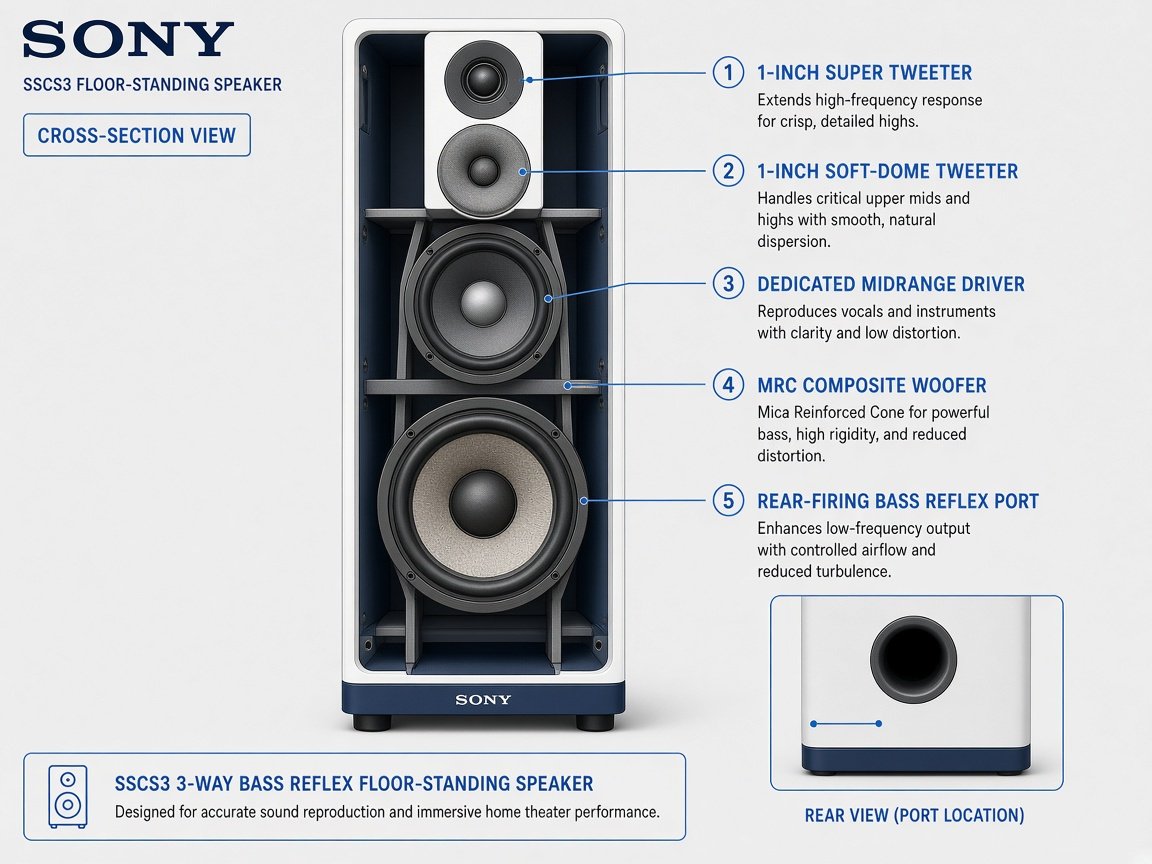
The 3-way, 4-driver topology is the central engineering decision that separates the SSCS3 from 2-way floor-standers at comparable price points. In a 3-way design, the crossover network divides the incoming audio signal into three discrete frequency bands — high, midrange, and low — routing each band to a driver optimized for that specific bandwidth. This reduces the distortion that occurs when a single driver is asked to reproduce frequencies beyond its design optimum.
The dual-tweeter pair is the SSCS3’s most distinctive design element. Sony’s configuration combines a 1-inch soft-dome tweeter handling the upper midrange and standard high-frequency range with a 1-inch super tweeter dedicated to the extended high-frequency range above approximately 20kHz. The practical effect operates on two dimensions: the super tweeter handles the ultrasonic content present in SACD and high-resolution PCM recordings without requiring the main tweeter to operate outside its design bandwidth, while the main tweeter’s distortion load is simultaneously reduced, since the super tweeter assumes responsibility for the highest-frequency content in the signal. Owner reviews frequently describe the SSCS3’s high-frequency reproduction as open and detailed — a reported characteristic consistent with this dual-driver approach to the top octave.
The dedicated midrange driver handles the acoustically critical frequencies carrying the fundamental tones and lower harmonics of vocals, guitars, piano, and film dialogue. Having a midrange driver dedicated to this band — rather than sharing the woofer between midrange and bass duties — contributes to the clarity that SSCS3 owners consistently report. The woofer uses Sony’s Mica Reinforced Cellular (MRC) composite cone material, which Sony describes as balancing cone stiffness with low mass to reduce resonance and distortion at high playback levels, operating within a rear-ported bass reflex enclosure.
What Do the SSCS3’s Published Specifications Mean in Practice?
Reading the SSCS3’s specification sheet in isolation is useful. Understanding what those numbers mean in a real home theater or listening room clarifies the buying decision significantly. Each key figure has practical implications for how the speaker performs, what amplification it requires, and how it integrates into a system.
The 88dB sensitivity figure (measured at 1W/1m) means the speaker produces 88 decibels of sound pressure level one metre from its front baffle with one watt of amplifier input. For every doubling of amplifier power, acoustic output increases by approximately 3dB — a relationship defined by the logarithmic nature of the decibel scale. At 88dB, the SSCS3 falls in the mid-efficiency range for floor-standing speakers. It will reach satisfying listening levels from modest receiver output but requires adequate amplifier headroom to avoid clipping in medium to large rooms.
The –10dB qualifier on the 45Hz lower frequency limit is important context. This measurement window is broader than the ±3dB window used by some competing manufacturers, meaning direct comparisons of low-frequency extension figures across brands require attention to the measurement standard used. The more common –3dB specification would yield a higher, narrower low-frequency figure for the SSCS3. For home theater use with a subwoofer crossed over at 80Hz, however, this distinction is irrelevant — the SSCS3 is never asked to reproduce content below 80Hz in this configuration. Sony’s 50kHz high-frequency ceiling is unqualified in Sony’s published documentation, reflecting the super tweeter’s design specification and its compatibility with the full bandwidth of high-resolution digital audio formats.
How Does the SSCS3’s 88dB Sensitivity Affect Amplifier Pairing?
Sensitivity is one of the two most consequential specifications for matching a speaker to an amplifier — the other being impedance. At 88dB, the SSCS3 is moderately efficient by floor-standing speaker standards. Some competing floor-standing designs — particularly horn-loaded configurations found in specialist high-efficiency speaker categories — reach 95–98dB sensitivity, producing equivalent loudness from a fraction of the amplifier power required by a standard dome-tweeter design at 88dB.
The SSCS3’s 88dB figure is not a performance liability in home theater systems using mainstream AV receivers. It does, however, establish a practical minimum for amplifier output relative to room size. Very low-powered amplifiers — below 25 watts per channel — may reach their clipping threshold before the SSCS3 achieves reference listening levels in medium or large rooms. Clipping — the distortion that occurs when an amplifier is asked to deliver more power than its design allows — produces high-energy harmonic content that can overheat speaker voice coils. Ensuring amplifier headroom is proportionate to room size matters more than focusing exclusively on nominal watt ratings when selecting amplification for the SSCS3.
For buyers evaluating the receiver side of the equation alongside the SSCS3, the relationship between receiver power ratings and real-world speaker efficiency is worth working through carefully before purchase. Choosing the right AV receiver for a home theater system is as consequential as the speaker selection itself — the two interact directly at the amplifier-to-speaker interface where efficiency and headroom meet.
What Does the SSCS3’s 8Ω Impedance Mean for Receiver Compatibility?
The SSCS3’s 8Ω nominal impedance makes it compatible with virtually all AV receivers and stereo amplifiers in production. Sony specifies a compatible impedance range of 6–16Ω — a broad tolerance that accommodates both entry-level and mid-range receivers without impedance mismatch concerns on either end of the range.
This compatibility breadth matters because some floor-standing speakers present nominal impedances of 4Ω or lower. That figure can exceed the safe operating range of budget receivers, causing thermal protection circuits to engage during sustained high-volume playback. The SSCS3’s 8Ω nominal figure avoids this complication entirely and makes the speaker a low-risk pairing for buyers who have not yet finalized their amplifier selection.
Nominal impedance ratings describe the average across the speaker’s frequency range rather than the minimum at any specific frequency. Real-world impedance curves dip below the nominal value at certain frequencies, particularly around crossover transition points. A speaker rated at 8Ω nominal may present 5–6Ω at specific frequencies. Sony’s specified 6Ω lower boundary of the compatible range confirms the SSCS3 stays within safe operating limits for virtually any receiver at these dip points, without requiring premium amplification to operate safely at high playback levels.
How Should the Sony SSCS3 Be Set Up in a Home Theater System?
Correct setup is as important as hardware selection. The SSCS3’s performance in a home theater configuration depends on accurate bass management, appropriate placement, and correct receiver configuration. The following steps apply standard home theater setup practice to the SSCS3’s specific design parameters.
- Position the speakers. Place each SSCS3 approximately 6–8 feet apart and 2–3 feet from the front wall, allowing the rear-firing bass reflex port adequate clearance — standard bass reflex guidelines recommend a minimum of 6–8 inches of clearance between the port and the wall directly behind the speaker to prevent boundary-induced bass buildup. Apply a slight inward toe-in, angling each speaker toward the primary listening position, to sharpen stereo imaging focus.
- Set bass management to “Small” mode. In the AV receiver’s speaker configuration menu, set the front main speakers to “Small” rather than “Large.” This routes bass content below the crossover frequency to the subwoofer rather than the SSCS3’s woofer, allowing the floor-stander to operate within its design bandwidth.
- Set the crossover frequency to 80Hz. The international multi-channel audio standard ITU-R BS.775 specifies an 80Hz crossover for main channel speakers in home theater configurations. This frequency ensures the SSCS3 operates within its design optimum and reduces driver excursion stress at high playback levels.
- Run automatic room correction. Most mid-range and higher AV receivers include automatic calibration systems — Sony DCAC, Audyssey MultEQ, Yamaha YPAO, and similar platforms — that measure the listening environment and adjust equalization, level, and delay for each speaker channel. Run calibration after the speakers are placed in their final positions.
- Verify level matching. Using the receiver’s test-tone function or the calibration output from Step 4, confirm that each speaker in the system is matched to reference level at the listening position. Unmatched channel levels affect dialogue intelligibility and soundstage localization accuracy in multi-channel configurations.
What You’ll Need for SSCS3 Integration
- AV receiver or stereo amplifier rated at 8Ω, delivering 70W or more per channel for medium-sized rooms
- Dedicated subwoofer for bass content below the 80Hz crossover point
- 16-gauge or heavier speaker cable for runs up to 25 feet
- Calibration microphone (typically bundled with mid-range and higher AV receivers)
- 6–8 inches minimum clearance behind each speaker for the rear-firing bass reflex port
Pairing the SSCS3 with a capable subwoofer completes the low-frequency foundation of the system. The crossover point between the floor-stander and the subwoofer directly affects both midrange clarity and the perceived impact of bass-intensive content. Our analysis of the best bass speakers for home theater covers how to match subwoofer output characteristics to the SSCS3’s low-frequency design parameters and the ITU-R BS.775 crossover standard.

How Does the SSCS3 Fit Into the Full Sony SSCS Speaker Series?
The SSCS3 is designed as the front main speaker anchor of the SSCS speaker family. Sony’s SSCS series extends to bookshelf and center channel formats, providing a matched acoustic system for multi-channel home theater configurations. Each model in the series uses the same MRC woofer cone technology and soft-dome tweeter design language, producing spectral consistency across all speaker positions in the listening room.
- SSCS3: 3-way, 4-driver floor-standing main speakers — primary front left and right channels in a 5.1 or 7.1 configuration
- SSCS5: 3-way, 3-driver bookshelf speakers — suitable for surround channels or secondary main use in smaller rooms
- SSCS8: Dedicated center channel speaker, designed to match the SSCS3’s tonal signature for dialogue clarity in 5.1 and 7.1 configurations
This spectral consistency across the SSCS series is acoustically meaningful. When the front left, front right, center, and surround speakers are drawn from the same manufacturer’s matched family, the brain’s localization processing is not distracted by timbral discontinuities as a sound pans from one speaker to another. The uniformity of the MRC cone material and dome tweeter design across the series means the transition between speaker positions sounds seamless rather than sonically interrupted. Buyers planning a full multi-channel build around the SSCS3 will find detailed configuration guidance in our coverage of the best Sony surround sound systems, which covers layout and calibration strategy for the complete SSCS series.
How Does the Sony SSCS3 Compare to Alternative Tower Speaker Designs?
The SSCS3 occupies a specific position in the floor-standing speaker market: a 3-way, mid-efficiency design with broad receiver compatibility and high-resolution audio bandwidth. Understanding how that positions it against alternative design archetypes clarifies which buyer profiles it serves best and where the tradeoffs lie.
| Design Factor | Sony SSCS3 | Typical 2-Way Floor-Stander | High-Efficiency Horn Tower |
|---|---|---|---|
| Crossover Design | 3-way | 2-way | 2-way or 3-way |
| Driver Count | 4 (dual tweeter, mid, woofer) | 2 (tweeter + woofer) | 2–3 |
| Tweeter Type | Dual 1-inch soft dome (Sony spec) | Single soft dome | Compression horn driver |
| Nominal Impedance | 8Ω (Sony spec; range 6–16Ω) | Varies (4–8Ω common) | Varies (8–16Ω common) |
| Manufacturer Sensitivity | 88dB (Sony spec) | Typically 86–90dB | Typically 95–99dB |
| Hi-Res Audio Bandwidth | Yes — to 50kHz (Sony spec) | Dependent on tweeter type | Dependent on driver choice |
| Enclosure Type | Bass reflex, rear port | Front or rear port | Sealed or vented |
| Receiver Compatibility | Broad (6–16Ω rated by Sony) | Varies; some 4Ω designs restrictive | Generally broad |
The 3-way design advantage over 2-way floor-standers is most pronounced in the midrange. A 2-way design typically routes both midrange frequencies and low bass to a single woofer, which must handle a wider frequency bandwidth than a dedicated midrange driver is required to manage. At high playback levels, this sharing can produce compression in the midrange band — the frequency range that carries the most intelligibility-critical audio content. The SSCS3’s dedicated midrange driver avoids this tradeoff by confining the woofer entirely to low-frequency duties.
Against horn-loaded tower designs, the SSCS3 trades raw sensitivity — horn-loaded designs can reach 95–99dB — for a broader compatible impedance range, lower placement sensitivity near room boundaries, and a significantly lower cost of entry. Horn-loaded designs require precise amplifier matching and are often less forgiving of rear-wall proximity. For buyers evaluating the premium end of the floor-standing speaker market, our coverage of the best high-end audio speakers examines how alternative design philosophies approach these acoustic engineering tradeoffs in detail.
What Do Owner Reviews Consistently Report About the Sony SSCS3?
Aggregated owner review data from major retail platforms shows consistent patterns in how SSCS3 owners characterize their experience with the speaker. These patterns are reported as owner observations rather than verified measurements, and they align coherently with the speaker’s published design specifications.
High-frequency performance is the most frequently cited strength in owner reviews. Owners consistently describe the SSCS3’s high-frequency reproduction as open, extended, and non-fatiguing — a reported characteristic consistent with the dual-tweeter design’s theoretical advantage of allowing each tweeter to operate within its design bandwidth rather than being pushed to its limits. Film soundtrack content, orchestral recordings, and acoustic music are specifically cited in owner reviews as genres that benefit from this quality, with owners noting that high-frequency transients — cymbals, string harmonics, ambient air — resolve with unusual clarity for a speaker in this category.
Soundstage width and instrument separation are frequently noted in positive owner reviews. Reviewers describe a wider perceived stereo field than anticipated from the speaker’s physical footprint, with voice and instrument placement within the soundstage described as specific and stable across a range of listening positions. Build quality relative to price receives consistent positive comment, with owners citing the MRC woofer cone finish and cabinet construction as exceeding expectations. Some owner reviews note that the rear-firing port requires a minimum clearance from the wall directly behind the speaker to avoid low-frequency buildup — consistent with standard bass reflex design guidelines and Sony’s own placement guidance.
What Should Sony Tower Speaker Buyers Watch Over the Next 12–24 Months?
Several trends in the home theater and consumer audio market are relevant for anyone evaluating the SSCS3 as a long-term platform through 2027 and 2028.
High-resolution audio adoption continues to expand through major streaming services, which have extended their high-resolution audio catalogs through 2025 and 2026. The SSCS3’s 50kHz frequency ceiling — enabled by the super tweeter in the dual-tweeter configuration — means it is already positioned to reproduce the full bandwidth of these formats without requiring a hardware upgrade. The dual-tweeter engineering that enables this bandwidth was designed with format longevity in mind: a 2-way speaker lacking a super tweeter purchased in the same period cannot access the extended-frequency content in high-resolution formats without a full hardware replacement.
Sony’s Bravia display ecosystem and 360 Reality Audio spatial audio developments suggest deeper integration between display, processing, and speaker hardware as Sony’s AV product line evolves through 2026 and 2027. The SSCS3’s membership in the SSCS series positions it as a natural candidate for compatibility with current and forthcoming Sony processing hardware. Buyers planning a comprehensive Sony home theater installation can explore current Sony home theater system configurations in our coverage of the best Sony home theater systems, which covers how the SSCS series fits within Sony’s current AV product ecosystem.
The broader passive speaker market in 2026 shows continued movement toward wireless and multi-room integration at the system level, primarily through wireless AV receivers, pre-amplifiers, and streaming endpoints rather than wireless speaker transducers themselves. The SSCS3 is a passive speaker requiring a wired amplifier connection — a characteristic it shares with virtually all audiophile-grade floor-standing designs. This is unlikely to change for high-performance passive floor-standers in the next 12–24 months, but the AV receiver ecosystem supporting passive speakers is evolving toward improved network streaming integration, which benefits the SSCS3 as a component in a modern AV system without requiring any hardware change to the speaker itself.
Frequently Asked Questions About Sony Tower Speakers
What is the best Sony tower speaker?
The Sony SSCS3 is Sony’s definitive standalone tower speaker — a 3-way, 4-driver bass reflex floor-stander with a dual-tweeter configuration, 88dB sensitivity (1W/1m), and 8Ω nominal impedance. Sony specifies a maximum input power of 145W and a frequency response from 45Hz to 50kHz. It is the company’s primary floor-standing speaker for both home theater and stereo listening configurations in 2026.
What amplifier power does the Sony SSCS3 require?
Sony’s published specification recommends amplifier output between 10W and 145W per channel at 8Ω. For home theater use in medium-sized rooms, an AV receiver delivering 70–100 watts per channel into 8Ω drives the SSCS3 adequately at both normal listening levels and reference-level peaks. Very low-powered amplifiers below 25 watts per channel may reach clipping before the SSCS3 achieves reference levels in larger listening spaces.
Does the Sony SSCS3 require a subwoofer?
The SSCS3’s manufacturer-specified frequency response begins at 45Hz (–10dB) and does not extend into the deep sub-bass range below 30Hz that film soundtracks and bass-intensive music demand. Sony’s design intent for the SSCS3 in home theater configurations is for it to operate crossed over to a dedicated subwoofer at 80Hz, with the AV receiver’s bass management set to “Small” mode for the front main channels.
What is the Sony SSCS3’s impedance rating?
Sony specifies 8Ω nominal impedance for the SSCS3, with a compatible range of 6–16Ω. This makes the SSCS3 compatible with virtually all mainstream AV receivers and stereo amplifiers in production. Some floor-standing speakers present 4Ω nominal impedance, which can stress budget receivers and trigger thermal protection; the SSCS3’s 8Ω nominal avoids this compatibility concern entirely.
Can the Sony SSCS3 be used for stereo music as well as home theater?
Yes. The SSCS3’s 3-way crossover architecture and 50kHz high-frequency ceiling make it well suited to stereo music playback, including high-resolution audio formats such as SACD and 192kHz PCM. Owner reviews frequently cite vocal clarity, instrument separation, and soundstage width as strengths in stereo listening configurations, in addition to its home theater performance in multi-channel setups.
What crossover frequency should I set for the Sony SSCS3?
When the SSCS3 is used as a front main speaker in a home theater system with a subwoofer, the international multi-channel audio standard ITU-R BS.775 specifies an 80Hz crossover for main channel speakers. Setting the AV receiver’s bass management to “Small” mode with an 80Hz crossover routes bass below 80Hz to the subwoofer, allows the SSCS3 to operate within its design optimum, and reduces driver excursion stress at high playback levels.
Conclusion: Building a System Around the Sony SSCS3
The Sony SSCS3 is the definitive Sony tower speaker for 2026 — an acoustically coherent, technically well-specified floor-stander that earns its position as the front anchor of a home theater system or stereo setup. Its 3-way, 4-driver architecture separates it from the majority of floor-standing speakers in its class, its 8Ω nominal impedance ensures broad receiver compatibility, and its Sony-specified 50kHz frequency ceiling future-proofs the investment against expanding high-resolution audio catalogs on major streaming platforms.
For buyers ready to move forward, the recommended implementation sequence is:
- Confirm room dimensions and amplifier headroom requirements. An AV receiver delivering 70–100W per channel at 8Ω covers medium-sized rooms; larger spaces warrant receivers toward the upper end of that range or beyond.
- Select a matched subwoofer for bass below 80Hz, following the ITU-R BS.775 crossover standard to keep the SSCS3 operating within its design bandwidth.
- Add an SSCS8 center channel speaker if dialogue clarity is a priority in a 5.1 or 7.1 configuration — the spectral matching across the SSCS series produces seamless front soundstage panning between channels.
- Run automatic room calibration after all speakers are placed and connected, using the AV receiver’s built-in calibration system to set level, delay, and equalization for each channel.
- Verify high-resolution audio source capability in the streaming or physical media chain — the SSCS3’s 50kHz ceiling means the speaker will not be the limiting factor in a high-resolution playback system.
The SSCS3’s value is clearest when it is treated as the first component in a planned system rather than an isolated purchase. Its design as the floor-standing anchor of the SSCS series means every subsequent component decision — center channel, surrounds, subwoofer, and receiver — has a coherent, spectrally matched reference point to build from, producing a system that performs as an integrated whole rather than a collection of unrelated parts.