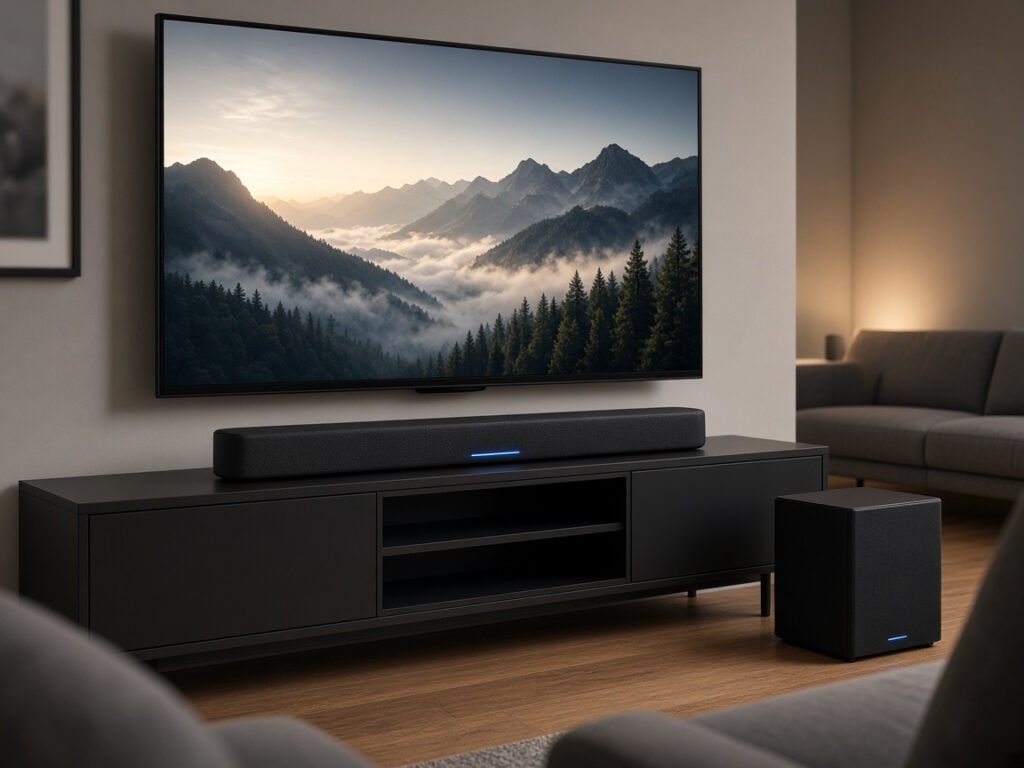
Polk Audio soundbar and subwoofer bundles are worth serious consideration in 2026 for home theater buyers who want genuine Dolby Atmos object-based audio, acoustic engineering depth, and reliable wireless subwoofer integration out of the box. The flagship MagniFi Max AX delivers a full 3.1.2-channel configuration with both Dolby Atmos and DTS:X, an 8-inch wireless subwoofer, and proprietary Voice Adjust dialogue processing per Polk Audio’s published specifications — a specification set that positions it competitively against Sony, LG, and Vizio at comparable price points in the current market.
Executive Summary
- Broad lineup, wireless sub standard across most of the range: Polk Audio’s current soundbar family spans entry-level 2.1 systems (Signa S2) through to the flagship 3.1.2 Dolby Atmos + DTS:X MagniFi Max AX, with wireless subwoofers bundled as standard across all major configurations except the React, per Polk Audio’s published product listings.
- Flagship dual-format support: The MagniFi Max AX decodes both Dolby Atmos and DTS:X, includes Chromecast built-in, Google Assistant, HDMI eARC, and an 8-inch wireless subwoofer per Polk Audio’s specifications — covering streaming and physical media buyers in a single system.
- Proprietary acoustic differentiation: Voice Adjust (dialogue clarity control) and SDA (Stereo Dimension Array) surround processing are built into the MagniFi AX range — engineering features not found as standard on most competing soundbar systems at the same price tier.
- Key limitation to understand before buying: No current Polk Audio soundbar system includes automatic room calibration. The MagniFi Max AX is the only model with DTS:X support. The React ships without a subwoofer included.
What Makes Polk Audio Soundbar and Subwoofer Systems Technically Distinctive?
Polk Audio has been designing and manufacturing loudspeakers since 1972, making it one of the longest-running dedicated acoustic engineering companies in the North American consumer audio market. That engineering history shows up in the current soundbar lineup through three specific proprietary technologies — not just as brand positioning, but as deliberate choices built into the hardware and DSP architecture of the current product range.
The first is SDA (Stereo Dimension Array). SDA is a cross-talk cancellation processing system developed by Polk Audio co-founder Matthew Polk, originally applied to the brand’s floor-standing and bookshelf speaker designs. In soundbar form, SDA works by reducing the acoustic cross-feed between the left and right channels — the phenomenon where the left ear partially perceives the right channel and vice versa. By processing and canceling this cross-feed, SDA is designed to widen the perceived soundstage significantly beyond the physical width of the bar itself. Owners of the MagniFi range consistently report a broader stereo presentation than a typical soundbar of comparable physical dimensions produces, particularly during music playback and two-channel TV audio.
The second technology is Voice Adjust — a dedicated DSP control that enables independent adjustment of the dialogue frequency band relative to music, low-frequency effects, and ambient audio layers. Polk Audio describes Voice Adjust as a core design consideration across its current soundbar range, specifically to address vocal masking during complex, dense, or bass-heavy soundtracks. Unlike blanket loudness boosts that raise all frequencies together, Voice Adjust targets only the mid-range band that carries speech. The result, per Polk Audio’s design intent, is improved dialogue intelligibility without altering the character of music or effects processing. This control is accessible via the included remote on all current MagniFi and Signa models.
At the subwoofer level, Polk Audio applies its Power Port bass-reflex porting geometry — developed originally for its bookshelf speaker line — to its wireless subwoofer enclosures. The Power Port is designed to reduce port turbulence at higher excursion levels, extending usable bass output before audible distortion enters the picture. This porting approach is applied to both the Signa and MagniFi subwoofer cabinets, aiming to maximize low-frequency performance from each cabinet’s given volume and driver displacement.
Which Polk Audio Soundbar and Subwoofer Bundles Are Available in 2026?
Polk Audio’s current soundbar lineup organizes into four main capability tiers. Understanding what separates each tier is essential before comparing individual models — the difference between a DTS Virtual:X system and a true 3.1.2 Dolby Atmos configuration is not a marketing distinction. It reflects a fundamental difference in audio architecture, driver count, and how spatial audio is decoded and reproduced.
| Model | Config | Dolby Atmos | Sub Included | HDMI | Smart Features | Tier |
|---|---|---|---|---|---|---|
| Signa S2 | 2.1 | No (DTS Virtual:X) | Yes — wireless | ARC | Bluetooth | Budget |
| React | 2.0 | No (DTS Virtual:X) | Optional (React Sub, sold separately) | ARC | Alexa built-in, Wi-Fi, Bluetooth | Mid |
| MagniFi Mini AX | 3.1.2 | Yes | Yes — wireless | eARC | Bluetooth | Mid-Premium |
| MagniFi Max AX | 3.1.2 | Yes + DTS:X | Yes — 8″ wireless | eARC | Chromecast built-in, Google Assistant, Bluetooth 5.0 | Premium |
The Signa S2 and React represent Polk Audio’s value and smart-home tiers. Neither supports native Dolby Atmos decoding — both use DTS Virtual:X, which is a virtual surround processing technology that creates a simulated surround effect from two or three physical drivers. DTS Virtual:X does not decode discrete object-based audio metadata; it applies psychoacoustic processing to generate a virtual height and surround impression from a standard stereo or 2.1 signal. The practical difference from true Atmos is most audible on Atmos-encoded content: a system with physical upward-firing drivers renders object placement from actual encoded metadata, while a DTS Virtual:X system approximates the effect. Our complete guide to Dolby Atmos for home theater covers this technical distinction in full, including what room conditions physical height-channel drivers require.
The MagniFi Mini AX and MagniFi Max AX are the systems to consider when genuine object-based spatial audio is a requirement. Both include dedicated upward-firing drivers that generate ceiling-reflected height channels using actual Dolby Atmos object metadata — not a simulation. The selection between the two comes down to DTS:X support, smart streaming features, subwoofer size, and price point, all of which the sections below cover in detail.
How Does the MagniFi Max AX Perform as the Polk Audio Flagship?
The MagniFi Max AX is Polk Audio’s reference soundbar system, and its specification sheet is designed to cover every major home theater audio requirement in a single front-stage bundle. The 3.1.2-channel configuration means three front-stage channels (left, center, right), one subwoofer channel delivered by the wireless sub, and two height channels produced by dedicated upward-firing drivers mounted in the bar itself.
- 3.1.2 channel configuration
- Dolby Atmos object-based decoding
- DTS:X object-based decoding
- Dedicated upward-firing height-channel drivers
- Voice Adjust dialogue DSP control
- SDA (Stereo Dimension Array) surround processing
- Wireless subwoofer, 8-inch woofer (Polk Audio spec)
- Power Port bass-reflex porting geometry
- HDMI eARC (Dolby Atmos TrueHD pass-through)
- Optical digital input
- Chromecast built-in
- Google Assistant
- Bluetooth 5.0
The dual object-based format support — Dolby Atmos and DTS:X — is a specification that separates the Max AX from many competing soundbars in the same price class. Dolby Atmos is the dominant format for 4K streaming services and 4K Blu-ray discs, but DTS:X remains in active use across a substantial portion of the existing physical media library. A system that decodes only Dolby Atmos falls back to a DTS core 5.1 mix when encountering DTS:X-encoded content — a meaningful quality compromise for buyers with an established disc collection. The Max AX decodes both formats natively, ensuring object-based audio from both encoding standards is delivered as intended.
HDMI eARC connectivity is the other technically critical specification here. Standard HDMI ARC carries Dolby Digital Plus — a compressed version of Atmos. HDMI eARC carries the full-bandwidth Dolby Atmos TrueHD bitstream, which is the lossless version of the format. If a connected 4K Blu-ray player or compatible streaming device outputs Atmos TrueHD, the Max AX receives the complete lossless signal through its eARC input rather than a lossy compressed version. For audiophile buyers and home cinema enthusiasts, eARC is the correct connection path and both AX models support it.
The 8-inch wireless subwoofer is designed as an integrated system component rather than a supplemental add-on. Polk Audio’s Power Port porting geometry is applied to the cabinet to extend bass output before port turbulence becomes audible. Owners of the Max AX system consistently report strong low-frequency integration between the bar and subwoofer, with the wireless connection maintaining stable performance in typical living room environments. Subwoofer output level is independently adjustable via both the included remote and the companion app on the Max AX, allowing the bass-to-soundbar balance to be tuned for specific room acoustics rather than relying on a fixed factory preset.
Chromecast built-in enables direct Wi-Fi streaming from compatible apps — Spotify, Tidal, YouTube Music, and others — without routing audio through the TV or a separate streaming dongle. This matters for buyers who want to use the soundbar as a primary music playback system, not just a home theater component. The Google Assistant integration allows voice-controlled playback and smart home device control from the same soundbar.
What Does the MagniFi Mini AX Offer for Compact Home Theater Setups?
The MagniFi Mini AX brings Polk Audio’s core Dolby Atmos architecture — 3.1.2 channels, upward-firing height drivers, and HDMI eARC — into a physically smaller soundbar chassis. This makes it a practical option for buyers with space constraints, smaller display setups, or rooms where the full-width MagniFi Max AX would dominate the furniture footprint without proportionate acoustic benefit.
The Mini AX retains the technically important specifications that define the AX range: 3.1.2-channel layout, physical upward-firing drivers (not virtual height processing), and HDMI eARC for lossless Dolby Atmos TrueHD delivery. These are the factors that place it above soundbars that claim Atmos support via virtual processing only. The differences from the Max AX are in what is omitted rather than what is fundamentally compromised:
- No DTS:X object-based decoding (Dolby Atmos only for spatial audio)
- No Chromecast built-in or Google Assistant voice control
- Smaller wireless subwoofer cabinet and driver compared to the Max AX’s 8-inch unit
The smaller subwoofer is the most acoustically significant trade-off. Cabinet volume and driver displacement are the physical determinants of maximum low-frequency output and extension. Polk Audio applies Power Port porting geometry to the Mini AX sub as it does to the Max AX, optimizing what the smaller cabinet can deliver — but the laws of acoustics impose inherent limits on a physically smaller enclosure. The Mini AX subwoofer reaches lower frequencies at equivalent output levels less readily than the Max AX’s 8-inch design, and it has less headroom before hitting its limits at high volumes.
For small-to-medium primary living rooms (used here as an illustrative decision-making benchmark, not an official Polk Audio performance specification), the Mini AX system is designed as a well-matched configuration. Owners report strong sub-to-bar integration and satisfying bass for TV viewing and film. For large rooms, high-output applications, or buyers who prioritize deep bass extension, the Max AX is the better-matched Polk Audio system — or a dedicated higher-output standalone unit may be warranted. Our home theater subwoofer comparison covers the full range of standalone options across all output classes and price tiers.
When Does the Entry-Level Signa S2 or React Make Sense?
Not every buyer needs a full Dolby Atmos system. For secondary viewing rooms, bedrooms, apartments with limited space, or buyers upgrading from TV built-in speakers without committing to a flagship budget, Polk Audio’s Signa S2 and React offer distinct value propositions on their own terms — and both benefit from the Voice Adjust dialogue technology that Polk Audio carries across the range.
The Signa S2 is a 2.1-channel system that uses DTS Virtual:X surround simulation and ships with a wireless subwoofer included as standard. It connects via HDMI ARC — not eARC — which limits audio delivery to Dolby Digital Plus and DTS, with no lossless TrueHD. Voice Adjust is present, which is Polk Audio’s notable advantage at this tier: independent dialogue clarity control is not standard on most competing budget soundbars. For the specific use case of improving TV dialogue clarity and adding meaningful bass extension over built-in TV speakers, the Signa S2 is designed to deliver its core function reliably, and owner feedback reflects this. It is an appropriate choice for bedrooms, secondary viewing rooms, and spaces where a full premium Atmos system would be disproportionate.
The React is a 2.0-channel soundbar with Amazon Alexa built-in, Wi-Fi connectivity, and optional expansion via the separate React Sub wireless subwoofer. It connects via HDMI ARC. The smart home integration is the React’s primary differentiator — buyers already embedded in an Amazon Alexa ecosystem will find the React the natural Polk Audio entry point for unified voice control across their setup. The React Sub must be purchased separately, which is a material cost consideration. Total system cost (bar plus sub) should be evaluated against bundle-inclusive competitors — including the Signa S2 — before treating the React as the more capable option by default.
How Does Polk Audio’s Wireless Subwoofer Pairing and Integration Work?
All bundled subwoofers in Polk Audio’s current MagniFi and Signa series pair with the soundbar via a proprietary radio frequency wireless link. The pairing is fully automatic at first power-on — both units discover each other and establish the connection without any manual button sequence, mobile app setup, or frequency scanning. Per Polk Audio’s standard setup documentation, the wireless connection is established within seconds of powering on both units in normal operating conditions.
Polk Audio describes the wireless link as operating on a dedicated RF frequency designed to minimize interference from the 2.4GHz Wi-Fi and Bluetooth signals that are common in modern living environments. The specific operating frequency is not publicly documented by Polk Audio. In practice, owners report stable wireless connections in typical living room setups with multiple simultaneous Wi-Fi and Bluetooth devices present — a reasonable indicator of interference resilience in real-world conditions.
Wireless subwoofer placement flexibility is a practical advantage over cabled alternatives. Corner placement — adjacent to two walls — is acoustically beneficial because boundary reinforcement from the two adjacent surfaces increases perceived bass output at the listening position. This can allow the sub level to be set lower for equivalent impact, which reduces port noise at high volumes. The wireless connection means this placement choice is unconstrained by cable routing.
Subwoofer output level is independently adjustable on all current Polk Audio models — via remote on the base systems, and via both remote and companion app on the MagniFi Max AX. This matters because room geometry, furniture density, floor material, and wall reflectivity all affect how much bass energy reaches the listening position from any given subwoofer placement. A fixed factory sub level cannot account for these variables. The independent level control allows owners to trim or boost the sub relative to the main soundbar output, integrating the system properly with the room’s specific acoustic characteristics.
How Does Polk Audio Compare to Sony, LG, and Vizio in 2026?
Polk Audio competes in a dense mid-to-premium soundbar segment in 2026 where Sony, LG, and Vizio all offer systems at overlapping price points. The comparison between brands involves genuine technical trade-offs rather than a simple quality hierarchy. The table below maps the key differentiating factors across all four brands at their respective flagship tiers.
| Brand / Flagship Tier | True Dolby Atmos | DTS:X | Auto Room Calibration | Wireless Sub Included | Proprietary Audio Tech |
|---|---|---|---|---|---|
| Polk Audio MagniFi Max AX | Yes | Yes | No | Yes (8″ woofer) | Voice Adjust, SDA, Power Port |
| Sony HT-A Series (flagship) | Yes | Yes | Yes (360 SSM) | Yes | 360 Spatial Sound Mapping |
| LG S-Series (premium) | Yes | Yes | Yes (auto calibration) | Yes | Meridian Audio processing (select models) |
| Vizio (mid-premium tier) | Yes | Varies by model | No | Yes | Rotating drivers (Elevate series) |
Polk Audio vs Sony
Sony’s premium HT-A series uses 360 Spatial Sound Mapping — a proprietary system that plays test tones, acoustically measures the room using a microphone, and adjusts audio processing to optimize for the measured environment. This adaptive room calibration is a capability Polk Audio’s current range does not offer at any tier. Sony’s HT-A flagships also support optional wireless rear speaker expansion via Sony’s SA-RS series, extending the surround envelope beyond what any front-stage bar alone can deliver — a meaningful upgrade path for buyers who want to evolve their system toward discrete rear channels over time. For a detailed breakdown of Sony’s current systems, our Sony soundbar and subwoofer comparison covers the full HT range with per-model specification analysis.
Polk Audio vs LG
LG’s current premium soundbars use AI Sound Pro processing and, on select high-tier models, Meridian Audio acoustic tuning — a partnership with the British high-fidelity audio brand that brings decades of mastering studio engineering into the DSP chain. LG also offers automatic sound calibration on its flagship models and tight ecosystem integration with LG OLED and QNED televisions through WOW Orchestra, which routes audio simultaneously through both the TV speakers and the soundbar. For buyers with non-LG displays, the Meridian processing and auto calibration are still relevant advantages independent of the TV brand. Our LG soundbar and subwoofer comparison provides a full model breakdown with subwoofer bundle specifics and pricing tiers.
Polk Audio vs Vizio
Vizio competes aggressively at the value end of the Atmos soundbar market, delivering Dolby Atmos support at price points that undercut Sony and Polk Audio’s equivalent configurations. The trade-off is typically in proprietary processing sophistication, build quality, and streaming integration depth. Vizio’s Elevate introduced physically rotating drivers that reorient toward the ceiling for Atmos content and return to forward-facing for stereo — a different mechanical approach to height-channel delivery compared to Polk Audio’s fixed upward-firing driver method. For buyers weighing value against feature depth in this segment, our Vizio soundbar and subwoofer comparison provides a direct model-by-model breakdown with current pricing context.
Polk Audio’s clearest competitive position in 2026 is the combination of Voice Adjust dialogue processing, SDA soundstage technology, and driver engineering heritage at mid-range Atmos price points. Buyers who prioritize adaptive room calibration should evaluate Sony’s HT-A range or LG’s auto-calibration-equipped models. Those seeking maximum value-to-spec ratio at a lower price point should compare Vizio’s current lineup carefully against Polk Audio’s mid-tier systems on a per-dollar basis.
How Do You Set Up a Polk Audio Soundbar and Subwoofer System?
Setting up a Polk Audio MagniFi or Signa system is straightforward, but following the correct sequence ensures the wireless subwoofer pairs correctly and the HDMI connection delivers maximum audio quality. The steps below apply to the MagniFi AX series with HDMI eARC; the Signa S2 follows the same process using standard HDMI ARC in place of step 3.
- Position the soundbar. Place the bar centered below (or above) the display. Confirm the soundbar does not block the TV’s IR sensor — this affects remote control reception from standard TV remotes. The MagniFi range ships with both mounting hardware and desk feet for shelf placement; choose the mounting method before running cables.
- Position the wireless subwoofer. Place the sub within wireless range of the soundbar, ideally in the same room. Corner placement — adjacent to two walls — maximizes perceived bass output through acoustic boundary reinforcement. Avoid placing the sub inside enclosed cabinets; restricted airflow affects thermal performance and limits output headroom.
- Connect via HDMI eARC (MagniFi AX models). Run an HDMI cable from the soundbar’s HDMI eARC output to the designated ARC/eARC HDMI port on the TV. Enable HDMI-CEC on the TV — marketed as Anynet+ on Samsung, Bravia Sync on Sony, Simplink on LG, or similar on other brands. HDMI-CEC allows the TV to pass audio commands to the soundbar through the HDMI connection and enables Dolby Atmos TrueHD pass-through from compatible upstream sources.
- Power on and verify wireless pairing. Power on the soundbar first, then the subwoofer. The wireless connection is automatic — no button press, app login, or frequency selection is required. LED status indicators on both units confirm a successful pairing per Polk Audio’s setup documentation.
- Adjust subwoofer level. Play audio content and use the remote’s subwoofer level control to balance the bass output against the main soundbar. As a starting point, Polk Audio recommends beginning from a neutral mid-point position and adjusting to taste based on room acoustics and listening preference. Corner-placed subwoofers often benefit from being trimmed down slightly relative to open-room placement.
- Configure Voice Adjust. Test the setting with dialogue-heavy content — a news broadcast or conversation-focused film scene works well. Increase Voice Adjust until speech is clearly intelligible without sounding artificially forward in the mix. This DSP setting affects only the mid-range vocal frequency band and does not alter the character of music or effects processing.
- (MagniFi Max AX only) Set up Chromecast. Open the Google Home app on a connected mobile device and add the MagniFi Max AX as a Chromecast audio device. This enables direct Wi-Fi streaming from compatible apps (Spotify, YouTube Music, Tidal, and others) and allows the soundbar to be incorporated into multi-room audio groups alongside other Chromecast-enabled speakers.
Which Polk Audio System Suits Your Room Size and Listening Environment?
Room size is one of the most important variables in soundbar selection. It directly affects how much bass pressure any given subwoofer generates at the listening position, how effectively Dolby Atmos height-channel reflections reach the listener, and how wide the soundstage needs to be to fill the space. The guidance below is an illustrative decision-making framework — it does not represent official Polk Audio performance ratings or certified product specifications for specific room dimensions.
Compact rooms — bedrooms, home offices, secondary viewing spaces: The Signa S2 and MagniFi Mini AX are the natural starting points for smaller rooms. As an illustrative example: in a bedroom setup where the TV is positioned 8–10 feet from the listening position, the Mini AX’s subwoofer is fully capable of generating meaningful bass pressure, Atmos height objects are more perceptible due to shorter ceiling reflection distances, and a compact soundbar width is proportionate to the room scale. The Signa S2 is appropriate here when budget does not support the Mini AX tier.
Medium rooms — primary living rooms in apartments and houses: Both the MagniFi Mini AX and MagniFi Max AX are appropriate for medium-sized primary living rooms. At typical medium-room listening distances, the Max AX’s larger subwoofer provides more headroom for high-volume listening and delivers deeper low-frequency extension at equivalent output levels. For buyers who regularly listen at high volumes, the Max AX is the better-matched choice. For moderate-volume listeners in a medium room, the Mini AX performs capably and costs less.
Large rooms and dedicated home cinema spaces: The MagniFi Max AX is the appropriate Polk Audio system for large living rooms and dedicated cinema rooms. Its 8-inch wireless subwoofer is designed to maintain output and low-frequency response at the volume levels needed to fill a larger space. For very large rooms or high-output home cinema applications where even the Max AX’s sub may be insufficient, supplementing with a dedicated higher-output standalone subwoofer is worth evaluating.
What Are the Trade-offs and Limitations to Know Before Buying a Polk Audio Soundbar?
Understanding the limitations of any soundbar system matters as much as knowing its strengths. Polk Audio’s current range has specific trade-offs that buyers should evaluate honestly before purchase — particularly buyers coming from discrete multichannel speaker systems or comparing Polk Audio’s current range against competitors who have added capabilities in recent product cycles.
No discrete rear surround channels: Every current Polk Audio soundbar, including the MagniFi Max AX, is a front-stage system. It does not ship with rear surround speaker modules, and Polk Audio’s current MagniFi systems do not support optional wireless rear speaker expansion. The surround effect is generated through SDA processing and Dolby Atmos object placement from the front-stage bar. Buyers who have experienced discrete 5.1 or 7.1 surround speaker systems should understand that processed front-stage surround differs from true multichannel rear-channel audio in terms of envelopment, localization precision, and rear-channel separation. For buyers who want an expansion path to rear channels, Sony’s HT-A series with optional SA-RS rear modules is worth evaluating.
No automatic room calibration at any tier: Polk Audio’s current soundbar range does not include a microphone-based room calibration system. Sony’s 360 Spatial Sound Mapping and LG’s automatic calibration tools have established acoustic optimization as an expected feature at the premium tier. Voice Adjust provides manual dialogue frequency control and subwoofer level is independently adjustable, but there is no system that automatically measures the room’s acoustic characteristics and adjusts the EQ response accordingly. Buyers who want a calibrated “set and forget” system should evaluate Sony’s HT-A range or LG’s calibration-equipped premium models.
DTS:X limited to the flagship MagniFi Max AX: DTS:X object-based decoding is available on the Max AX only. Buyers of the MagniFi Mini AX, Signa S2, or React who play DTS:X-encoded Blu-ray discs will receive the DTS core 5.1 audio track rather than the full DTS:X object-based presentation. For buyers with large physical media libraries that include DTS:X-encoded titles, this is a material quality difference that warrants either selecting the Max AX or choosing a competing system with broader format support at the preferred price point.
React subwoofer is optional, not included: Unlike every other Polk Audio soundbar bundle, the React ships as a 2.0 bar without a subwoofer. The React Sub must be purchased as a separate item. Total system cost — bar plus sub — should be directly compared against bundle-inclusive competitors and against the Signa S2 bundle price when evaluating the React for a 2.1 configuration.
Buyers who find the fundamental limitations of a front-stage soundbar architecture insufficient — particularly the absence of discrete rear-channel audio — may find that a traditional AV receiver and speaker configuration is a better long-term fit. Our guide to the best audio receivers for home theater compares current receiver options across all price tiers, including entry-level 5.1 setups that begin at comparable total system costs to premium soundbar bundles.
Frequently Asked Questions About Polk Audio Soundbar and Subwoofer Systems
Yes. The MagniFi Max AX connects via HDMI eARC, optical digital input, and Bluetooth — all of which are compatible with any TV that includes those connection types, regardless of TV manufacturer. HDMI eARC is required for Dolby Atmos TrueHD delivery; for TVs with standard HDMI ARC only, Dolby Digital Plus Atmos is the maximum audio quality over that connection. Voice Adjust, SDA processing, and all onboard DSP features function independently of which TV brand the soundbar is paired with.
Not all. The Signa S2, MagniFi Mini AX, and MagniFi Max AX all include wireless subwoofers as standard. The React soundbar ships as a 2.0 bar without a subwoofer — the React Sub must be purchased separately and costs additional. When comparing the React as a 2.1 system against bundle-inclusive alternatives, the total system price (bar plus sub) is the correct comparison figure.
Dolby Atmos on the MagniFi AX series uses dedicated physical upward-firing drivers to decode actual encoded three-dimensional audio object metadata — objects are placed in a spatial field using the ceiling-reflected height channels from real hardware. DTS Virtual:X on the Signa S2 and React is a psychoacoustic simulation: it generates a virtual surround and height impression from two or three physical drivers without decoding actual object-based metadata. The practical difference is most audible on Atmos-encoded content, where a system with physical height drivers renders object placement more accurately than a virtual processing system.
Polk Audio’s current MagniFi systems do not support official wireless rear speaker modules. The MagniFi Max AX is a self-contained front-stage system with no documented rear speaker expansion path from Polk Audio. Buyers who want discrete rear-channel audio and a future upgrade path should evaluate competing brands — Sony’s HT-A series with optional SA-RS wireless rear speakers is the most direct example at the premium soundbar tier.
Voice Adjust targets the mid-range frequency band that carries vocal content — the same band that carries lead vocals in music. When applied during music playback, it boosts the same frequency range, which makes vocal tracks more prominent in the mix. Many owners prefer to set Voice Adjust to a neutral or low level for music listening and reserve higher settings for speech-heavy TV content and films. The control adjusts in real time via the remote without any source interruption.
If the wireless link is interrupted, Polk Audio’s subwoofers are designed to automatically reconnect when both units are powered on and within range. For persistent connection drops, Polk Audio recommends repositioning the subwoofer to reduce the distance and physical obstacles between it and the soundbar, and minimizing the density of competing RF devices — particularly 2.4GHz Wi-Fi routers and cordless phones — in the immediate wireless environment.
Yes, provided the connection path supports it. If a streaming device connected to the TV passes audio to the soundbar via HDMI eARC, Dolby Atmos from compatible streaming services is delivered to the MagniFi Max AX. The streaming service, the content title, and the streaming device must all support Dolby Atmos output for the full chain to deliver the format. HDMI eARC delivers full lossless Atmos TrueHD; standard HDMI ARC limits output to Dolby Digital Plus Atmos rather than the lossless version.
The Max AX pairs with an 8-inch woofer per Polk Audio’s published specifications; the Mini AX includes a physically smaller subwoofer with a smaller enclosure. Cabinet volume and driver displacement are the physical determinants of maximum bass output and low-frequency extension — the Max AX subwoofer reaches lower frequencies at equivalent output levels and has more headroom before hitting its limits. Both apply Polk Audio’s Power Port porting geometry. For small-to-medium rooms at moderate listening volumes, the Mini AX sub is designed to perform capably; for large rooms, high-volume listening, or buyers who prioritize deep bass extension, the Max AX subwoofer is the more capable system.
Conclusion: Is a Polk Audio Soundbar and Subwoofer Worth It in 2026?
The hometheaterinfoline.com editorial team assessment: Polk Audio soundbar and subwoofer systems are a technically credible choice in 2026, particularly at the MagniFi AX tier where genuine Dolby Atmos object-based audio, Voice Adjust dialogue processing, SDA soundstage technology, and dual Atmos/DTS:X support on the Max AX distinguish them from commodity soundbar alternatives. The brand’s acoustic engineering heritage is reflected in real proprietary technologies with specific measurable design intents — not just marketing language applied to generic hardware.
The cases for and against Polk Audio are both clear. For: Voice Adjust is a genuinely useful dialogue clarity tool that most competitors don’t offer at the same tier; SDA produces a meaningfully wider soundstage than the bar’s physical width suggests; wireless subwoofer integration is reliable and simple; and dual Atmos/DTS:X support on the Max AX covers both major object-based formats in a single bundle. Against: no room calibration at any tier, no rear speaker expansion option, the React sub sold separately, and DTS:X limited to the flagship are real competitive gaps against Sony and LG’s development trajectories.
Looking ahead to 2027 and 2028, the competitive pressure on Polk Audio will come primarily from room calibration technology. Sony’s 360 Spatial Sound Mapping and LG’s automatic acoustic optimization have established microphone-based calibration as an expected feature at the premium tier. Dolby’s FlexConnect standard — which enables soundbars to operate as part of a broader multi-speaker Atmos system through a compatible TV — also represents an emerging capability gap for brands that have not yet integrated it. The next generation of Polk Audio flagships will likely need to address both areas to maintain positioning against Sony and LG’s forward roadmaps. For 2026, the MagniFi Max AX and Mini AX remain solid choices for buyers whose priorities align with Polk Audio’s existing engineering strengths.
MagniFi Max AX (Best in range): Genuine Dolby Atmos + DTS:X, 8-inch wireless sub, Voice Adjust, SDA, Chromecast built-in, and HDMI eARC — a complete specification at the premium tier. The absence of room calibration is the main gap vs Sony.
MagniFi Mini AX (Best compact Atmos option): Physical upward-firing drivers, HDMI eARC, and Voice Adjust at a smaller form factor and lower price. DTS:X and streaming features sacrificed vs the Max AX — appropriate trade-off for smaller rooms.
Signa S2 (Best budget option): No true Atmos, but Voice Adjust dialogue control and wireless sub included as standard — a meaningful step up from TV built-in audio at an accessible price point.
React (Best for Alexa households): Amazon Alexa built-in and Wi-Fi streaming are the differentiators. Remember the React Sub is sold separately — factor total system cost before comparing against bundle-inclusive alternatives.
Related Comparisons and Buying Guides on hometheaterinfoline.com
- Best Dolby Atmos Soundbar: Compared and Ranked for 2026 — full cross-brand Atmos soundbar ranking across all price tiers
- Best LG Dolby Atmos Soundbar: Compared and Ranked for 2026 — LG’s Atmos-specific lineup in detail
- Best Subwoofer Speaker for Home: Compared and Ranked for 2026 — standalone subwoofer options across all output classes