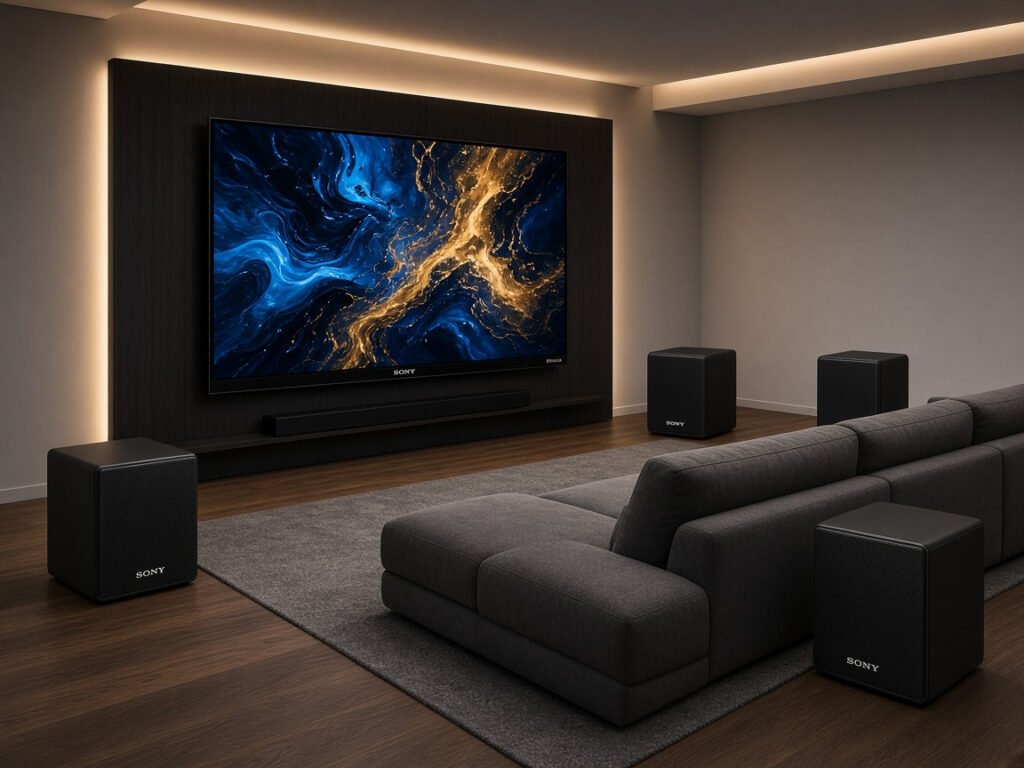
The Sony Bravia Theater Quad is worth serious consideration for Sony Bravia XR TV owners seeking a cable-free, true multi-speaker surround system in 2026. Its 360 Spatial Sound Mapping technology generates convincing spatial audio from four wireless units — but buyers without Sony’s ecosystem will receive significantly less value from the premium investment.
Executive Summary
- Four wireless speakers, 504W total output: Sony rates the Bravia Theater Quad at 504W combined across all four wireless speaker units, each with integrated amplification and up-firing drivers for Dolby Atmos height effects, according to Sony’s product specifications.
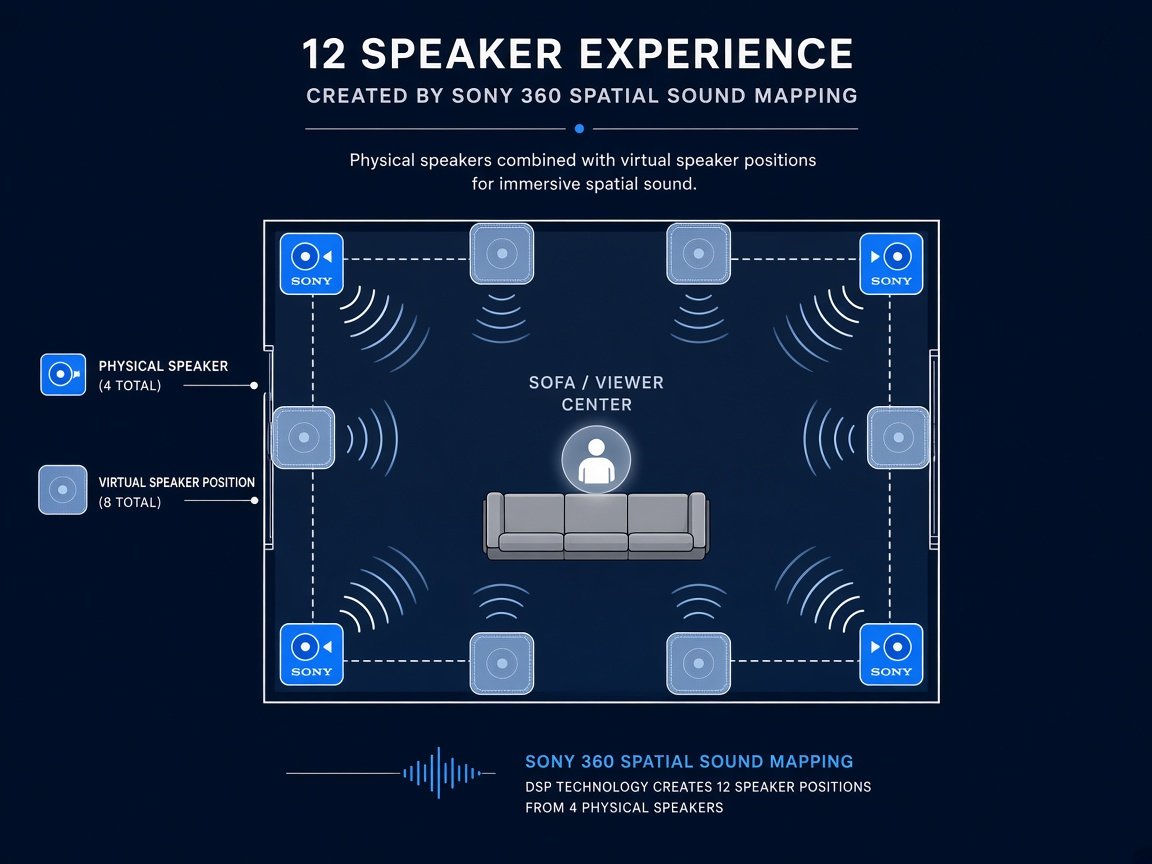
- 360 Spatial Sound Mapping creates up to 12 virtual speaker positions: Sony’s proprietary DSP generates phantom channels beyond the four physical units, producing a 7.1.4-equivalent audio field without additional hardware.
- Full feature set requires a Sony Bravia XR TV: Acoustic Center Sync, automatic acoustic room mapping, and single-remote operation are exclusive to the BRAVIA CONNECT ecosystem; non-Sony TV users receive a reduced feature set.
- Total system cost warrants careful planning: The base system does not include a subwoofer. Owners of larger rooms consistently report that the optional SA-SW5 or SA-SW3 wireless subwoofer is necessary for satisfying low-frequency performance.
What Is the Sony Bravia Theater Quad System?
The Sony Bravia Theater Quad is a premium wireless home theater audio system built around four identical active speaker units. Unlike traditional soundbar configurations, which concentrate all audio production inside a single forward-facing cabinet, the Bravia Theater Quad distributes four independent powered speakers around the listening space — typically two at the front, flanking the television, and two at or behind the primary listening position. Each unit integrates its own amplifier, eliminating the need for a separate AV receiver or any speaker cable infrastructure beyond the television connection itself.
The system connects to any HDMI eARC-equipped television using a single cable to the designated primary speaker unit, which acts as the system hub and audio processor. The remaining three speakers communicate wirelessly over a dedicated 5GHz band, creating a fully cable-free surround environment with that single exception. This architecture represents a meaningful technical departure from both soundbar-with-satellites designs and from AV receiver-based multi-speaker configurations, making it one of the few commercially available systems to place four fully independent active speaker units in the room without any wire runs between them.
Sony designed the Bravia Theater Quad to function at its full capability as part of the Bravia ecosystem, particularly when paired with Bravia XR televisions. Among Sony’s range of surround sound configurations for 2026, the Bravia Theater Quad occupies the highest tier of the company’s wireless multi-speaker lineup, sitting above the HT-A5000 and HT-A7000 soundbar range in both price and architectural ambition.
Core Technical Specifications and Audio Format Support
| Specification | Detail |
|---|---|
| Total System Power Output | 504W (Sony specification, all four speaker units combined) |
| Speaker Units | 4 wireless active speakers |
| Driver Configuration | Up-firing tweeter + forward-facing drivers per unit |
| Spatial Audio Technology | 360 Spatial Sound Mapping (Sony proprietary DSP) |
| Virtual Speaker Positions | Up to 12 (Sony specification) |
| Equivalent Channel Mapping | Up to 7.1.4 |
| Audio Decoding | Dolby Atmos, DTS:X, Dolby TrueHD, DTS-HD Master Audio, 360 Reality Audio, PCM 2.0 / 5.1 / 7.1, Dolby Digital, DTS |
| TV Connection | HDMI eARC (1 port on primary speaker unit) |
| Inter-Speaker Wireless | Wi-Fi (5GHz, proprietary Sony protocol) |
| Additional Connectivity | Bluetooth 5.0, Wi-Fi streaming, Chromecast built-in, Spotify Connect |
| Optical Input | Not included |
| Room Calibration | Automatic (via companion app; enhanced with Bravia XR TV) |
| Ecosystem Integration | BRAVIA CONNECT (Sony Bravia XR TVs) |
| Optional Subwoofer | SA-SW5 / SA-SW3 (sold separately, wireless) |
The system decodes every current major audio format: Dolby Atmos and DTS:X for object-based spatial content, Dolby TrueHD and DTS-HD Master Audio for lossless multi-channel disc sources, and standard Dolby Digital and DTS for legacy material. Sony’s proprietary 360 Reality Audio spatial format is also supported through compatible streaming services. For buyers evaluating wireless surround sound systems across the broader market, the Bravia Theater Quad’s combination of lossless format decoding with a fully wireless multi-speaker architecture is relatively uncommon at any price tier. The HDMI eARC input is the only direct TV connection pathway; the system does not include an optical input, making eARC the mandatory interface for TV audio routing.
How Does 360 Spatial Sound Mapping Work?
360 Spatial Sound Mapping is the core DSP technology that differentiates the Bravia Theater Quad from simpler wireless speaker configurations. Rather than relying on the four physical speaker positions alone, the system uses digital signal processing to synthesize virtual phantom channels between and around the physical units. Sony specifies that the technology generates up to 12 virtual speaker positions from the four physical points, expanding the perceived audio field into a continuous 360-degree surround experience that significantly exceeds what four speakers could produce without that processing layer.
The process operates in real time. When the system receives a Dolby Atmos or DTS:X signal, it identifies the directional metadata encoded in the audio object stream and routes each audio object to the most appropriate combination of physical and virtual speaker positions simultaneously. For non-spatial source material — standard stereo or 5.1 surround tracks — the system applies Sony’s upmixing algorithms to construct a spatial field from the original signal, expanding the perceived soundstage beyond its recorded dimensions.
Up-firing driver elements within each speaker unit direct audio toward the ceiling to simulate the overhead height channels required by Dolby Atmos content. The reflected sound creates the perception of audio arriving from above. The effectiveness of this height simulation depends heavily on ceiling height and surface material. Sony recommends 8- to 10-foot ceilings with a flat, reflective surface for optimal performance; angled, vaulted, or acoustically treated ceilings may require DSP correction via the companion app to achieve comparable results.
How Does It Integrate With Sony Bravia TVs?
For Sony Bravia XR TV owners, BRAVIA CONNECT is the defining differentiator of the Bravia Theater Quad experience. This ecosystem-level integration enables a range of capabilities that standard HDMI eARC alone cannot provide.
Acoustic Center Sync routes dialogue through the television’s built-in center speaker in addition to the external speaker units, creating a center channel that appears to emanate from the screen rather than from the nearest satellite position. This addresses a persistent limitation of multi-speaker setups in which dialogue can sound displaced from the visual action when the nearest physical speaker is off-axis from the viewing position. Automatic acoustic mapping uses data from both the TV and the speaker system to analyze room geometry and optimize speaker output for the specific listening environment, running without external measurement microphones. Single-remote operation and automatic power synchronization unify control of the television and audio system under one interface.
For users of LG, Samsung, or other television brands, the Bravia Theater Quad still delivers its core audio performance — HDMI eARC connectivity, Dolby Atmos and DTS:X decoding, and 360 Spatial Sound Mapping across four physical speaker positions — but Acoustic Center Sync, automatic room calibration, and integrated remote control are unavailable. Non-Sony TV users access a capable wireless surround system; they do not access the full product as designed.
What Does Setup and Calibration Involve?
The Bravia Theater Quad is designed for user self-installation without professional assistance. The initial configuration follows a structured eight-step sequence:
- Connect the designated primary speaker unit to the television via the supplied HDMI eARC cable.
- Position all four speakers — the front pair flanking the television at approximately ear height, the rear pair at or slightly behind the primary listening position.
- Power on all four units; the wireless pairing sequence initiates automatically and links the rear and secondary front speaker to the primary unit.
- Download Sony’s companion app (available for iOS and Android) to manage calibration settings and EQ adjustments.
- Launch the automatic calibration sequence, which uses test tones transmitted by each speaker to measure acoustic timing and level relationships across the room.
- For Sony Bravia XR TV users, enable BRAVIA CONNECT within the television’s audio output settings to activate ecosystem integration features.
- Select a sound mode suited to the primary content type (Auto Sound, Cinema, Music, or a custom EQ profile).
- Test playback with Dolby Atmos content to confirm spatial audio performance and refine speaker placement before finalizing positions.
The calibration sequence typically completes in under 20 minutes, based on owner reports. The system does not support a 2.4GHz Wi-Fi fallback; a stable 5GHz band is required for reliable inter-speaker wireless communication. Owners in environments with heavily congested 5GHz networks report occasional initial pairing challenges that resolve after adjusting router channel allocation. For broader guidance on home theater installation considerations applicable to any multi-component system, the complete home theater system setup guide covers the foundational technical principles.
What Does Real-World Surround Performance Look Like?
Owner reviews consistently identify the Bravia Theater Quad’s ability to produce convincing directional audio cues for cinema content as its primary strength. For Dolby Atmos film mixes, the combination of four physical speaker positions with 360 Spatial Sound Mapping creates a sense of envelopment that owners frequently distinguish from premium single-cabinet soundbar configurations in direct comparisons. The spatial separation between front and rear sound events — a helicopter passing overhead, rain coming from behind, or an ambient soundscape wrapping the listening position — is a consistent point of positive feedback across owner reviews.
Dialogue intelligibility is well-regarded, particularly in Sony Bravia XR TV setups where Acoustic Center Sync contributes the television’s built-in speaker to the center channel audio field. Front sound staging is described as wide and accurate for both music and film content. Height channel performance, produced by the up-firing driver elements, generates credible overhead effects for content specifically mixed with Atmos height objects; owners note that the effect is distinct in rooms with 8-foot flat ceilings and diminishes in angled or vaulted spaces without DSP compensation.
Low-frequency performance without a subwoofer is the most common limitation in owner feedback. Owners in rooms under approximately 300 square feet report adequate bass impact for most content types; above that threshold, the absence of a dedicated subwoofer becomes more noticeable during action film sequences and music with extended low-frequency content. Room geometry is a meaningful variable for any multi-speaker installation. The home theater ideas for small rooms resource addresses room-specific acoustic optimization strategies relevant to compact listening environments in particular.
How Does It Compare to Competing Systems?
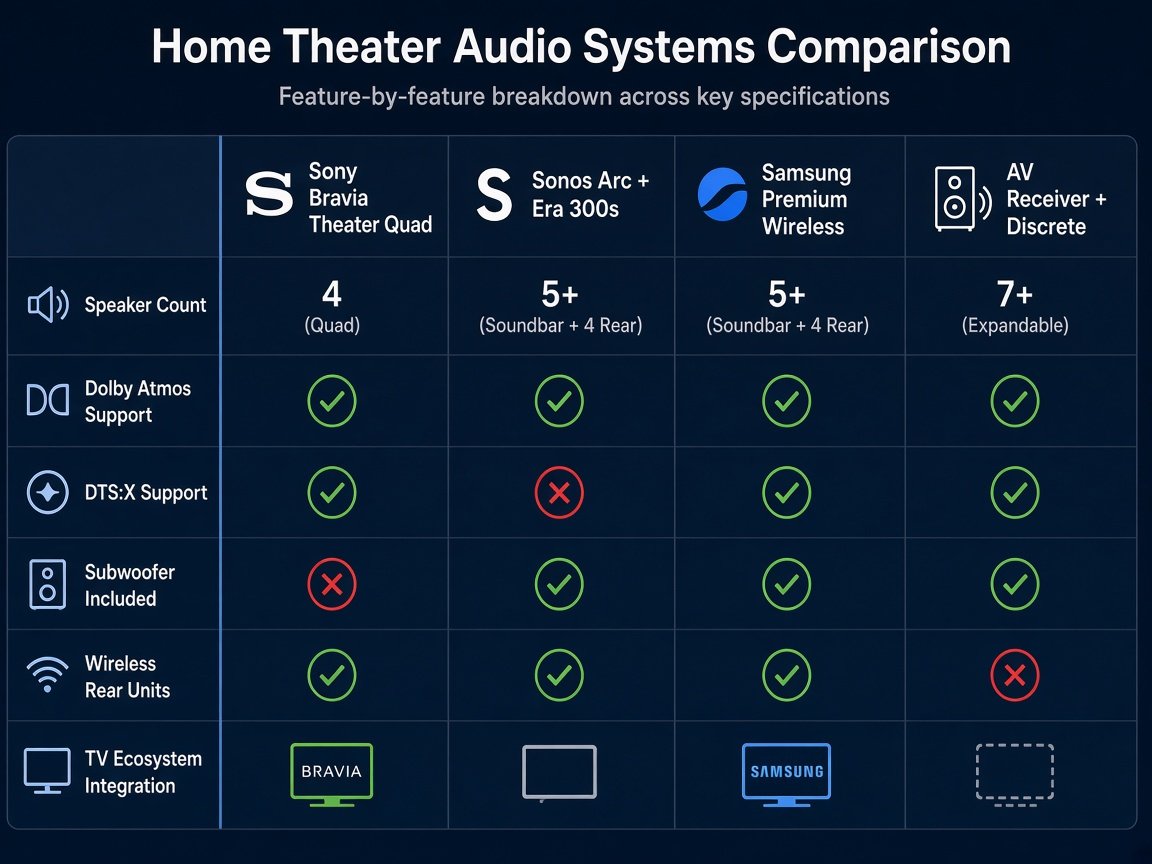
| System | Physical Speakers | Equiv. Channels | Dolby Atmos | DTS:X | Sub Included | Wireless Rears | TV Ecosystem |
|---|---|---|---|---|---|---|---|
| Sony Bravia Theater Quad | 4 (all wireless) | Up to 7.1.4 | Yes | Yes | No (optional) | Yes | Sony Bravia XR |
| Sonos Arc + Era 300 Surrounds | 1 soundbar + 2 surrounds | Up to 7.1.4 | Yes | No | No (optional) | Yes | Brand-agnostic |
| Samsung Premium Wireless Surround System | 1 soundbar + 2 surrounds | Up to 9.1.4 (varies) | Yes | Yes | Yes (most configs) | Yes | Samsung QLED |
| AV Receiver + Discrete Speakers | 5–9+ (wired) | Discrete (no virtualization) | Yes | Yes | Optional | No | Brand-agnostic |
Against Sonos Arc + Era 300 Surrounds: The Sonos configuration integrates more deeply with whole-home multi-room audio and maintains a mature, stable app ecosystem across multiple zones. However, Sonos Arc does not decode DTS:X — only Dolby Atmos — which is a meaningful limitation for buyers using 4K Blu-ray sources with DTS:X mixes. The Bravia Theater Quad’s symmetric four-speaker layout also distributes front staging across dedicated active units rather than through a single forward-facing soundbar.
Against Samsung Premium Wireless Surround Systems: Samsung’s flagship configurations typically bundle a wireless subwoofer with the system, directly addressing the low-frequency gap that the Bravia Theater Quad requires an additional purchase to close. Samsung’s systems are optimized for integration with QLED televisions in a manner that parallels Sony’s Bravia XR ecosystem dependency — both companies apply the same logic, just for different TV lines. Against AV Receiver + Discrete Speakers: A mid-to-high-end AV receiver paired with separate bookshelf and ceiling speakers achieves fully discrete multi-channel audio with greater precision and upgrade flexibility, but requires speaker cable installation, rack infrastructure, and significantly greater setup complexity. For a comprehensive cross-brand comparison, the top-ranked home theater surround sound systems for 2026 evaluates the leading options across multiple price tiers.
What Are the Known Limitations?
- No subwoofer in the base package. The optional SA-SW5 or SA-SW3 adds meaningfully to total system cost and should be factored in for any room above approximately 300 square feet or any listener who prioritizes cinematic bass impact.
- Full feature parity requires Sony Bravia XR TV. Non-Sony TV users access the core audio performance — Dolby Atmos, DTS:X, four-speaker positioning, and 360 Spatial Sound Mapping — but Acoustic Center Sync, automatic room calibration, and remote integration are unavailable.
- No optical input. HDMI eARC is the only direct TV connection. Devices requiring optical routing must connect through the television rather than directly to the speaker system.
- 5GHz Wi-Fi dependency. The inter-speaker wireless link requires a clean 5GHz network environment. Owners in high-density buildings or environments with heavily congested Wi-Fi report occasional audio dropouts until network settings are optimized.
- Closed upgrade path. Individual speaker units cannot be replaced or upgraded with third-party hardware. Expansion beyond the four included speakers is limited to Sony’s compatible SA-SW5 and SA-SW3 wireless subwoofers; no other expansion is architecturally supported.
Strengths
- Fully cable-free four-speaker surround layout
- Genuine Dolby Atmos and DTS:X object-based decoding
- 360 Spatial Sound Mapping with up to 12 virtual positions
- Strong Sony Bravia XR TV integration via BRAVIA CONNECT
- Acoustic Center Sync for screen-locked dialogue
- Automatic room calibration without external microphones
- Expandable with optional wireless subwoofer
- Firmware-delivered feature enhancements post-launch
Limitations
- No subwoofer included in base package
- Full features locked to Sony Bravia XR ecosystem
- No optical input
- Requires stable 5GHz Wi-Fi band
- No third-party speaker expansion possible
- Premium price relative to discrete AV receiver setups
- Height effects diminished in vaulted or treated ceilings
What Does Total Ownership Cost to Consider?
The Sony Bravia Theater Quad occupies the premium tier of the wireless home theater market. Prospective buyers should build their total cost estimate from two line items: the base four-speaker system and, for most rooms, the optional wireless subwoofer. The absence of a subwoofer in the box is the most significant ongoing budget variable for buyers who prioritize full cinematic bass impact.
Beyond the initial purchase, ongoing ownership costs are low relative to component-based systems. No separate AV receiver requires maintenance or replacement. No speaker cable infrastructure needs management. Sony delivers system firmware updates wirelessly and automatically. The HT-A9 platform — the hardware foundation of the Bravia Theater Quad — has a documented history of receiving post-launch feature enhancements through firmware, suggesting that the system’s capability profile can extend over time without hardware replacement.
The SA-SW5 and SA-SW3 wireless subwoofers both use Sony’s inter-connection protocol and pair with the main system automatically, without manual network configuration. For buyers who plan to add a subwoofer later, it functions as a straightforward plug-and-play expansion. The SA-SW5 is Sony’s higher-specification subwoofer option; the SA-SW3 serves as a mid-tier alternative. Neither is included in any standard Bravia Theater Quad bundle configuration.
Is the Sony Bravia Theater Quad Worth It in 2026?
The Bravia Theater Quad makes its strongest case for a specific buyer: a Sony Bravia XR TV owner with a medium-sized dedicated viewing room, a flat reflective ceiling at 8 to 10 feet, and a primary use case of streaming Dolby Atmos content and 4K Blu-ray cinematic material. For that buyer, the system delivers an immersive wireless surround experience that is technically difficult to replicate without either running physical speaker cables or accepting the front-staging compromises inherent to a single-cabinet soundbar. The 360 Spatial Sound Mapping technology produces directional accuracy across four physical speaker positions that owner comparisons consistently distinguish from virtualized soundbar configurations.
The case weakens considerably for buyers who don’t own a Sony Bravia XR TV, who operate in large open-plan living spaces, or for whom music listening is the primary use case rather than cinema. In these contexts, competing systems at comparable or lower price points offer better overall utility — either through whole-home audio integration (Sonos), bundled subwoofer inclusion (Samsung’s premium tier), or greater channel precision and upgrade flexibility (discrete AV receiver installations). As wireless home theater technology continues to advance through 2026 and into 2027, the Bravia Theater Quad’s approach — four physical speakers augmented by DSP-driven virtual channels — holds its position as a credible middle ground between the simplicity of soundbars and the complexity of full discrete component systems.
Frequently Asked Questions
Does the Sony Bravia Theater Quad work without a Sony TV?
Yes. The system connects to any HDMI eARC-equipped television and delivers full Dolby Atmos, DTS:X, and 360 Spatial Sound Mapping performance regardless of TV brand. However, features including Acoustic Center Sync, automatic room calibration, and single-remote integration require a Sony Bravia XR television paired via BRAVIA CONNECT. Non-Sony TV users receive a capable wireless surround system; they do not receive the complete ecosystem experience the product is designed around.
Does the system require a constant internet connection to operate?
An active internet connection is not required for playback once the system is configured. The inter-speaker wireless audio link operates over your home’s 5GHz Wi-Fi band, which must remain available and stable during use. Firmware updates are delivered over Wi-Fi when available but do not interrupt normal operation. Chromecast built-in and streaming services do require internet access for content delivery.
Can the Bravia Theater Quad replace a 7.1 discrete AV receiver setup?
It generates a 7.1.4-equivalent virtual audio field using DSP processing from four physical speaker positions. For critical listeners, a fully discrete 7.1 configuration with eight or more independent speaker units will deliver more precise channel separation without relying on psychoacoustic virtualization. The Bravia Theater Quad prioritizes installation simplicity over absolute channel precision; it is not a direct substitute for a discrete installation in performance terms. For a comparison of dedicated channel-specific systems, the best 7.1 surround sound systems ranked for 2026 provides a detailed reference.
Is a subwoofer required for good performance?
Not universally. Owner reports indicate adequate bass performance in rooms under approximately 300 square feet for most content types. For larger rooms, or for buyers who prioritize full cinematic low-frequency impact during action films and bass-heavy music, the optional SA-SW5 or SA-SW3 wireless subwoofer is recommended. Sony designed both subwoofer models specifically for use with the Bravia Theater Quad system and they pair automatically via Sony’s wireless protocol.
How long does initial setup typically take?
Based on owner reports, initial speaker pairing and automatic calibration typically complete within 15 to 30 minutes from unboxing. Additional time for sound mode selection, speaker position fine-tuning, and BRAVIA CONNECT configuration (for Sony TV owners) may extend the total first-session setup to around 45–60 minutes. The system does not require a service technician or professional installer for standard room configurations.
Does the system support music streaming services?
Yes. The Bravia Theater Quad supports Bluetooth audio streaming and Chromecast built-in for Wi-Fi audio from compatible streaming services, as well as Spotify Connect for direct playlist control. Sony’s 360 Reality Audio spatial music format is supported on streaming platforms that offer it. Owner reports note that for dedicated music listening, the system performs well for immersive and spatial audio content; listeners who prioritize two-channel stereo fidelity above cinema immersion may find dedicated stereo systems a better match.
Conclusion: Recommended Next Steps for Prospective Buyers
The Sony Bravia Theater Quad is a technically sophisticated wireless home theater system that delivers on its core promise — genuine multi-speaker immersive audio without speaker cable runs — for buyers in the right context. The Sony Bravia XR TV dependency is real and meaningful, but for owners already in that ecosystem, the BRAVIA CONNECT integration represents a cohesive, well-engineered user experience. For buyers outside that ecosystem, the system still functions as a premium wireless surround product; it simply costs more than the value it delivers relative to competing alternatives.
Recommended implementation sequence:
- Before purchase: Confirm your television has an HDMI eARC port; verify whether your TV is a Sony Bravia XR model; assess room dimensions and ceiling characteristics; determine whether the optional subwoofer should be included in the initial purchase budget rather than added later.
- Day 1 (Initial setup): Pair all four speakers, run automatic calibration, enable BRAVIA CONNECT if applicable, and test with a Dolby Atmos film source to establish a baseline surround performance reference.
- Week 1 (Listening and refinement): Test with Dolby Atmos film content, DTS:X sources, standard stereo music, and 360 Reality Audio if available on your streaming services; adjust speaker placement and sound mode settings based on initial impressions from multiple content types.
- Weeks 2–4 (Optimization decision): Evaluate bass performance in your specific room across a range of cinematic and musical content; add the optional wireless subwoofer if low-frequency performance does not meet expectations without it; check for available firmware updates via Sony’s companion app.
The Bravia Theater Quad is a premium product designed for a specific use case. For the buyer it is built for, it is one of the most capable and architecturally distinctive wireless home theater systems available in 2026.